
纳米声敏剂增强的声动力学疗法联合免疫检查点阻断用于癌症免疫治疗。
Nanosonosensitizer-Augmented Sonodynamic Therapy Combined with Checkpoint Blockade for Cancer Immunotherapy.
机构信息
Department of Neurosurgery, Zhongshan Hospital Xiamen University, Xiamen, 361004, People's Republic of China.
Department of Child Health, Women and Children's Hospital, Xiamen University, Xiamen, 361003, People's Republic of China.
出版信息
Int J Nanomedicine. 2021 Mar 5;16:1889-1899. doi: 10.2147/IJN.S290796. eCollection 2021.
INTRODUCTION
Sonodynamic therapy (SDT) has good targeting and non-invasive advantages in the treatment of solid cancers, and checkpoint blockade immunotherapy is also a promising treatment to cure cancer. However, their antitumor effects are not sufficient due to some inherent factors. Some studies that combined SDT with immunotherapy or nanoparticles have managed to enhance its efficiency to treat cancers.
METHODS
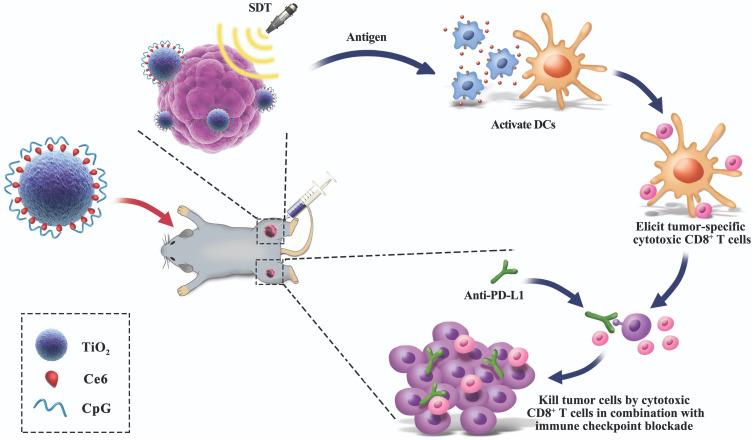
In this work, an effective therapeutic strategy that can potentiate the antitumor efficacy of anti-PD-L1 antibody (aPD-L1) is developed by the use of cascade immuno-sonodynamic therapy (immuno-SDT). Titanium dioxide (TiO), a nanostructured agent for SDT, sonosensitizer Chlorin e6 (Ce6), and immunological adjuvant CpG oligonucleotide (CpG ODN), are used to construct a multifunctional nanosonosensitizer (TiO-Ce6-CpG). Then, we conducted in vitro and in vivo experiments to explore the antitumor effect of TiO-Ce6-CpG under ultrasound (US) treatment.
RESULTS
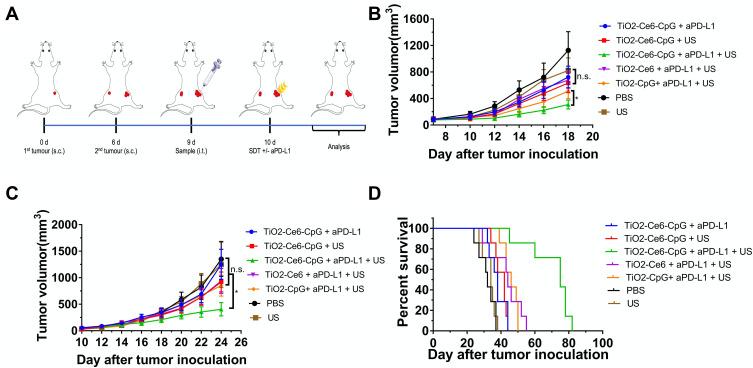
The characterization tests showed that the nanosonosensitizers are polycrystalline structure with homogeneous sizes, resulting in a good drug loading efficiency. The innovative nanosonosensitizers (TiO-Ce6-CpG) can not only effectively inhibit tumor growth but also stimulate the immune system to activate the adaptive immune responses, using the TiO-Ce6 to augment SDT and the immune adjuvant CpG to enhance the immune response. After combined with the aPD-L1, the synergistic effect could not only efficiently inhibit the primary tumor growth but also lead to an inhibition of the non-irradiated pre-existing distant tumors by inducing a strong tumor-specific immune response.
CONCLUSION
In this study, we present an effective strategy for tumor treatment by combining nanosonosensitizer-augmented SDT and aPD-L1 checkpoint blockade. This work provides a promising strategy and offers a new vision for treating malignant tumors.
简介
声动力学疗法(SDT)在治疗实体瘤方面具有良好的靶向性和非侵入性优势,而检查点阻断免疫疗法也是一种有前途的治愈癌症的方法。然而,由于一些内在因素,它们的抗肿瘤效果并不充分。一些将 SDT 与免疫疗法或纳米粒子结合的研究已经成功地提高了治疗癌症的效率。
方法
在这项工作中,通过使用级联免疫声动力学疗法(immuno-SDT),开发了一种可以增强抗 PD-L1 抗体(aPD-L1)抗肿瘤疗效的有效治疗策略。TiO2(TiO),一种用于 SDT 的纳米结构试剂、声敏剂 Chlorin e6(Ce6)和免疫佐剂 CpG 寡核苷酸(CpG ODN),被用于构建多功能纳米声敏剂(TiO-Ce6-CpG)。然后,我们进行了体外和体内实验,以研究超声(US)治疗下 TiO-Ce6-CpG 的抗肿瘤效果。
结果
特性测试表明,纳米声敏剂具有多晶结构和均匀的尺寸,从而具有良好的药物负载效率。创新的纳米声敏剂(TiO-Ce6-CpG)不仅能有效抑制肿瘤生长,还能刺激免疫系统激活适应性免疫反应,使用 TiO-Ce6 增强 SDT 和免疫佐剂 CpG 增强免疫反应。与 aPD-L1 结合后,协同作用不仅能有效地抑制原发肿瘤的生长,还能通过诱导强烈的肿瘤特异性免疫反应来抑制未辐照的预先存在的远处肿瘤。
结论
在这项研究中,我们提出了一种通过联合纳米声敏剂增强 SDT 和 aPD-L1 检查点阻断治疗肿瘤的有效策略。这项工作为肿瘤治疗提供了一种有前途的策略,并为治疗恶性肿瘤提供了新的视角。



 Zotero 插件