
COVID-19 肺炎患者继发肺部感染的研究进展。
State-of-the-art review of secondary pulmonary infections in patients with COVID-19 pneumonia.
机构信息
Department of Pulmonary and Critical Care Medicine, Albany Medical Center, 43 New Scotland Avenue, Albany, NY, USA.
Department of Pulmonary and Critical Care, Ozarks Medical Center, West Plains, MO, USA.
出版信息
Infection. 2021 Aug;49(4):591-605. doi: 10.1007/s15010-021-01602-z. Epub 2021 Mar 11.
BACKGROUND
The incidence of secondary pulmonary infections is not well described in hospitalized COVID-19 patients. Understanding the incidence of secondary pulmonary infections and the associated bacterial and fungal microorganisms identified can improve patient outcomes.
OBJECTIVE
This narrative review aims to determine the incidence of secondary bacterial and fungal pulmonary infections in hospitalized COVID-19 patients, and describe the bacterial and fungal microorganisms identified.
METHOD
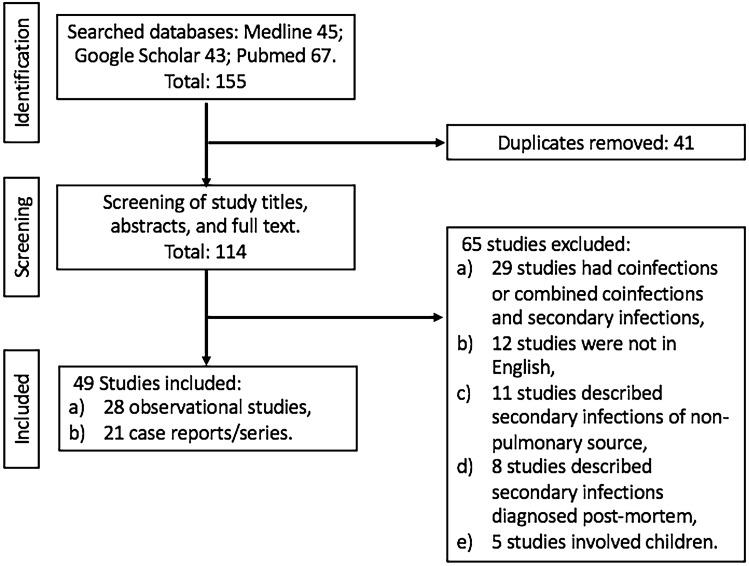
We perform a literature search and select articles with confirmed diagnoses of secondary bacterial and fungal pulmonary infections that occur 48 h after admission, using respiratory tract cultures in hospitalized adult COVID-19 patients. We exclude articles involving co-infections defined as infections diagnosed at the time of admission by non-SARS-CoV-2 viruses, bacteria, and fungal microorganisms.
RESULTS
The incidence of secondary pulmonary infections is low at 16% (4.8-42.8%) for bacterial infections and lower for fungal infections at 6.3% (0.9-33.3%) in hospitalized COVID-19 patients. Secondary pulmonary infections are predominantly seen in critically ill hospitalized COVID-19 patients. The most common bacterial microorganisms identified in the respiratory tract cultures are Pseudomonas aeruginosa, Klebsiella species, Staphylococcus aureus, Escherichia coli, and Stenotrophomonas maltophilia. Aspergillus fumigatus is the most common microorganism identified to cause secondary fungal pulmonary infections. Other rare opportunistic infection reported such as PJP is mostly confined to small case series and case reports. The overall time to diagnose secondary bacterial and fungal pulmonary infections is 10 days (2-21 days) from initial hospitalization and 9 days (4-18 days) after ICU admission. The use of antibiotics is high at 60-100% involving the studies included in our review.
CONCLUSION
The widespread use of empirical antibiotics during the current pandemic may contribute to the development of multidrug-resistant microorganisms, and antimicrobial stewardship programs are required for minimizing and de-escalating antibiotics. Due to the variation in definition across most studies, a large, well-designed study is required to determine the incidence, risk factors, and outcomes of secondary pulmonary infections in hospitalized COVID-19 patients.
背景
在住院的 COVID-19 患者中,继发性肺部感染的发生率尚不清楚。了解继发性肺部感染的发生率以及所鉴定的相关细菌和真菌微生物,可以改善患者的预后。
目的
本叙述性综述旨在确定住院 COVID-19 患者中继发性细菌性和真菌性肺部感染的发生率,并描述所鉴定的细菌和真菌微生物。
方法
我们进行了文献检索,并选择了已确诊的在住院成人 COVID-19 患者中,在入院后 48 小时发生的继发性细菌性和真菌性肺部感染的文章,使用呼吸道培养进行诊断。我们排除了涉及合并感染的文章,这些感染被定义为在入院时由非 SARS-CoV-2 病毒、细菌和真菌微生物引起的感染。
结果
在住院 COVID-19 患者中,继发性肺部感染的发生率较低,细菌性感染为 16%(4.8-42.8%),真菌性感染为 6.3%(0.9-33.3%)。继发性肺部感染主要见于重症住院 COVID-19 患者。呼吸道培养中最常见的细菌微生物为铜绿假单胞菌、肺炎克雷伯菌、金黄色葡萄球菌、大肠埃希菌和嗜麦芽窄食单胞菌。曲霉菌属中的烟曲霉是引起继发性真菌性肺部感染的最常见微生物。其他罕见的机会性感染,如 PJP,主要局限于小的病例系列和病例报告。从初始住院到诊断继发性细菌性和真菌性肺部感染的总时间为 10 天(2-21 天),从 ICU 入院到诊断的时间为 9 天(4-18 天)。抗生素的使用率很高,为 60-100%,这涉及到我们综述中包含的研究。
结论
在当前大流行期间,广泛使用经验性抗生素可能导致多药耐药微生物的产生,需要进行抗菌药物管理计划以尽量减少和降低抗生素的使用。由于大多数研究的定义存在差异,因此需要进行一项大型、精心设计的研究,以确定住院 COVID-19 患者继发性肺部感染的发生率、风险因素和结局。
 Zotero 插件