
急诊科与血流感染相关的临床因素。
Clinical factors associated with bloodstream infection at the emergency department.
作者信息
Phungoen Pariwat, Lerdprawat Nunchalit, Sawanyawisuth Kittisak, Chotmongkol Verajit, Ienghong Kamonwon, Sumritrin Sumana, Apiratwarakul Korakot
机构信息
Department of Emergency Medicine, Faculty of Medicine, Khon Kaen University, 123/2000 Mitraparp Rd, Muang, Khon Kaen, 40002, Thailand.
Department of Medicine, Faculty of Medicine, Khon Kaen University, Khon Kaen, 40002, Thailand.
出版信息
BMC Emerg Med. 2021 Mar 12;21(1):30. doi: 10.1186/s12873-021-00426-2.
BACKGROUND
Bloodstream infection (BSI) is a common urgent condition at the emergency department (ED). However, current guidelines for diagnosis do not specify the juncture at which blood cultures should be taken. The decision whether or not to obtain hemoculture is based solely upon clinical judgment and potential outcomes of inappropriately ordered cultures. This study aimed to find clinical factors present on ED arrival that are predictive of bloodstream infection.
METHODS
This study was conducted retrospectively at the ED of a single tertiary care hospital in Thailand. We included adult patients with suspected infection based on blood culture who were treated with intravenous antibiotics during their ED visit. Independent positive predictors for positive blood culture were calculated by logistic regression analysis.
RESULTS
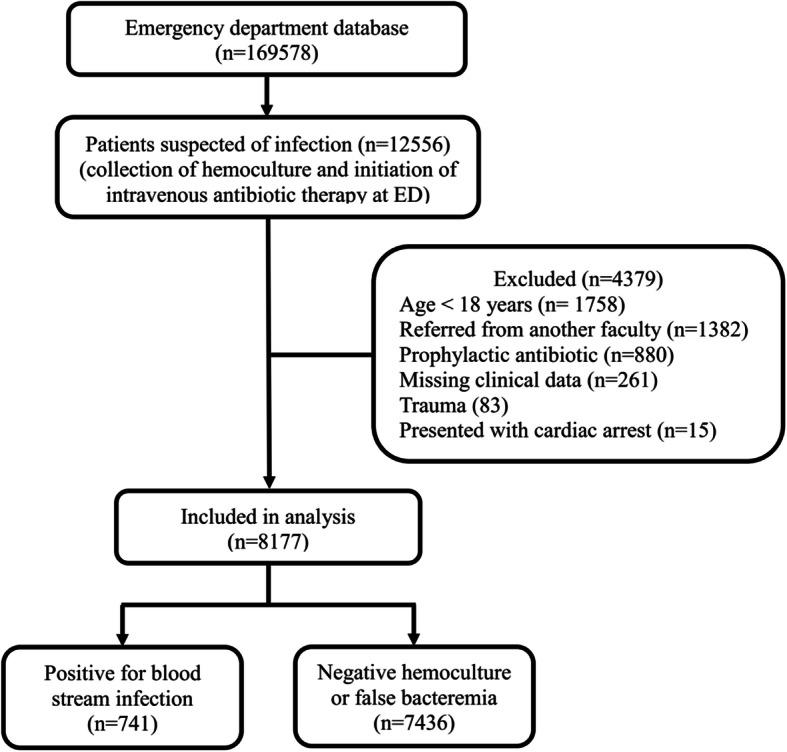
A total of 169,578 patients visited the ED during the study period, 12,556 (7.40%) of whom were suspected of infection. Of those, 8177 met the study criteria and were categorized according to blood culture results (741 positive; 9.06%). Six clinical factors, including age over 55 years, moderate to severe CKD, solid organ tumor, liver disease, history of chills, and body temperature of over 38.3 °C, were associated with positive blood culture.
CONCLUSIONS
Clinical factors at ED arrival can be used as predictors of bloodstream infection.
背景
血流感染(BSI)是急诊科常见的紧急情况。然而,目前的诊断指南并未明确应在何时采集血培养样本。是否进行血培养的决定仅基于临床判断以及不适当开具血培养的潜在后果。本研究旨在找出急诊科就诊时存在的可预测血流感染的临床因素。
方法
本研究在泰国一家三级护理医院的急诊科进行回顾性研究。我们纳入了在急诊科就诊期间接受静脉抗生素治疗且基于血培养怀疑感染的成年患者。通过逻辑回归分析计算血培养阳性的独立阳性预测因素。
结果
在研究期间,共有169578名患者前往急诊科就诊,其中12556名(7.40%)怀疑感染。在这些患者中,8177名符合研究标准,并根据血培养结果进行分类(741例阳性;9.06%)。六个临床因素,包括年龄超过55岁、中度至重度慢性肾脏病、实体器官肿瘤、肝脏疾病、寒战病史以及体温超过38.3°C,与血培养阳性相关。
结论
急诊科就诊时的临床因素可作为血流感染的预测指标。
 Zotero 插件