
利用基于医疗保险系统的癌症监测系统(MIS-CASS)评估癌症生存率和患病率:一项中国的实证研究。
Estimating cancer survival and prevalence with the Medical-Insurance-System-based Cancer Surveillance System (MIS-CASS): An empirical study in China.
作者信息
Tian Hongrui, Hu Yanjun, Li Qingxiang, Lei Liang, Liu Zhen, Liu Mengfei, Guo Chuanhai, Liu Fangfang, Liu Ying, Pan Yaqi, Dos-Santos-Silva Isabel, He Zhonghu, Ke Yang
机构信息
Key Laboratory of Carcinogenesis and Translational Research (Ministry of Education/Beijing), Laboratory of Genetics, Peking University Cancer Hospital & Institute, Beijing, China.
Healthcare Security Administration of Hua County, Henan Province, China.
出版信息
EClinicalMedicine. 2021 Feb 24;33:100756. doi: 10.1016/j.eclinm.2021.100756. eCollection 2021 Mar.
BACKGROUND
We aimed to establish a new approach for surveillance of cancer prevalence and survival in China, based on the Medical-Insurance-System-based Cancer Surveillance System (MIS-CASS).
METHODS
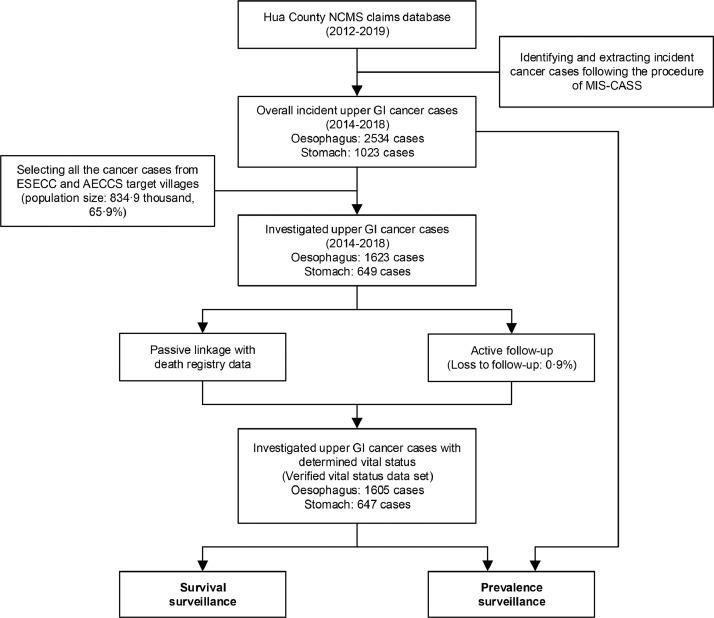
We constructed a standard procedure for data collection, cleaning, processing, linkage, verification, analysis, and estimation of cancer prevalence and survival (including both actual observations and model estimates) by conjoint use of medical insurance claims data and all-cause death surveillance data. As a proof-of-principle study, we evaluated the performance of this surveillance approach by estimating the latest prevalence and survival for upper gastrointestinal cancers in Hua County, a high-risk region for oesophageal cancer in China.
FINDINGS
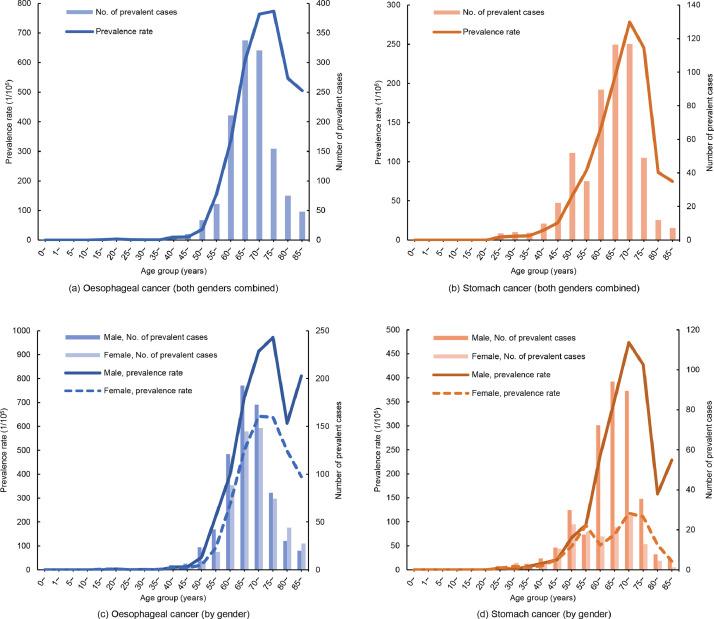
In Hua County, the age-standardised relative 5-year survival was 39·2% (male: 36·8%; female: 43·6%) for oesophageal cancer and 33·3% (male: 29·6%; female: 43·4%) for stomach cancer. For oesophageal cancer, better survival was observed in patients of 45-64 years compared with national average estimates, and women of <75 years had better survival than men. The 5-year prevalence rate in Hua County was 99·8/100,000 (male: 105·9/100,000; female: 93·3/100,000) for oesophageal cancer and 41·5/100,000 (male: 57·4/100,000; female: 24·5/100,000) for stomach cancer. For both of these cancers, the prevalence burden peaked at 65-79 years. The model estimates for survival and prevalence were close to the observations in real investigation, with a relative difference of less than 4·5%.
INTERPRETATION
This novel approach allows accurate estimation of cancer prevalence and survival with a short delay, which has great potential for regular use in general Chinese populations, especially those not covered by cancer registries.
FUNDING
The National Key R&D Program of China (2016YFC0901404), the National Science & Technology Fundamental Resources Investigation Program of China (2019FY101102), the National Natural Science Foundation of China (82073626), the Taikang Yicai Public Health and Epidemic Control Fund (TKYC-GW-2020), the Beijing-Tianjin-Hebei Basic Research Cooperation Project (J200016), and the Digestive Medical Coordinated Development Center of Beijing Hospitals Authority (XXZ0204).
背景
我们旨在基于医疗保险系统癌症监测系统(MIS - CASS)建立一种新的中国癌症患病率及生存率监测方法。
方法
我们构建了一个标准程序,通过联合使用医疗保险理赔数据和全因死亡监测数据,进行数据收集、清理、处理、关联、验证、分析以及癌症患病率和生存率(包括实际观察值和模型估计值)的估计。作为一项原理验证研究,我们通过估计中国食管癌高风险地区滑县上消化道癌症的最新患病率和生存率,评估了这种监测方法的性能。
结果
在滑县,食管癌的年龄标准化相对5年生存率为39.2%(男性:36.8%;女性:43.6%),胃癌为33.3%(男性:29.6%;女性:43.4%)。对于食管癌,45 - 64岁患者的生存率高于全国平均估计值,75岁以下女性的生存率高于男性。滑县食管癌的5年患病率为99.8/10万(男性:105.9/10万;女性:93.3/10万),胃癌为41.5/10万(男性:57.4/10万;女性:24.5/10万)。这两种癌症的患病率负担在65 - 79岁达到峰值。生存率和患病率的模型估计值与实际调查中的观察值接近,相对差异小于4.5%。
解读
这种新方法能够在短时间内准确估计癌症患病率和生存率,在中国普通人群,尤其是未被癌症登记覆盖的人群中定期使用具有巨大潜力。
资助
国家重点研发计划(2016YFC0901404)、国家科技基础资源调查专项(2019FY101102)、国家自然科学基金(82073626)、泰康溢彩公共卫生与疫情防控基金(TKYC - GW - 2020)、京津冀基础研究合作项目(J200016)以及北京医院管理局消化医学协同发展中心(XXZ0204)。


 Zotero 插件