
基于人工神经网络的模型预测无大血管侵犯肝癌术后早期复发。
Artificial neural network model to predict post-hepatectomy early recurrence of hepatocellular carcinoma without macroscopic vascular invasion.
机构信息
Department of Hepatobilliary & Pancreatic Surgery, Guangxi Medical University Cancer Hospital, 71 He Di Road, Nanning, China.
Department of Experimental Research, Guangxi Medical University Cancer Hospital, Nanning, 530021, China.
出版信息
BMC Cancer. 2021 Mar 16;21(1):283. doi: 10.1186/s12885-021-07969-4.
BACKGROUND
The accurate prediction of post-hepatectomy early recurrence (PHER) of hepatocellular carcinoma (HCC) is vital in determining postoperative adjuvant treatment and monitoring. This study aimed to develop and validate an artificial neural network (ANN) model to predict PHER in HCC patients without macroscopic vascular invasion.
METHODS
Nine hundred and three patients who underwent curative liver resection for HCC participated in this study. They were randomly divided into derivation (n = 679) and validation (n = 224) cohorts. The ANN model was developed in the derivation cohort and subsequently verified in the validation cohort.
RESULTS
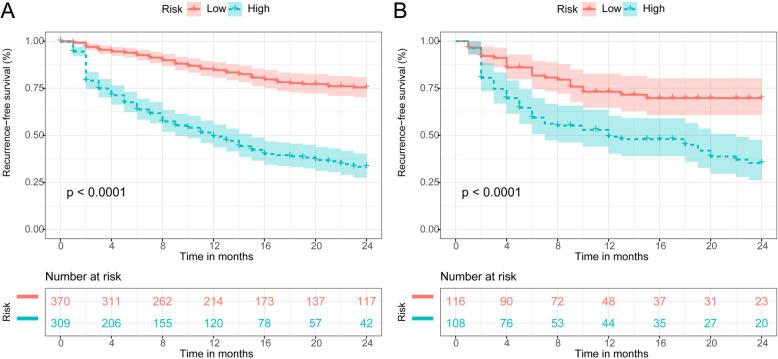
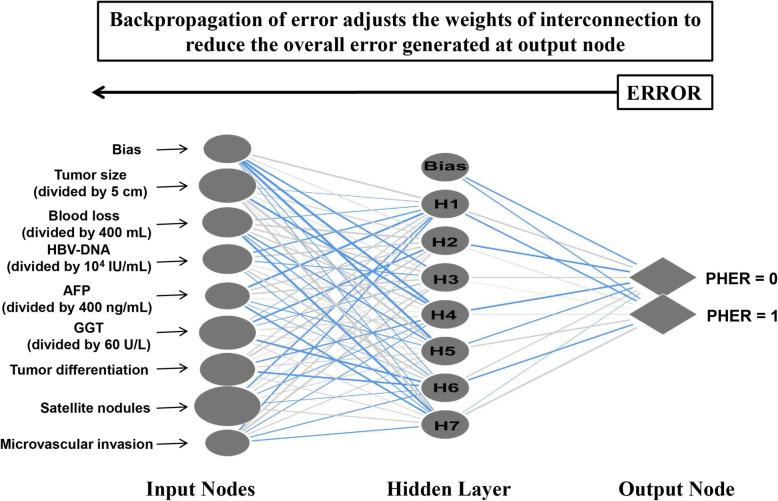
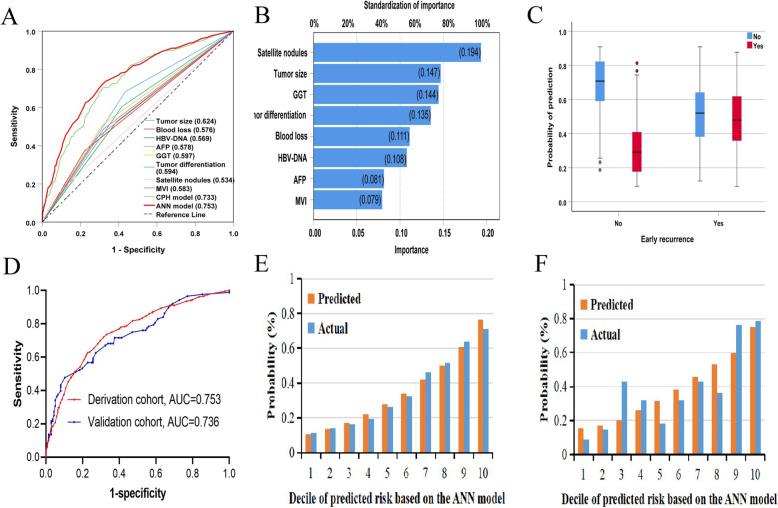
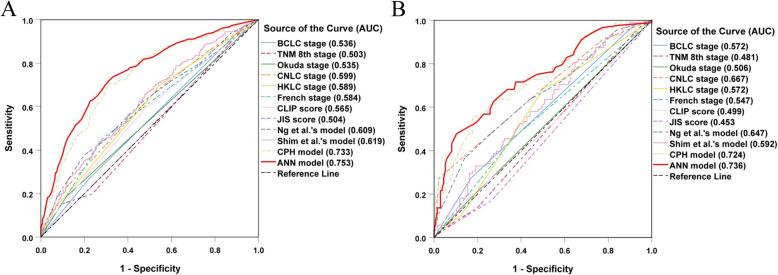
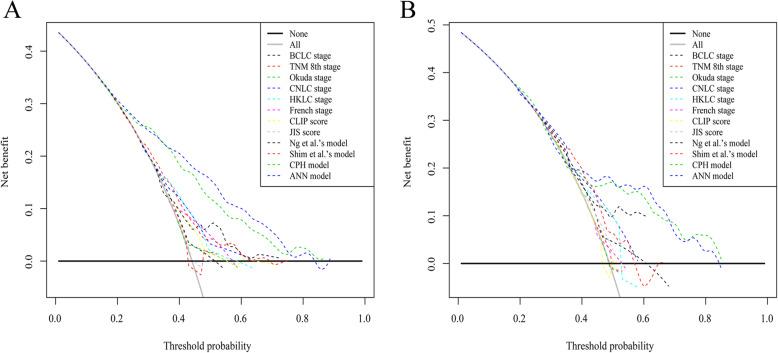
PHER morbidity in the derivation and validation cohorts was 34.8 and 39.2%, respectively. A multivariable analysis revealed that hepatitis B virus deoxyribonucleic acid load, γ-glutamyl transpeptidase level, α-fetoprotein level, tumor size, tumor differentiation, microvascular invasion, satellite nodules, and blood loss were significantly associated with PHER. These factors were incorporated into an ANN model, which displayed greater discriminatory abilities than a Cox's proportional hazards model, preexisting recurrence models, and commonly used staging systems for predicting PHER. The recurrence-free survival curves were significantly different between patients that had been stratified into two risk groups.
CONCLUSION
When compared to other models and staging systems, the ANN model has a significant advantage in predicting PHER for HCC patients without macroscopic vascular invasion.
背景
准确预测肝细胞癌(HCC)肝切除术后早期复发(PHER)对于确定术后辅助治疗和监测至关重要。本研究旨在开发和验证一种人工神经网络(ANN)模型,以预测无大血管侵犯的 HCC 患者的 PHER。
方法
903 例接受根治性肝切除术治疗 HCC 的患者参与了本研究。他们被随机分为推导(n=679)和验证(n=224)队列。ANN 模型在推导队列中建立,并随后在验证队列中验证。
结果
推导和验证队列中 PHER 的发病率分别为 34.8%和 39.2%。多变量分析显示,乙型肝炎病毒脱氧核糖核酸载量、γ-谷氨酰转肽酶水平、甲胎蛋白水平、肿瘤大小、肿瘤分化、微血管侵犯、卫星结节和出血量与 PHER 显著相关。这些因素被纳入 ANN 模型,该模型显示出比 Cox 比例风险模型、现有复发模型和常用于预测 PHER 的分期系统更好的区分能力。在根据风险分层的患者之间,无复发生存曲线存在显著差异。
结论
与其他模型和分期系统相比,ANN 模型在预测无大血管侵犯的 HCC 患者的 PHER 方面具有显著优势。
 Zotero 插件