
头颈癌放疗后长期使用阿片类药物的风险:一项系统评价与荟萃分析。
Risk of Chronic Opioid Use After Radiation for Head and Neck Cancer: A Systematic Review and Meta-Analysis.
作者信息
Zayed Sondos, Lin Cindy, Boldt R Gabriel, Sathya Jinka, Venkatesan Varagur, Read Nancy, Mendez Lucas C, Moulin Dwight E, Palma David A
机构信息
Department of Radiation Oncology, London Health Sciences Centre, London, Canada.
Department of Clinical Neurological Sciences and Oncology, London Health Sciences Centre, London, Canada.
出版信息
Adv Radiat Oncol. 2020 Oct 26;6(2):100583. doi: 10.1016/j.adro.2020.09.023. eCollection 2021 Mar-Apr.
PURPOSE
Opioid addiction is a major public health concern. Chronic opioid use (COU) patterns after radiation for head and neck cancer (HNC) remain poorly understood. The aim of this study was to estimate the prevalence of COU and to identify its risk factors in patients with HNC undergoing curative-intent radiation therapy (RT) or chemoradiotherapy (CRT).
METHODS AND MATERIALS
We performed a systematic review and meta-analysis using the PubMed (Medline), EMBASE, and Cochrane Library databases, queried from dates of inception until January 2020. COU was defined as persistent use of opioids ≥ 3 months after treatment completion. Meta-analyses were performed using random effects models. Heterogeneity was assessed using the I value.
RESULTS
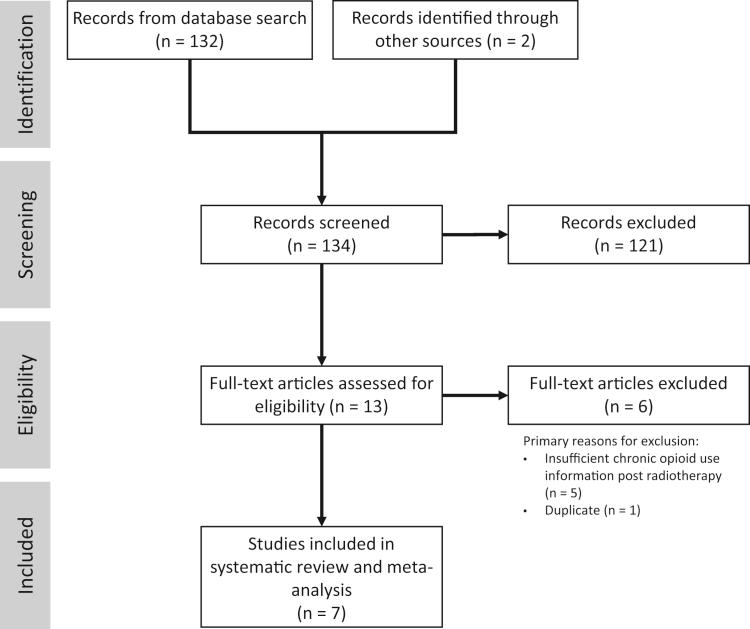
Seven retrospective studies, reporting on 1841 patients, met the inclusion criteria. Median age was 59.4 (range: 56.0-62.0) years with 1343 (72.9%) men and 498 (27.1%) women. Primary tumor locations included oropharynx (n = 891, 48.4%), oral cavity (n = 533, 29.0%), larynx (n = 93, 5.1%), hypopharynx (n = 32, 1.7%), and nasopharynx (n = 29, 1.6%). Eight hundred fifty-four (46.0%) patients had stage I/II and 952 (50.3%) had stage III-IV disease. Three hundred one (16.3%) patients had RT alone, 738 (40.1%) received CRT, and 594 (32.3%) underwent surgery followed by adjuvant RT/CRT. The proportion of patients with HNC who developed COU post-RT/CRT was 40.7% at 3 months (95% confidence interval [CI]: 22.6%-61.7%; I = 97.1%) and 15.5% at 6 months (95% CI: 7.3%-29.7%; I = 94.3%). Oropharyngeal malignancies had the highest rate of COU based on primary tumor location (46.6%; 95% CI: 30.8%-63.1%; < .0001). High proportions of COU were found in patients with a history of psychiatric disorder(s) (61.7%), former/current alcohol abuse (53.9%), and opioid requirements before radiation treatment (51.6%; = .035).
CONCLUSIONS
A significant proportion of patients who undergo RT for HNC suffer from COU. High-risk factors for COU include an oropharyngeal primary, history of psychiatric disorder, former/current alcohol abuse, and pre-treatment opioid use. New strategies to mitigate COU are needed.
目的
阿片类药物成瘾是一个主要的公共卫生问题。头颈部癌(HNC)放疗后的慢性阿片类药物使用(COU)模式仍知之甚少。本研究的目的是估计接受根治性放疗(RT)或放化疗(CRT)的HNC患者中COU的患病率,并确定其危险因素。
方法和材料
我们使用PubMed(Medline)、EMBASE和Cochrane图书馆数据库进行了系统评价和荟萃分析,检索时间从数据库建立之日至2020年1月。COU被定义为治疗完成后持续使用阿片类药物≥3个月。使用随机效应模型进行荟萃分析。使用I²值评估异质性。
结果
七项回顾性研究,共报道1841例患者,符合纳入标准。中位年龄为59.4岁(范围:56.0 - 62.0岁),男性1343例(72.9%),女性498例(27.1%)。原发肿瘤部位包括口咽(n = 891,48.4%)、口腔(n = 533,29.0%)、喉(n = 93,5.1%)、下咽(n = 32,1.7%)和鼻咽(n = 29,1.6%)。854例(46.0%)患者为I/II期,952例(50.3%)为III - IV期疾病。301例(16.3%)患者仅接受放疗,738例(40.1%)接受放化疗,594例(32.3%)接受手术,随后接受辅助放疗/放化疗。HNC患者放疗/放化疗后发生COU的比例在3个月时为40.7%(95%置信区间[CI]:22.6% - 61.7%;I² = 97.1%),在6个月时为15.5%(95% CI:7.3% - 29.7%;I² = 94.3%)。根据原发肿瘤部位,口咽恶性肿瘤的COU发生率最高(46.6%;95% CI:30.8% - 63.1%;P <.0001)。有精神疾病史的患者(61.7%)、既往/当前有酒精滥用史的患者(53.9%)以及放疗前有阿片类药物需求的患者(51.6%;P =.035)中COU的比例较高。
结论
接受HNC放疗的患者中有相当一部分患有COU。COU的高危因素包括口咽原发、精神疾病史、既往/当前酒精滥用以及放疗前使用阿片类药物。需要新的策略来减轻COU。
 Zotero 插件