
皮下注射替扎尼定治疗骨关节炎:疼痛和功能的早期改善是否有意义且持续?
Subcutaneous tanezumab for osteoarthritis: Is the early improvement in pain and function meaningful and sustained?
机构信息
Department of Rheumatology, Sorbonne Université, INSERM CRSA, AP-HP Hopital Saint Antoine, Paris, France.
Pain and Anaesthesia Research Centre, St Bartholomew's Hospital, London, UK.
出版信息
Eur J Pain. 2021 Aug;25(7):1525-1539. doi: 10.1002/ejp.1764. Epub 2021 May 3.
BACKGROUND
To evaluate if early improvements in pain and function with subcutaneous tanezumab are meaningful and sustained over 24 weeks.
METHODS
Patients with moderate-to-severe osteoarthritis (hip or knee) in Europe and Japan were randomized to placebo, tanezumab 2.5 mg or tanezumab 5 mg (baseline, Week 8 and Week 16). Outcomes included: average daily index joint pain score, Western Ontario and McMaster Universities Osteoarthritis Index (WOMAC) subscales, rescue medication use, WOMAC responders (within-patient ≥30% reduction in WOMAC Pain or Physical Function), Outcome Measures in Rheumatology-Osteoarthritis Research Society International (OMERACT-OARSI) responders (within-patient) and Patient-reported Treatment Impact Assessment-Modified questionnaire.
RESULTS
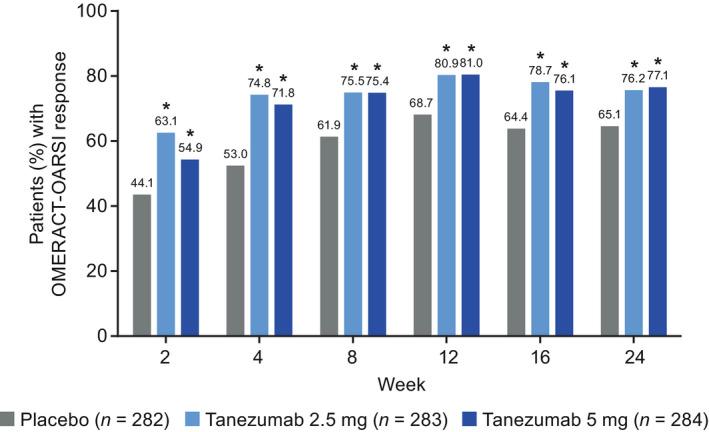
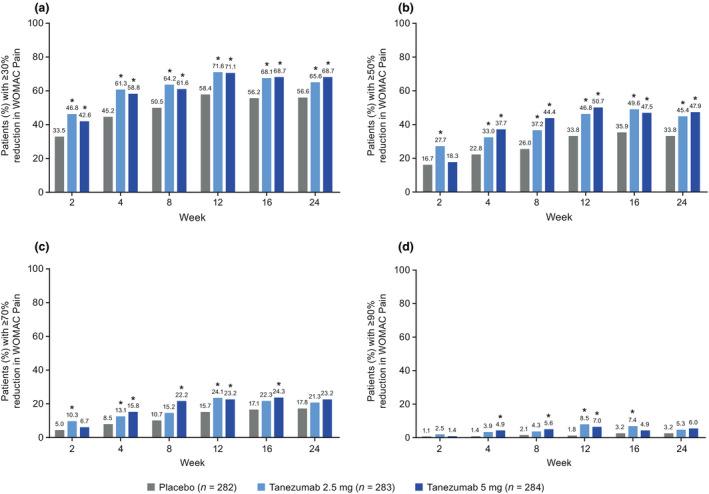
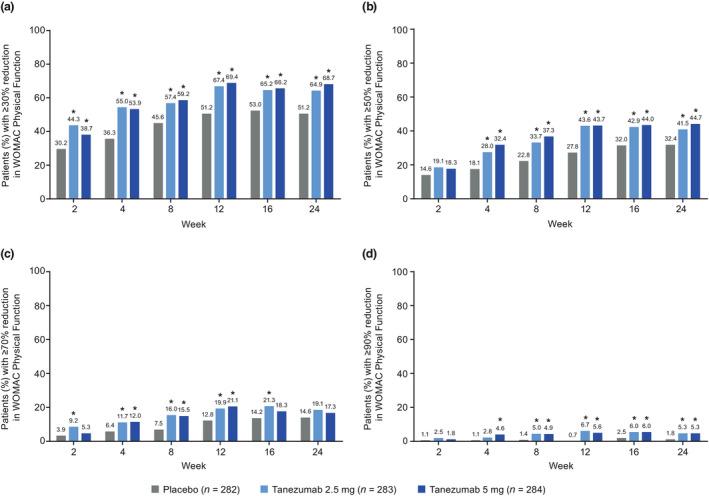
Patients received placebo (n = 282), tanezumab 2.5 mg (n = 283) or tanezumab 5 mg (n = 284). Changes from baseline in average daily index joint pain (within the first week) and WOMAC subscales (Week 2 through Week 24) were greater for each tanezumab group versus placebo (least squares [LS] mean, unadjusted p ≤ .05). Rescue medication use (days/week) was lower for each tanezumab group versus placebo from Week 2 through Week 12 (LS mean, unadjusted p ≤ .05) but not at Week 16 or 24. A higher proportion of each tanezumab group than placebo achieved ≥30% reduction from baseline in WOMAC Pain or Physical Function, or OMERACT-OARSI response (Week 2 through Week 24, unadjusted p ≤ .05), or were satisfied with treatment at Week 24 (unadjusted p ≤ .05).
CONCLUSIONS
Subcutaneous tanezumab, compared with placebo, reduced pain within the first week, and pain and function were improved throughout 24 weeks. The proportions of responders and patients satisfied were higher with tanezumab than placebo. ClinicalTrials.gov:NCT02709486.
SIGNIFICANCE
This exploratory analysis of data from a placebo-controlled, Phase 3 study of patients with moderate-to-severe osteoarthritis of the hip or knee for whom standard analgesics were not effective or could not be taken, found that onset of efficacy of subcutaneous tanezumab was within the first week, and efficacy was maintained through the 24-week treatment period. Tanezumab was effective in those patients with the most radiologically severe osteoarthritis.
背景
评估皮下注射替纳珠单抗是否能在 24 周内持续改善疼痛和功能,并带来早期改善。
方法
在欧洲和日本,患有中重度骨关节炎(髋关节或膝关节)的患者被随机分配至安慰剂组、替纳珠单抗 2.5mg 组或替纳珠单抗 5mg 组(基线、第 8 周和第 16 周)。评估指标包括:平均每日关节疼痛指数、西安大略和麦克马斯特大学骨关节炎指数(WOMAC)量表、解救药物使用情况、WOMAC 应答者(患者 WOMAC 疼痛或躯体功能评分较基线降低≥30%)、疗效评价指标改良问卷(Patient-reported Treatment Impact Assessment-Modified questionnaire)、骨关节炎疗效评价指标-骨关节炎研究学会国际(Outcome Measures in Rheumatology-Osteoarthritis Research Society International,OMERACT-OARSI)应答者(患者 WOMAC 疼痛或躯体功能评分较基线降低≥30%)。
结果
共有 282 名患者接受安慰剂治疗、283 名患者接受替纳珠单抗 2.5mg 治疗、284 名患者接受替纳珠单抗 5mg 治疗。与安慰剂组相比,各替纳珠单抗组在基线时的平均每日关节疼痛(第 1 周内)和 WOMAC 量表评分(第 2 周至第 24 周)均有显著改善(最小二乘法[LS]均值,未调整 p 值≤0.05)。与安慰剂组相比,各替纳珠单抗组从第 2 周至第 12 周的解救药物使用(每周天数)均较低(LS 均值,未调整 p 值≤0.05),但在第 16 周或第 24 周时没有差异。与安慰剂组相比,各替纳珠单抗组在第 2 周至第 24 周时 WOMAC 疼痛或躯体功能、或 OMERACT-OARSI 应答(未调整 p 值≤0.05)的患者比例更高,或在第 24 周时对治疗更满意(未调整 p 值≤0.05)。
结论
与安慰剂相比,皮下注射替纳珠单抗能在第 1 周内减轻疼痛,并且在 24 周内持续改善疼痛和功能。与安慰剂相比,应答者和对治疗满意的患者比例在替纳珠单抗组更高。临床试验注册:NCT02709486。
意义
本研究对一项安慰剂对照、3 期临床试验数据进行了探索性分析,该试验纳入了中重度髋关节或膝关节骨关节炎患者,这些患者对标准镇痛药无效或无法使用,结果表明,皮下注射替纳珠单抗的疗效在第 1 周内即可显现,且在 24 周的治疗期间保持稳定。替纳珠单抗对影像学上骨关节炎最严重的患者也有效。


 Zotero 插件