
肺免疫肿瘤预后评分(LIPS-3):用于接受一线帕博利珠单抗治疗 PD-L1≥50%的晚期非小细胞肺癌患者的预后分类。
The lung immuno-oncology prognostic score (LIPS-3): a prognostic classification of patients receiving first-line pembrolizumab for PD-L1 ≥ 50% advanced non-small-cell lung cancer.
机构信息
Oncology Department, Portsmouth University Hospitals NHS Trust, Portsmouth, UK.
Department of Surgery and Cancer, Imperial College London, London, UK; Department of Biotechnology and Applied Clinical Sciences, University of L'Aquila, L'Aquila, Italy.
出版信息
ESMO Open. 2021 Apr;6(2):100078. doi: 10.1016/j.esmoop.2021.100078. Epub 2021 Mar 16.
BACKGROUND
To stratify the prognosis of patients with programmed cell death-ligand 1 (PD-L1) ≥ 50% advanced non-small-cell lung cancer (aNSCLC) treated with first-line immunotherapy.
METHODS
Baseline clinical prognostic factors, the neutrophil-to-lymphocyte ratio (NLR), PD-L1 tumour cell expression level, lactate dehydrogenase (LDH) and their combination were investigated by a retrospective analysis of 784 patients divided between statistically powered training (n = 201) and validation (n = 583) cohorts. Cut-offs were explored by receiver operating characteristic (ROC) curves and a risk model built with validated independent factors by multivariate analysis.
RESULTS
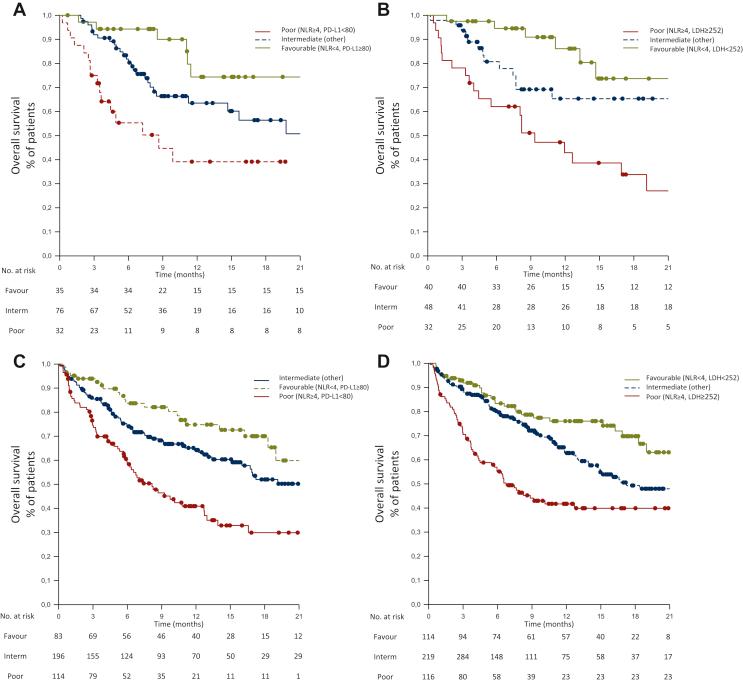
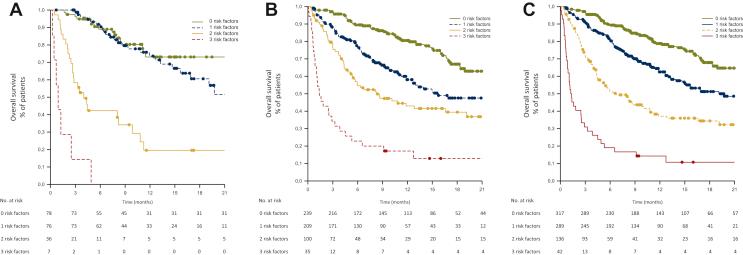
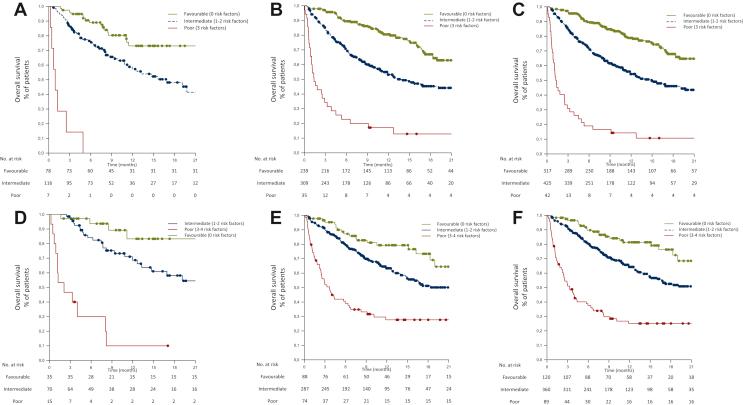
NLR < 4 was a significant prognostic factor in both cohorts (P < 0.001). It represented 53% of patients in the validation cohort, with 1-year overall survival (OS) of 76.6% versus 44.8% with NLR > 4, in the validation series. The addition of PD-L1 ≥ 80% (21% of patients) or LDH < 252 U/l (25%) to NLR < 4 did not result in better 1-year OS (of 72.6% and 74.1%, respectively, in the validation cohort). Eastern Cooperative Oncology Group (ECOG) performance status (PS) of 2 [P < 0.001, hazard ratio (HR) 2.04], pretreatment steroids (P < 0.001, HR 1.67) and NLR < 4 (P < 0.001, HR 2.29) resulted in independent prognostic factors. A risk model with these three factors, namely, the lung immuno-oncology prognostic score (LIPS)-3, accurately stratified three OS risk-validated categories of patients: favourable (0 risk factors, 40%, 1-year OS of 78.2% in the whole series), intermediate (1 or 2 risk factors, 54%, 1-year OS 53.8%) and poor (>2 risk factors, 5%, 1-year OS 10.7%) prognosis.
CONCLUSIONS
We advocate the use of LIPS-3 as an easy-to-assess and inexpensive adjuvant prognostic tool for patients with PD-L1 ≥ 50% aNSCLC.
背景
对程序性死亡配体 1(PD-L1)≥50%的晚期非小细胞肺癌(aNSCLC)患者进行一线免疫治疗,以分层其预后。
方法
通过对 784 例患者进行回顾性分析,将患者分为具有统计学意义的训练(n=201)和验证(n=583)队列,以研究基线临床预后因素、中性粒细胞与淋巴细胞比值(NLR)、肿瘤细胞 PD-L1 表达水平、乳酸脱氢酶(LDH)及其组合。通过接收者操作特征(ROC)曲线和多变量分析验证独立因素建立风险模型来探索截断值。
结果
在两个队列中,NLR<4 都是显著的预后因素(P<0.001)。在验证队列中,NLR<4 代表了 53%的患者,其 1 年总生存率(OS)为 76.6%,而 NLR>4 的患者为 44.8%。将 PD-L1≥80%(21%的患者)或 LDH<252U/L(25%)添加到 NLR<4 中,并未导致 1 年 OS 更好(验证队列中分别为 72.6%和 74.1%)。东部肿瘤协作组(ECOG)表现状态(PS)为 2[P<0.001,风险比(HR)2.04]、预处理类固醇(P<0.001,HR 1.67)和 NLR<4(P<0.001,HR 2.29)是独立的预后因素。具有这三个因素的风险模型,即肺免疫肿瘤预后评分(LIPS)-3,准确地将验证的三种 OS 风险类别分层:有利(0 个危险因素,40%,整个系列的 1 年 OS 为 78.2%)、中等(1 个或 2 个危险因素,54%,1 年 OS 为 53.8%)和差(>2 个危险因素,5%,1 年 OS 为 10.7%)。
结论
我们主张使用 LIPS-3 作为 PD-L1≥50%的 aNSCLC 患者易于评估且经济实惠的辅助预后工具。

 Zotero 插件