
TAIL 研究的主要结果:一项在先前接受过治疗的晚期非小细胞肺癌的多种族患者中进行的阿替利珠单抗单药治疗的全球性单臂安全性研究。
Primary results from TAIL: a global single-arm safety study of atezolizumab monotherapy in a diverse population of patients with previously treated advanced non-small cell lung cancer.
机构信息
Department of Medical Oncology, IRCCS Azienda Ospedaliero-Universitaria di Bologna, Bologna, Italy
Oncology Service, Hospital de Clínicas de Porto Alegre, Porto Alegre, Brazil.
出版信息
J Immunother Cancer. 2021 Mar;9(3). doi: 10.1136/jitc-2020-001865.
BACKGROUND
Atezolizumab treatment improves survival, with manageable safety, in patients with previously treated advanced/metastatic non-small cell lung cancer. The global phase III/IV study TAIL (NCT03285763) was conducted to evaluate the safety and efficacy of atezolizumab monotherapy in a clinically diverse population of patients with previously treated non-small cell lung cancer, including those not eligible for pivotal trials.
METHODS
Patients with stage IIIB/IV non-small cell lung cancer whose disease progressed after 1-2 lines of chemotherapy were eligible for this open-label, single-arm, multicenter study, including those with severe renal impairment, an Eastern Cooperative Oncology Group performance status of 2, prior anti-programmed death 1 (PD-1) therapy, and autoimmune disease. Atezolizumab was administered intravenously (1200 mg every 3 weeks). Coprimary endpoints were treatment-related serious adverse events and immune-related adverse events.
RESULTS
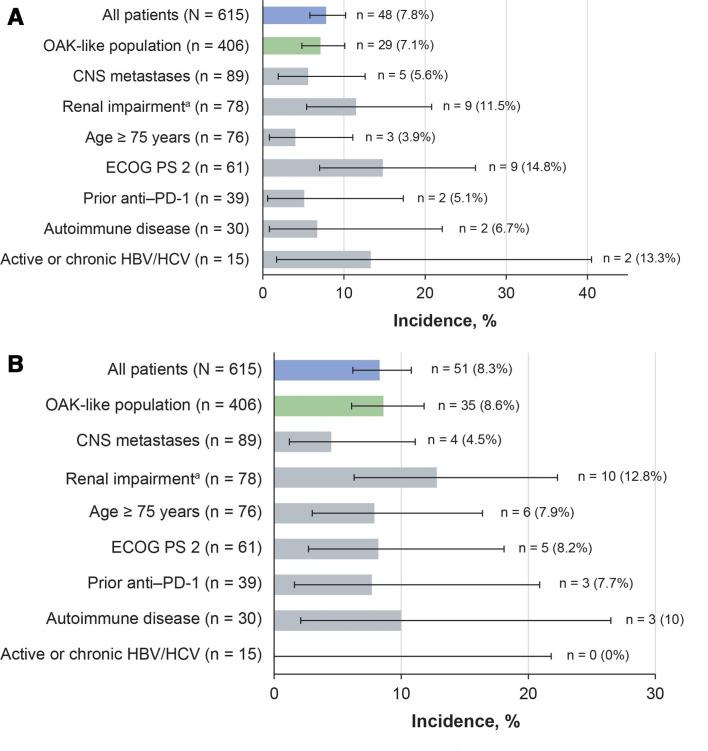
619 patients enrolled and 615 received atezolizumab. At data cutoff, the median follow-up was 12.6 months (95% CI 11.9 to 13.1). Treatment-related serious adverse events occurred in 7.8% and immune-related adverse events in 8.3% of all patients and as follows, respectively, in these subgroups: renal impairment (n=78), 11.5% and 12.8%; Eastern Cooperative Oncology Group performance status of 2 (n=61), 14.8% and 8.2%; prior anti-PD-1 therapy (n=39), 5.1% and 7.7%; and autoimmune disease (n=30), 6.7% and 10.0%. No new safety signals were reported. In the overall population, the median overall survival was 11.1 months (95% CI 8.9 to 12.9), the median progression-free survival was 2.7 months (95% CI 2.1 to 2.8) and the objective response rate was 11%.
CONCLUSIONS
This study confirmed the benefit-risk profile of atezolizumab monotherapy in a clinically diverse population of patients with previously treated non-small cell lung cancer. These safety and efficacy outcomes may inform treatment decisions for patients generally excluded from checkpoint inhibitor trials.
背景
阿特珠单抗治疗可改善既往治疗的晚期/转移性非小细胞肺癌患者的生存,安全性可管理。全球 III/IV 期 TAIL 研究(NCT03285763)旨在评估阿特珠单抗单药治疗既往治疗的非小细胞肺癌患者的安全性和疗效,这些患者包括不符合关键试验条件的患者。
方法
疾病进展后接受 1-2 线化疗的 IIIB/IV 期非小细胞肺癌患者有资格参加这项开放标签、单臂、多中心研究,包括严重肾功能损害、东部肿瘤协作组体力状态 2、既往抗程序性死亡 1(PD-1)治疗和自身免疫性疾病患者。阿特珠单抗静脉输注(每 3 周 1200mg)。主要终点为治疗相关严重不良事件和免疫相关不良事件。
结果
619 例患者入组,615 例患者接受了阿特珠单抗治疗。数据截止时,中位随访时间为 12.6 个月(95%CI 11.9 至 13.1)。所有患者中,治疗相关严重不良事件发生率为 7.8%,免疫相关不良事件发生率为 8.3%,分别为:肾功能损害(n=78),11.5%和 12.8%;东部肿瘤协作组体力状态 2(n=61),14.8%和 8.2%;既往抗 PD-1 治疗(n=39),5.1%和 7.7%;自身免疫性疾病(n=30),6.7%和 10.0%。未报告新的安全性信号。在总体人群中,中位总生存期为 11.1 个月(95%CI 8.9 至 12.9),中位无进展生存期为 2.7 个月(95%CI 2.1 至 2.8),客观缓解率为 11%。
结论
这项研究证实了阿特珠单抗单药治疗既往治疗的非小细胞肺癌患者的获益风险特征。这些安全性和疗效结果可能为通常排除在检查点抑制剂试验之外的患者的治疗决策提供信息。


 Zotero 插件