
戈利木单抗,一种新型、双价 CD20 靶向 T 细胞衔接双特异性抗体,在复发或难治性 B 细胞淋巴瘤中诱导持久完全缓解:一项 I 期试验。
Glofitamab, a Novel, Bivalent CD20-Targeting T-Cell-Engaging Bispecific Antibody, Induces Durable Complete Remissions in Relapsed or Refractory B-Cell Lymphoma: A Phase I Trial.
机构信息
Department of Hematology and Phase 1 Unit, Rigshospitalet, Copenhagen, Denmark.
Université de Lille, CHU Lille, ULR 7365 - GRITA - Groupe de Recherche sur les formes Injectables et les Technologies Associées, Lille, France.
出版信息
J Clin Oncol. 2021 Jun 20;39(18):1959-1970. doi: 10.1200/JCO.20.03175. Epub 2021 Mar 19.
PURPOSE
Glofitamab is a T-cell-engaging bispecific antibody possessing a novel 2:1 structure with bivalency for CD20 on B cells and monovalency for CD3 on T cells. This phase I study evaluated glofitamab in relapsed or refractory (R/R) B-cell non-Hodgkin lymphoma (B-NHL). Data for single-agent glofitamab, with obinutuzumab pretreatment () to reduce toxicity, are presented.
METHODS
Seven days before the first dose of glofitamab (0.005-30 mg), all patients received 1,000 mg . Dose-escalation steps were determined using a Bayesian continuous reassessment method with overdose control. Primary end points were safety, pharmacokinetics, and the maximum tolerated dose of glofitamab.
RESULTS
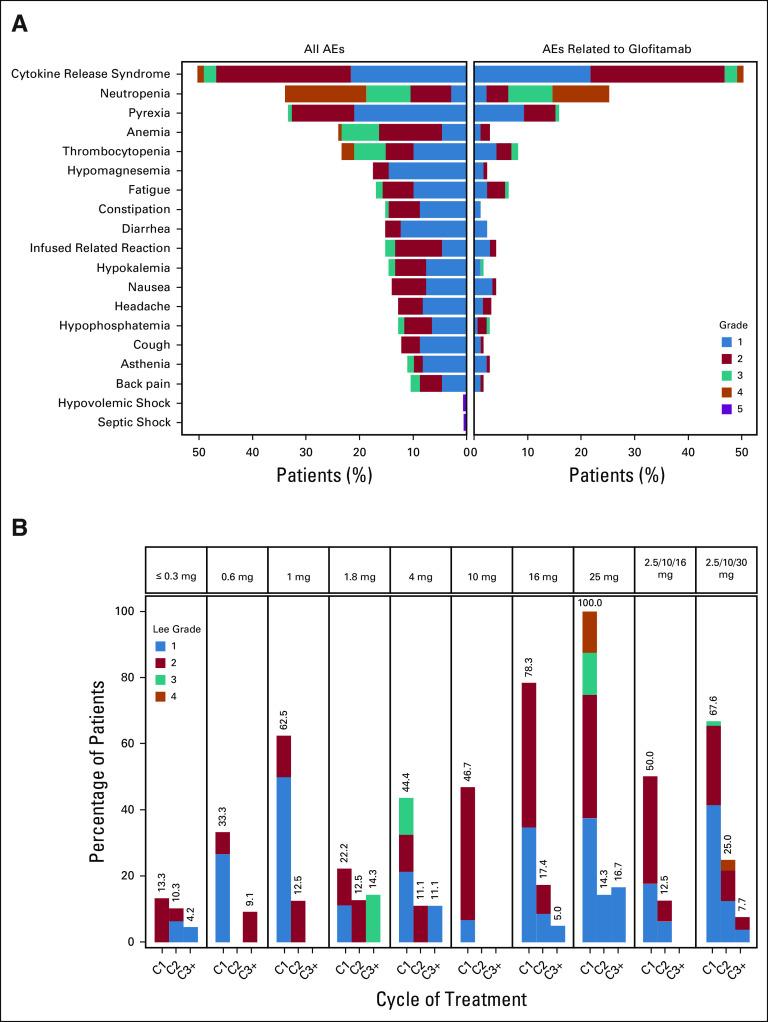
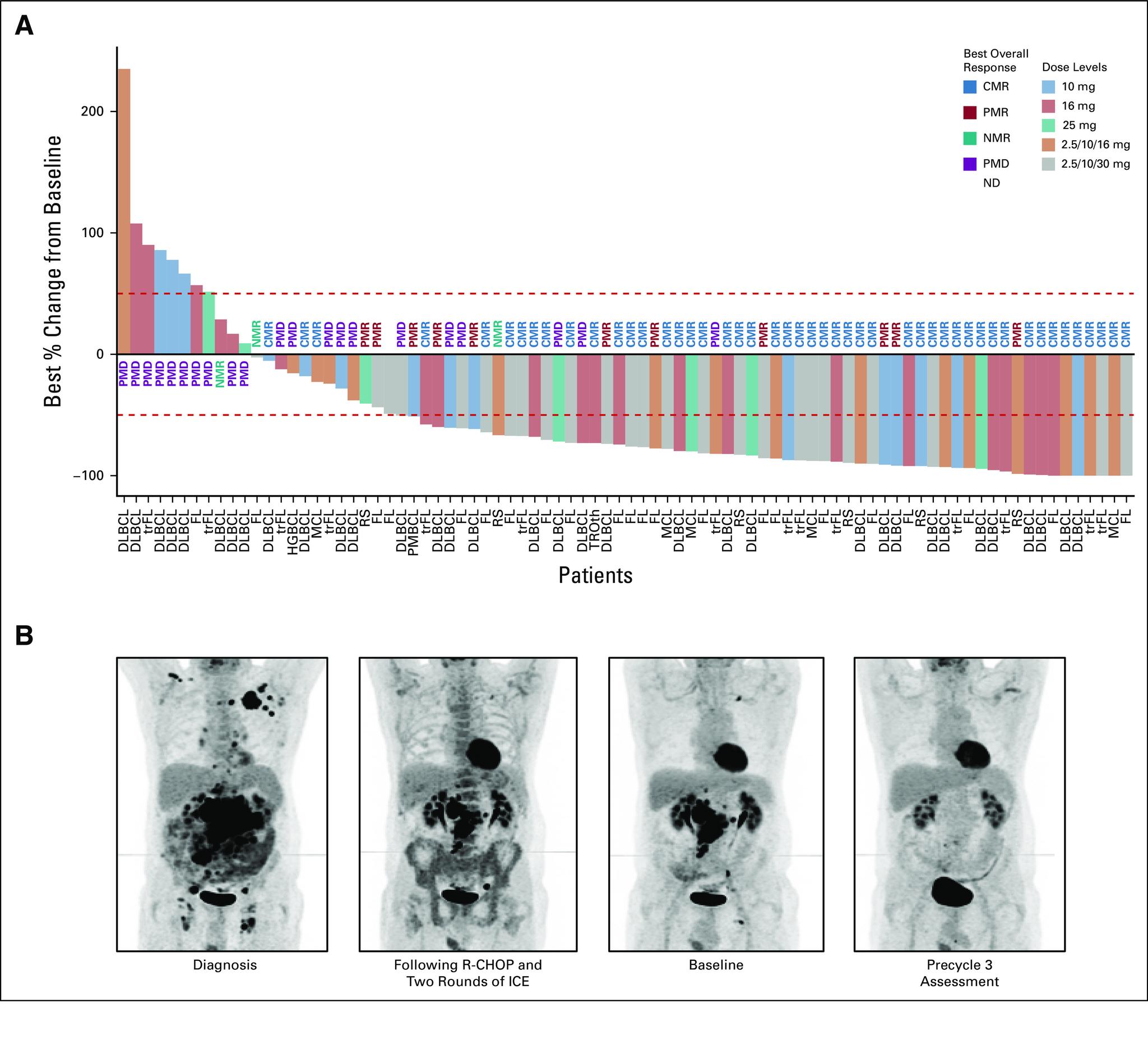
Following initial single-patient cohorts, 171 patients were treated within conventional multipatient cohorts and received at least one dose of glofitamab. This trial included heavily pretreated patients with R/R B-NHL; most were refractory to prior therapy (155; 90.6%) and had received a median of three prior therapies. One hundred and twenty-seven patients (74.3%) had diffuse large B-cell lymphoma, transformed follicular lymphoma, or other aggressive histology, and the remainder had indolent lymphoma subtypes. Five (2.9%) patients withdrew from treatment because of adverse events. Cytokine release syndrome occurred in 86 of 171 (50.3%) patients (grade 3 or 4: 3.5%); two (1.2%) patients experienced grade 3, transient immune effector cell-associated neurotoxicity syndrome-like symptoms. The overall response rate was 53.8% (complete response [CR], 36.8%) among all doses and 65.7% (CR, 57.1%) in those dosed at the recommended phase II dose. Of 63 patients with CR, 53 (84.1%) have ongoing CR with a maximum of 27.4 months observation.
CONCLUSION
In patients with predominantly refractory, aggressive B-NHL, glofitamab showed favorable activity with frequent and durable CRs and a predictable and manageable safety profile.
目的
Glofitamab 是一种 T 细胞结合双特异性抗体,具有新型的 2:1 结构,对 B 细胞上的 CD20 具有二价,对 T 细胞上的 CD3 具有单价。这项 I 期研究评估了复发或难治性(R/R)B 细胞非霍奇金淋巴瘤(B-NHL)中的 glofitamab。本文报告了使用奥滨尤妥珠单抗预处理()以降低毒性的单药 glofitamab 的数据。
方法
在 glofitamab 首次给药前 7 天(0.005-30mg),所有患者均接受 1000mg 。采用贝叶斯连续评估方法和过量控制来确定剂量递增步骤。主要终点为 glofitamab 的安全性、药代动力学和最大耐受剂量。
结果
在初始单患者队列之后,171 名患者在常规多患者队列中接受治疗,并接受了至少一剂 glofitamab。该试验纳入了 R/R B-NHL 中接受过多线治疗的患者;大多数患者对先前的治疗有抗药性(155;90.6%),并且接受了中位数为 3 种先前的治疗。127 名(74.3%)患者患有弥漫性大 B 细胞淋巴瘤、转化滤泡性淋巴瘤或其他侵袭性组织学,其余患者患有惰性淋巴瘤亚型。5 名(2.9%)患者因不良事件而退出治疗。171 名患者中有 86 名(50.3%)发生细胞因子释放综合征(CR3 或 4:3.5%);2 名(1.2%)患者出现 3 级、短暂性免疫效应细胞相关神经毒性综合征样症状。所有剂量的总缓解率为 53.8%(完全缓解[CR],36.8%),推荐的 II 期剂量组为 65.7%(CR,57.1%)。在 63 名获得 CR 的患者中,53 名(84.1%)获得持续的 CR,最大观察期为 27.4 个月。
结论
在主要为难治性侵袭性 B-NHL 的患者中,glofitamab 表现出良好的活性,频繁且持久的 CR 率和可预测且可管理的安全性特征。

 Zotero 插件