
早期生活抗生素与儿童胃肠道疾病:系统评价。
Early life antibiotics and childhood gastrointestinal disorders: a systematic review.
机构信息
Pediatrics, Amsterdam Gastroenterology, Metabolism & Nutrition, Amsterdam Reproduction & Development Amsterdam, Amsterdam UMC Location AMC, Amsterdam, The Netherlands.
Paediatrics, Sint Antonius Ziekenhuis, Nieuwegein, The Netherlands.
出版信息
BMJ Paediatr Open. 2021 Mar 3;5(1):e001028. doi: 10.1136/bmjpo-2021-001028. eCollection 2021.
BACKGROUND
In adults, there is increasing evidence for an association between antibiotic use and gastrointestinal (GI) disorders but in children, the evidence is scarce.
OBJECTIVE
Assess the association between exposure to antibiotics in the first 2 years of life in term born children and the presence of chronic GI disorders later in childhood.
DESIGN
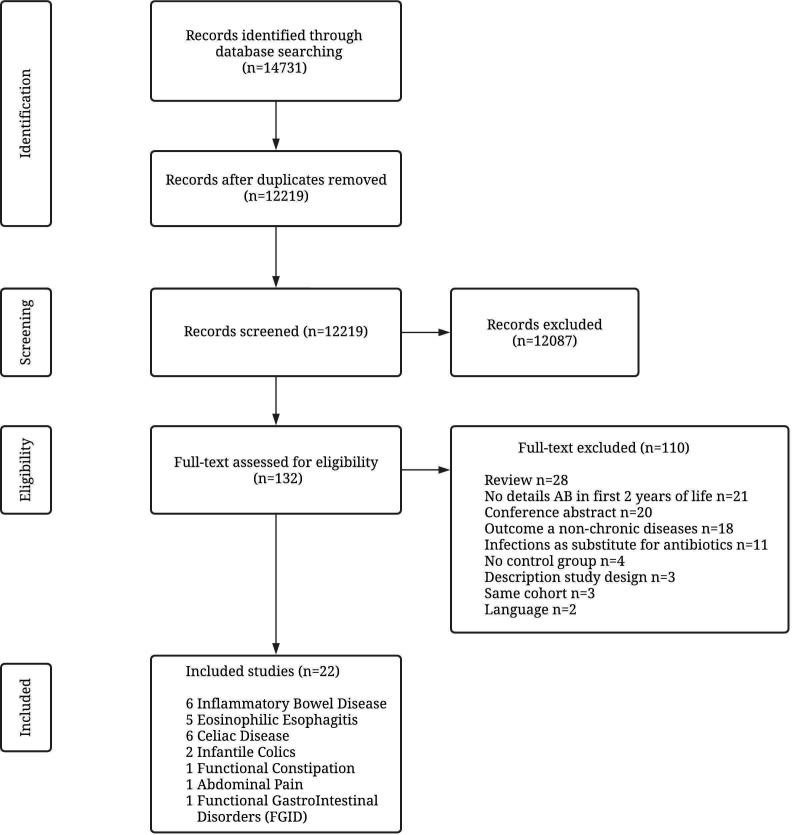
For this systematic review the MEDLINE, Embase, WHO trial register and Web of Science were systematically searched from inception to 8 June 2020. Title and abstract screening (n=12 219), full-text screening (n=132) as well as the quality assessment with the Newcastle-Ottawa Scale were independently performed by two researchers.
MAIN OUTCOME MEASURES
The association between antibiotics and inflammatory bowel disease (IBD) (n=6), eosinophilic oesophagitis (EoE) (n=5), coeliac disease (CeD) (n=6), infantile colics (n=3), functional constipation (n=2), recurrent abdominal pain, regurgitation, functional diarrhoea and infant dyschezia were examined.
RESULTS
Twenty-two studies were included, 11 cohort and 11 case-control studies. A best evidence synthesis showed strong evidence for an association between antibiotic exposure in the first 2 years of life and the presence of IBD, and CeD during childhood. Moderate evidence was found for an association with EoE and no association with functional constipation in the first year of life. There was insufficient evidence for the other studied disorders.
CONCLUSIONS
The use of antibiotics in early life may increase the risk of GI disorders later in life. Further studies are necessary to unravel the underlying mechanisms and determine potential preventive measures. Meanwhile judicious use of antibiotics in early childhood is highly warranted.
PROSPERO REGISTRATION NUMBER
PROSPERO CRD42019132631.
背景
在成年人中,越来越多的证据表明抗生素的使用与胃肠道(GI)疾病之间存在关联,但在儿童中,证据很少。
目的
评估在足月出生的儿童生命的头 2 年内接触抗生素与儿童后期慢性胃肠道疾病之间的关系。
设计
为了进行这项系统综述,从开始到 2020 年 6 月 8 日,系统地检索了 MEDLINE、Embase、世界卫生组织试验登记处和 Web of Science。由两名研究人员独立进行标题和摘要筛选(n=12219)、全文筛选(n=132)以及使用纽卡斯尔-渥太华量表进行的质量评估。
主要观察结果
研究了抗生素与炎症性肠病(IBD)(n=6)、嗜酸性食管炎(EoE)(n=5)、乳糜泻(CeD)(n=6)、婴儿绞痛(n=3)、功能性便秘(n=2)、复发性腹痛、反流、功能性腹泻和婴儿排便困难之间的关系。
结果
共纳入 22 项研究,其中 11 项为队列研究,11 项为病例对照研究。最佳证据综合表明,生命的头 2 年内接触抗生素与儿童期 IBD 和 CeD 的发生之间存在强关联。中度证据表明与 EoE 有关联,与生命第一年的功能性便秘无关。对于其他研究的疾病,证据不足。
结论
生命早期使用抗生素可能会增加日后患胃肠道疾病的风险。需要进一步的研究来揭示潜在的机制并确定潜在的预防措施。同时,在儿童早期谨慎使用抗生素是非常必要的。
前瞻性注册编号
PROSPERO CRD42019132631。

 Zotero 插件