
HPV 自我采样装置 Qvintip 和 HerSwab 在未参加宫颈癌筛查项目女性中的随访长期结果。
Long term results of follow-up after HPV self-sampling with devices Qvintip and HerSwab in women non-attending cervical screening programme.
机构信息
Mistelbach-Gänserndorf Regional Hospital, MistelbachAustria.
Institute of Oncology Ljubljana, Ljubljana, Slovenia.
出版信息
Radiol Oncol. 2021 Jan 6;55(2):187-195. doi: 10.2478/raon-2021-0001.
BACKGROUND
We are presenting the results of the Slovenian human papillomaviruses (HPV) self-sampling pilot study in colposcopy population of National Cervical Cancer Screening Programme ZORA for the first time. One-year and four-year follow-up results are presented for two different self-sampling devices.
PARTICIPANTS AND METHODS
A total of 209 women were enrolled in the study at colposcopy clinic. Prior to the gynaecological examination, all women performed self-collected vaginal swab at the clinic; 111 using Qvintip and 98 using HerSwab self-sampling device. After self-sampling, two cervical smears were taken by a clinician; first for conventional cytology and second for HPV test. After that, all women underwent colposcopy and a cervical biopsy if needed. We compared sensitivity, specificity, and predictive values of cytology (at the cut-off atypical squamous cells of undetermined significance or more [ASC-US+]) and HPV test (on self- and clinician-taken samples) for the detection of cervical intraepithelial neoplasia grade 2 or more (CIN2+) after one and four years of follow-up. Hybrid Capture 2 (HC2) assay was used for all HPV testing.
RESULTS
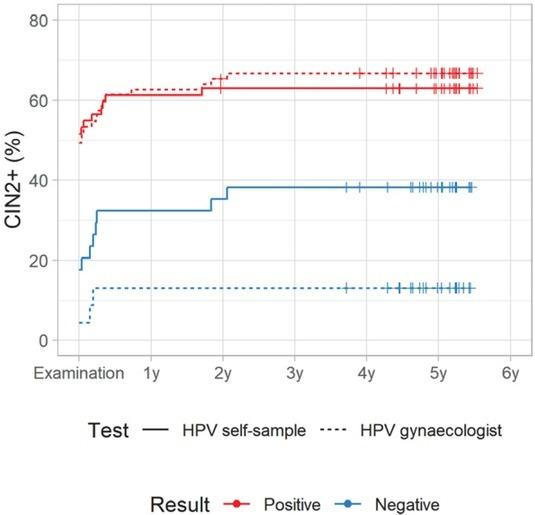
The mean age of 209 women was 37.6 years and HPV positivity rate 67.0% (140/209), 36.9 years and 70.3% (78/111) in the Qvintip group and 38.4 years and 63.3% (62/98) in the HerSwab group, respectively. Overall, percent agreement between self and clinician-taken samples was 81.8% (kappa 0.534) in the Qvintip and 77.1% (kappa 0.456) in the HerSwab group. In the Qvintip group, the longitudinal sensitivity, specificity, positive and negative predictive values were 71.8%, 75.0%, 83.6%, 60.0% for cytology; 83.1%, 51.3%, 75.6% and 62.5% for HPV test of self-taken samples and 94.4%, 57.5%, 79.8% and 85.2% for HPV test on clinician-taken samples. In the HerSwab group, the corresponding results were 71.7%, 46.7%, 61.3%, 58.3% for cytology; 75.0%, 47.7%, 62.9% and 61.8% for HPV test on self-taken samples and 94.3%, 44.4%, 66.7% and 87.0% for clinician-taken samples, respectively.
CONCLUSIONS
The results confirm that HPV self-sampling is not as accurate as clinician sampling when HC2 is used. All HPV tests showed a higher sensitivity in detecting CIN2+ compared to cytology. Due to non-inferior longitudinal sensitivity of HPV self-sampling compared to cytology, HPV self-sampling might be an option for non-attenders to the National Cancer Screening Programme.
背景
我们首次报告了斯洛文尼亚人乳头瘤病毒(HPV)自我采样在国家宫颈癌筛查计划 ZORA 阴道镜人群中的试点研究结果。报告了两种不同自我采样设备的一年和四年随访结果。
参与者和方法
共有 209 名女性在阴道镜诊所入组。在妇科检查前,所有女性均在诊所自行采集阴道拭子;111 人使用 Qvintip,98 人使用 HerSwab 自我采样设备。自我采样后,临床医生采集两份宫颈涂片;第一份用于常规细胞学检查,第二份用于 HPV 检测。之后,所有女性均行阴道镜检查,必要时行宫颈活检。我们比较了细胞学(在非典型鳞状细胞不明确意义或以上 [ASC-US+] 界限)和 HPV 检测(自我和临床医生采集的样本)在一年和四年随访时对检测宫颈上皮内瘤变 2 级或以上(CIN2+)的敏感性、特异性和预测值。所有 HPV 检测均使用杂交捕获 2(HC2)检测。
结果
209 名女性的平均年龄为 37.6 岁,HPV 阳性率为 67.0%(140/209),Qvintip 组为 36.9 岁,70.3%(78/111),HerSwab 组为 38.4 岁,63.3%(62/98)。总体而言,Qvintip 组和 HerSwab 组自我采集样本与临床采集样本之间的一致性百分比分别为 81.8%(kappa 0.534)和 77.1%(kappa 0.456)。在 Qvintip 组中,细胞学的纵向敏感性、特异性、阳性预测值和阴性预测值分别为 71.8%、75.0%、83.6%和 60.0%;自我采集样本的 HPV 检测为 83.1%、51.3%、75.6%和 62.5%;临床采集样本的 HPV 检测为 94.4%、57.5%、79.8%和 85.2%。在 HerSwab 组中,细胞学的相应结果分别为 71.7%、46.7%、61.3%和 58.3%;自我采集样本的 HPV 检测为 75.0%、47.7%、62.9%和 61.8%;临床采集样本的 HPV 检测为 94.3%、44.4%、66.7%和 87.0%。
结论
结果证实,当使用 HC2 时,HPV 自我采样不如临床采样准确。与细胞学相比,所有 HPV 检测均显示出更高的 CIN2+检测敏感性。由于 HPV 自我采样的纵向敏感性与细胞学相比非劣效,HPV 自我采样可能是国家癌症筛查计划未参与者的一种选择。


 Zotero 插件