
人类抗 SARS-CoV-2 单克隆抗体的 IgV 体细胞突变决定了中和作用和反应广度。
IgV somatic mutation of human anti-SARS-CoV-2 monoclonal antibodies governs neutralization and breadth of reactivity.
机构信息
Department of Surgery.
Department of Urology.
出版信息
JCI Insight. 2021 May 10;6(9):147386. doi: 10.1172/jci.insight.147386.
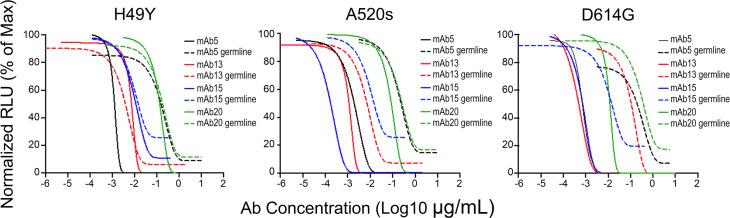
Abs that neutralize SARS-CoV-2 are thought to provide the most immediate and effective treatment for those severely afflicted by this virus. Because coronavirus potentially diversifies by mutation, broadly neutralizing Abs are especially sought. Here, we report a possibly novel approach to rapid generation of potent broadly neutralizing human anti-SARS-CoV-2 Abs. We isolated SARS-CoV-2 spike protein-specific memory B cells by panning from the blood of convalescent subjects after infection with SARS-CoV-2 and sequenced and expressed Ig genes from individual B cells as human mAbs. All of 43 human mAbs generated in this way neutralized SARS-CoV-2. Eighteen of the forty-three human mAbs exhibited half-maximal inhibitory concentrations (IC50) of 6.7 × 10⁻¹² M to 6.7 × 10⁻¹⁵ M for spike-pseudotyped virus. Seven of the human mAbs also neutralized (with IC50 < 6.7 × 10⁻¹² M) viruses pseudotyped with mutant spike proteins (including receptor-binding domain mutants and the S1 C-terminal D614G mutant). Neutralization of the Wuhan Hu-1 founder strain and of some variants decreased when coding sequences were reverted to germline, suggesting that potency of neutralization was acquired by somatic hypermutation and selection of B cells. These results indicate that infection with SARS-CoV-2 evokes high-affinity B cell responses, some products of which are broadly neutralizing and others highly strain specific. We also identify variants that would potentially resist immunity evoked by infection with the Wuhan Hu-1 founder strain or by vaccines developed with products of that strain, suggesting evolutionary courses that SARS-CoV-2 could take.
被认为能够中和 SARS-CoV-2 的 Abs 可能为那些受该病毒严重影响的人提供最直接和最有效的治疗方法。由于冠状病毒可能通过突变而多样化,因此特别需要广泛中和的 Abs。在这里,我们报告了一种可能的新方法,可以快速产生有效的广谱中和人类抗 SARS-CoV-2 Abs。我们通过从感染 SARS-CoV-2 后的恢复期患者的血液中进行筛选,分离出 SARS-CoV-2 刺突蛋白特异性记忆 B 细胞,并对来自单个 B 细胞的 Ig 基因进行测序和表达为人类 mAbs。以这种方式产生的 43 种人类 mAbs 全部中和了 SARS-CoV-2。在这 43 种人类 mAbs 中,有 18 种对刺突假型病毒的半最大抑制浓度(IC50)为 6.7×10⁻¹² M 至 6.7×10⁻¹⁵ M。其中 7 种人类 mAbs 还中和了突变刺突蛋白(包括受体结合域突变体和 S1 C 端 D614G 突变体)假型化的病毒(IC50<6.7×10⁻¹² M)。当编码序列恢复为 germline 时,对武汉 Hu-1 原型株和一些变体的中和作用降低,这表明中和效力是通过体细胞超突变和 B 细胞选择获得的。这些结果表明,SARS-CoV-2 感染会引发高亲和力的 B 细胞反应,其中一些产物是广谱中和的,而另一些则高度具有菌株特异性。我们还鉴定了可能会抵抗由武汉 Hu-1 原型株感染或由该株产品开发的疫苗引发的免疫的变体,这表明了 SARS-CoV-2 可能采取的进化方向。


 Zotero 插件