
考虑潜在疫苗效果的情况下美国的 COVID-19 疫情预测,以及对社会隔离和戴口罩的影响。
Projected COVID-19 epidemic in the United States in the context of the effectiveness of a potential vaccine and implications for social distancing and face mask use.
机构信息
China-Australia Joint Research Center for Infectious Diseases, School of Public Health, Xi'an Jiaotong University Health Science Center, Xi'an, Shaanxi, China.
School of Mathematics and Statistics, Xi'an Jiaotong University, Xi'an, Shaanxi, China.
出版信息
Vaccine. 2021 Apr 15;39(16):2295-2302. doi: 10.1016/j.vaccine.2021.02.056. Epub 2021 Feb 27.
BACKGROUND
Multiple candidates of COVID-19 vaccines have entered Phase III clinical trials in the United States (US). There is growing optimism that social distancing restrictions and face mask requirements could be eased with widespread vaccine adoption soon.
METHODS
We developed a dynamic compartmental model of COVID-19 transmission for the four most severely affected states (New York, Texas, Florida, and California). We evaluated the vaccine effectiveness and coverage required to suppress the COVID-19 epidemic in scenarios when social contact was to return to pre-pandemic levels and face mask use was reduced. Daily and cumulative COVID-19 infection and death cases from 26th January to 15th September 2020 were obtained from the Johns Hopkins University Coronavirus resource center and used for model calibration.
RESULTS
Without a vaccine (scenario 1), the spread of COVID-19 could be suppressed in these states by maintaining strict social distancing measures and face mask use levels. But relaxing social distancing restrictions to the pre-pandemic level without changing the current face mask use would lead to a new COVID-19 outbreak, resulting in 0.8-4 million infections and 15,000-240,000 deaths across these four states over the next 12 months. Under this circumstance, introducing a vaccine (scenario 2) would partially offset this negative impact even if the vaccine effectiveness and coverage are relatively low. However, if face mask use is reduced by 50% (scenario 3), a vaccine that is only 50% effective (weak vaccine) would require coverage of 55-94% to suppress the epidemic in these states. A vaccine that is 80% effective (moderate vaccine) would only require 32-57% coverage to suppress the epidemic. In contrast, if face mask usage stops completely (scenario 4), a weak vaccine would not suppress the epidemic, and further major outbreaks would occur. A moderate vaccine with coverage of 48-78% or a strong vaccine (100% effective) with coverage of 33-58% would be required to suppress the epidemic. Delaying vaccination rollout for 1-2 months would not substantially alter the epidemic trend if the current non-pharmaceutical interventions are maintained.
CONCLUSIONS
The degree to which the US population can relax social distancing restrictions and face mask use will depend greatly on the effectiveness and coverage of a potential COVID-19 vaccine if future epidemics are to be prevented. Only a highly effective vaccine will enable the US population to return to life as it was before the pandemic.
背景
多种候选的 COVID-19 疫苗已进入美国(US)的 III 期临床试验。人们越来越乐观地认为,随着广泛采用疫苗,社交距离限制和戴口罩的要求可能会放宽。
方法
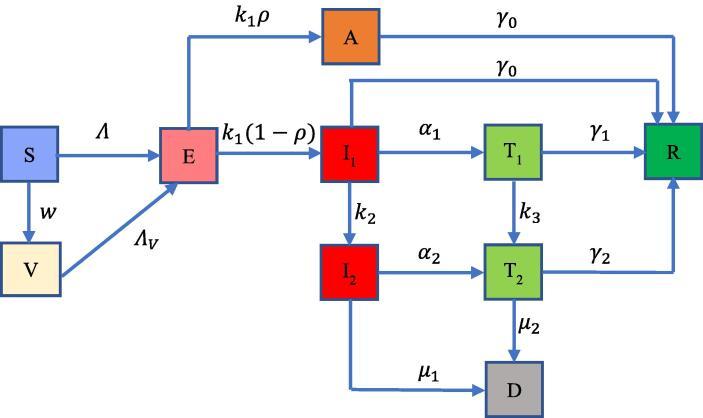
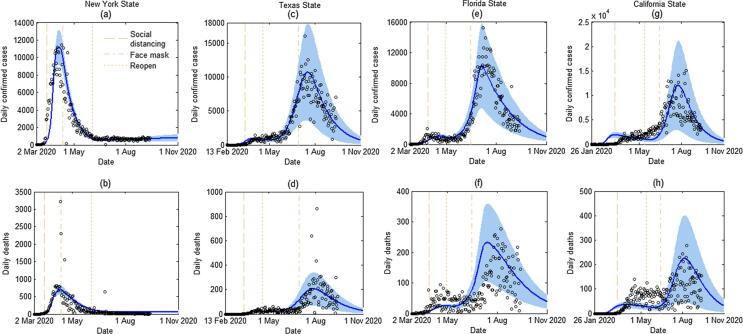
我们为受影响最严重的四个州(纽约、德克萨斯、佛罗里达和加利福尼亚)开发了一种 COVID-19 传播的动态隔室模型。我们评估了疫苗的有效性和覆盖率,以在社交接触恢复到大流行前水平和减少口罩使用的情况下抑制 COVID-19 疫情。从 2020 年 1 月 26 日至 9 月 15 日,我们从约翰·霍普金斯大学冠状病毒资源中心获得了每日和累计 COVID-19 感染和死亡病例,并用于模型校准。
结果
如果没有疫苗(方案 1),通过维持严格的社交距离措施和当前的口罩使用水平,可以抑制这些州 COVID-19 的传播。但是,如果不改变当前的口罩使用方式而将社交距离限制放宽到大流行前的水平,则会导致新的 COVID-19 爆发,在接下来的 12 个月内,这四个州将有 0.8-400 万例感染和 15000-240000 例死亡。在这种情况下,即使疫苗的有效性和覆盖率相对较低,引入疫苗(方案 2)也会部分抵消这种负面影响。但是,如果口罩的使用减少 50%(方案 3),则只有 50%有效的疫苗(弱疫苗)需要 55-94%的覆盖率才能抑制这些州的疫情。有效性为 80%(中度疫苗)的疫苗仅需要 32-57%的覆盖率即可抑制疫情。相比之下,如果完全停止使用口罩(方案 4),则弱疫苗将无法抑制疫情,并且会发生进一步的大规模爆发。如果要预防未来的疫情,需要具有中等效力(覆盖率为 48-78%)或高度效力(100%有效)的疫苗,其覆盖率为 33-58%,才能抑制疫情。如果保持当前的非药物干预措施,疫苗接种的延迟 1-2 个月不会显著改变疫情趋势。
结论
如果要预防未来的疫情,美国人口在多大程度上可以放宽社交距离限制和口罩使用将在很大程度上取决于潜在 COVID-19 疫苗的有效性和覆盖率。只有高度有效的疫苗才能使美国民众恢复大流行前的生活。


 Zotero 插件