
呼吸道住院情况与野火烟雾:对加利福尼亚州圣地亚哥县一场极端火灾风暴的时空分析
Respiratory hospitalizations and wildfire smoke: a spatiotemporal analysis of an extreme firestorm in San Diego County, California.
作者信息
Aguilera Rosana, Hansen Kristen, Gershunov Alexander, Ilango Sindana D, Sheridan Paige, Benmarhnia Tarik
机构信息
Scripps Institution of Oceanography, University of California San Diego.
Department of Family Medicine and Public Health, University of California San Diego, La Jolla; and.
出版信息
Environ Epidemiol. 2020 Oct 1;4(5):e114. doi: 10.1097/EE9.0000000000000114. eCollection 2020 Oct.
UNLABELLED
Wildfire smoke adversely impacts respiratory health as fine particles can penetrate deeply into the lungs. Epidemiological studies of differential impacts typically target population subgroups in terms of vulnerability to wildfire smoke. Such information is useful to customize smoke warnings and mitigation actions for specific groups of individuals. In addition to individual vulnerability, it is also important to assess spatial patterns of health impacts to identify vulnerable communities and tailor public health actions during wildfire smoke events.
METHODS
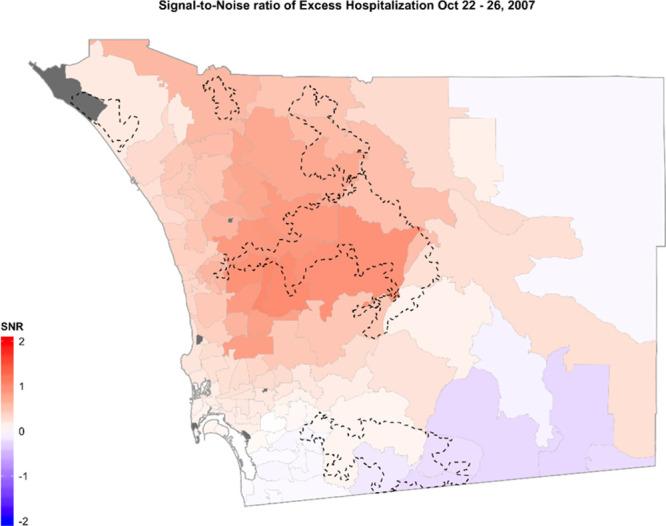
We assess the spatiotemporal variation in respiratory hospitalizations in San Diego County during a set of major wildfires in 2007, which led to a substantial public health burden. We propose a spatial within-community matched design analysis, adapted to the study of wildfire impacts, coupled with a Bayesian Hierarchical Model, that explicitly considers the spatial variation of respiratory health associated with smoke exposure, compared to reference periods before and after wildfires. We estimate the signal-to-noise ratio to ultimately gauge the precision of the Bayesian model output.
RESULTS
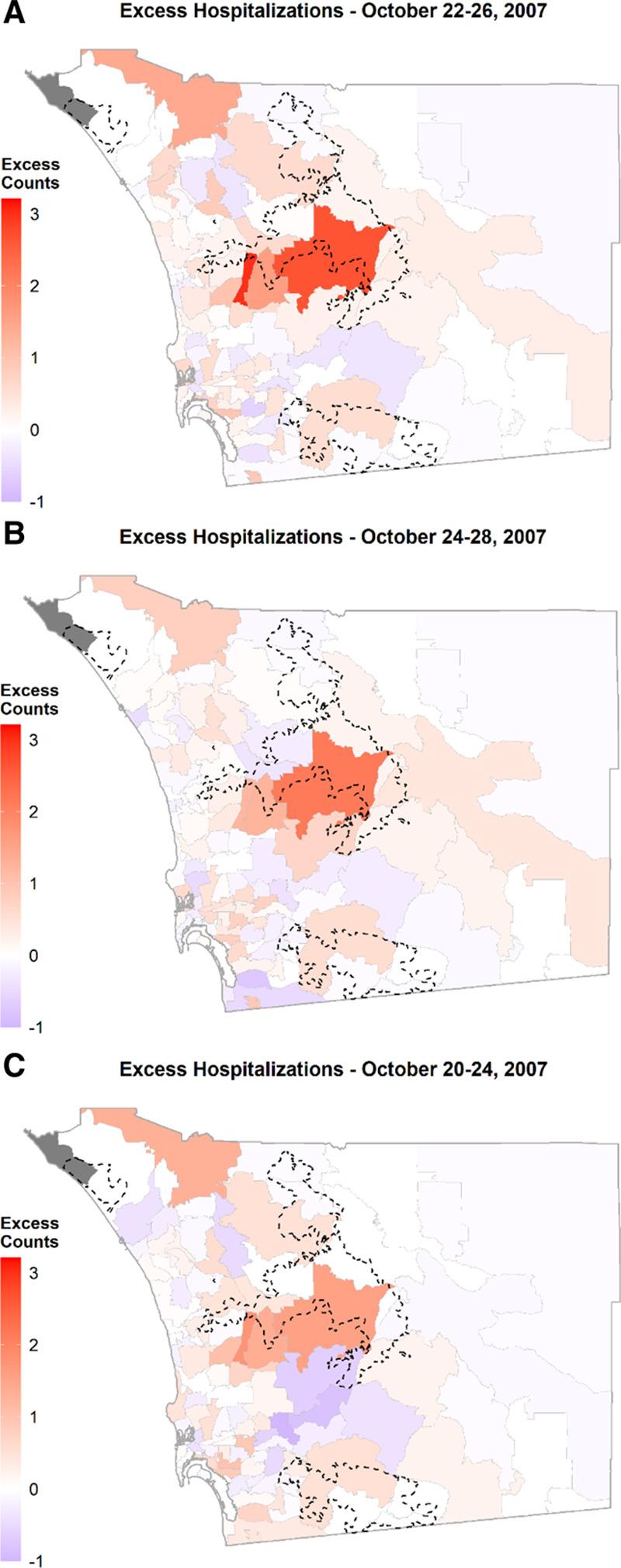
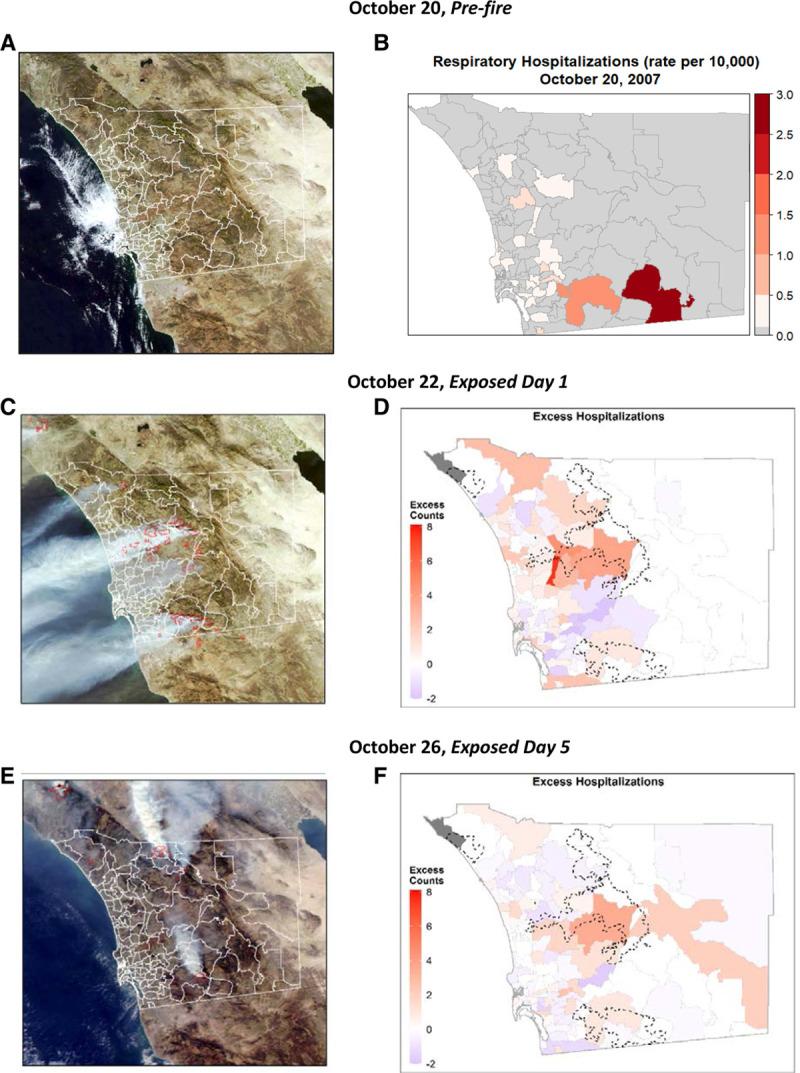
We find the highest excess hospitalizations in areas covered by smoke, mainly ZIP codes contained by and immediately downwind of wildfire perimeters, and that excess hospitalizations tend to follow the distribution of smoke plumes across space (ZIP codes) and time (days).
CONCLUSIONS
Analyzing the spatiotemporal evolution of exposure to wildfire smoke is necessary due to variations in smoke plume extent, particularly in this region where the most damaging wildfires are associated with strong wind conditions.
未标注
野火烟雾会对呼吸健康产生不利影响,因为细颗粒物可深入肺部。关于差异影响的流行病学研究通常根据易受野火烟雾影响的程度来针对人群亚组。此类信息对于为特定个体群体定制烟雾预警和缓解措施很有用。除了个体易感性外,评估健康影响的空间模式以识别脆弱社区并在野火烟雾事件期间调整公共卫生行动也很重要。
方法
我们评估了2007年圣地亚哥县一系列重大野火期间呼吸道住院的时空变化,这些野火导致了巨大的公共卫生负担。我们提出了一种适用于野火影响研究的社区内空间匹配设计分析,并结合贝叶斯分层模型,该模型明确考虑了与烟雾暴露相关的呼吸道健康的空间变化,并与野火前后的参考期进行比较。我们估计信噪比以最终衡量贝叶斯模型输出的精度。
结果
我们发现烟雾覆盖区域的住院超额率最高,主要是野火周边范围内及其下风方向紧邻的邮政编码区域,并且住院超额率往往遵循烟雾羽流在空间(邮政编码区域)和时间(天数)上的分布。
结论
由于烟雾羽流范围的变化,分析野火烟雾暴露的时空演变是必要的,特别是在该地区,最具破坏性的野火与强风条件相关。



 Zotero 插件