
评估城市内部空气污染健康风险的分布:利用加利福尼亚州湾区高分辨率数据集进行的邻里尺度分析
Assessing the Distribution of Air Pollution Health Risks within Cities: A Neighborhood-Scale Analysis Leveraging High-Resolution Data Sets in the Bay Area, California.
作者信息
Southerland Veronica A, Anenberg Susan C, Harris Maria, Apte Joshua, Hystad Perry, van Donkelaar Aaron, Martin Randall V, Beyers Matt, Roy Ananya
机构信息
Milken Institute School of Public Health, George Washington University, Washington, District of Columbia, USA.
Environmental Defense Fund, San Francisco, California, USA.
出版信息
Environ Health Perspect. 2021 Mar;129(3):37006. doi: 10.1289/EHP7679. Epub 2021 Mar 31.
BACKGROUND
Air pollution-attributable disease burdens reported at global, country, state, or county levels mask potential smaller-scale geographic heterogeneity driven by variation in pollution levels and disease rates. Capturing within-city variation in air pollution health impacts is now possible with high-resolution pollutant concentrations.
OBJECTIVES
We quantified neighborhood-level variation in air pollution health risks, comparing results from highly spatially resolved pollutant and disease rate data sets available for the Bay Area, California.
METHODS
We estimated mortality and morbidity attributable to nitrogen dioxide (), black carbon (BC), and fine particulate matter [PM in aerodynamic diameter ()] using epidemiologically derived health impact functions. We compared geographic distributions of pollution-attributable risk estimates using concentrations from ) mobile monitoring of and BC; and ) models predicting annual , BC and concentrations from land-use variables and satellite observations. We also compared results using county vs. census block group (CBG) disease rates.
RESULTS
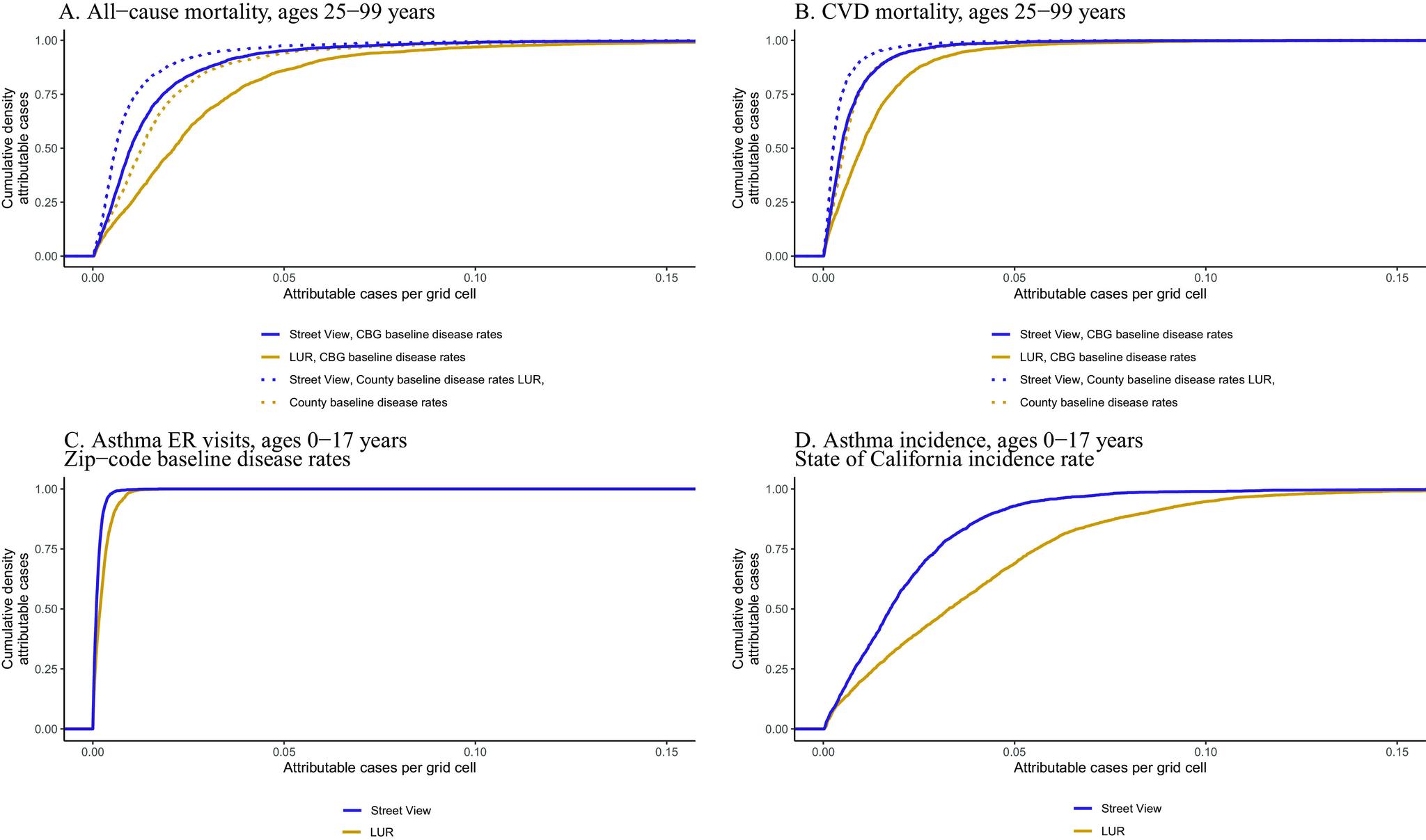
Estimated pollution-attributable deaths per 100,000 people at the grid-cell level ranged across the Bay Area by a factor of 38, 4, and 5 for [ (95% CI: 9, 50)], BC [ (95% CI: 1, 2)], and , [ (95% CI: 33, 64)]. Applying concentrations from mobile monitoring and land-use regression (LUR) models in Oakland neighborhoods yielded similar spatial patterns of estimated grid-cell-level mortality rates. Mobile monitoring concentrations captured more heterogeneity [mobile monitoring (95% CI: 19, 107) deaths per 100,000 people; (95% CI: 30, 167)]. Using CBG-level disease rates instead of county-level disease rates resulted in 15% larger attributable mortality rates for both and , with more spatial heterogeneity at the grid-cell-level [ CBG deaths per 100,000 people (95% CI: 12, 68); (95% CI: 11, 64); (95% CI: 40, 77); and (95% CI: 37, 71)].
DISCUSSION
Air pollutant-attributable health burdens varied substantially between neighborhoods, driven by spatial variation in pollutant concentrations and disease rates. https://doi.org/10.1289/EHP7679.
背景
在全球、国家、州或县层面报告的空气污染所致疾病负担掩盖了由污染水平和疾病发生率差异驱动的潜在更小尺度的地理异质性。借助高分辨率污染物浓度,现在能够捕捉城市内部空气污染对健康影响的差异。
目标
我们量化了邻里层面空气污染健康风险的差异,比较了加利福尼亚州湾区可获取的高空间分辨率污染物和疾病发生率数据集的结果。
方法
我们使用流行病学推导的健康影响函数估算了二氧化氮()、黑碳(BC)和细颗粒物[空气动力学直径()中的PM ]所致的死亡率和发病率。我们使用来自) 和BC的移动监测浓度;以及)根据土地利用变量和卫星观测预测年度 、BC和 浓度的模型,比较了污染所致风险估计值的地理分布。我们还使用县疾病发生率与人口普查街区组(CBG)疾病发生率比较了结果。
结果
在湾区,每10万人中估计的由污染所致的死亡人数在网格单元层面上,对于 [ (95%可信区间:9,50)]、BC [ (95%可信区间:1,2)]和 ,[ (95%可信区间:33,64)]分别相差38倍、4倍和5倍。在奥克兰邻里应用移动监测和土地利用回归(LUR)模型的浓度得出了类似的估计网格单元层面 死亡率的空间模式。移动监测浓度捕捉到了更多异质性[每10万人中移动监测 (95%可信区间:19,107)例死亡; (95%可信区间:30,167)]。使用CBG层面的疾病发生率而非县层面的疾病发生率,导致 和 的归因死亡率分别高出15%,在网格单元层面有更多空间异质性[每10万人中CBG 死亡(95%可信区间:12,68); (95%可信区间:11,64); (95%可信区间:40,77);以及 (95%可信区间:37,71)]。
讨论
受污染物浓度和疾病发生率空间差异的驱动,邻里之间空气污染所致的健康负担差异很大。https://doi.org/10.1289/EHP7679


 Zotero 插件