
局限期小细胞肺癌患者同步放化疗的疗效:一项回顾性、全国性、基于人群的队列研究。
Efficacy of concurrent chemoradiotherapy for patients with limited-disease small-cell lung cancer: a retrospective, nationwide, population-based cohort study.
机构信息
Division of Oncology, Department of Internal Medicine, College of Medicine, The Catholic University of Korea, 222, Banpo-daero, Seocho-gu, Seoul, 06591, Republic of Korea.
Department of Radiation Oncology, College of Medicine, The Catholic University of Korea, Seoul, Republic of Korea.
出版信息
BMC Cancer. 2021 Mar 31;21(1):340. doi: 10.1186/s12885-021-08082-2.
BACKGROUND
Small-cell lung cancer (SCLC) is a highly proliferative, rapidly growing tumor with a poor prognosis, even in cases of limited disease (LD). Timely and accurate high-intensity therapy is necessary. For concurrent chemoradiotherapy (CCRT), etoposide/platinum (EP)-based regimens are recommended, although irinotecan/platinum (IP)-based regimens are also effective with radiotherapy. This large-scale, retrospective, nationwide cohort study aimed to analyze the efficacy of CCRT in patients with LD-SCLC.
METHODS
Population data registered between January 2008 and December 2018 was extracted from the Health Insurance Review and Assessment Service of Korea database. Survival outcomes of 4446 LD-SCLC patients who received CCRT were analyzed.
RESULTS
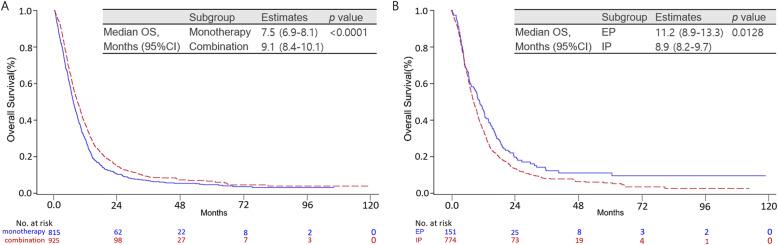
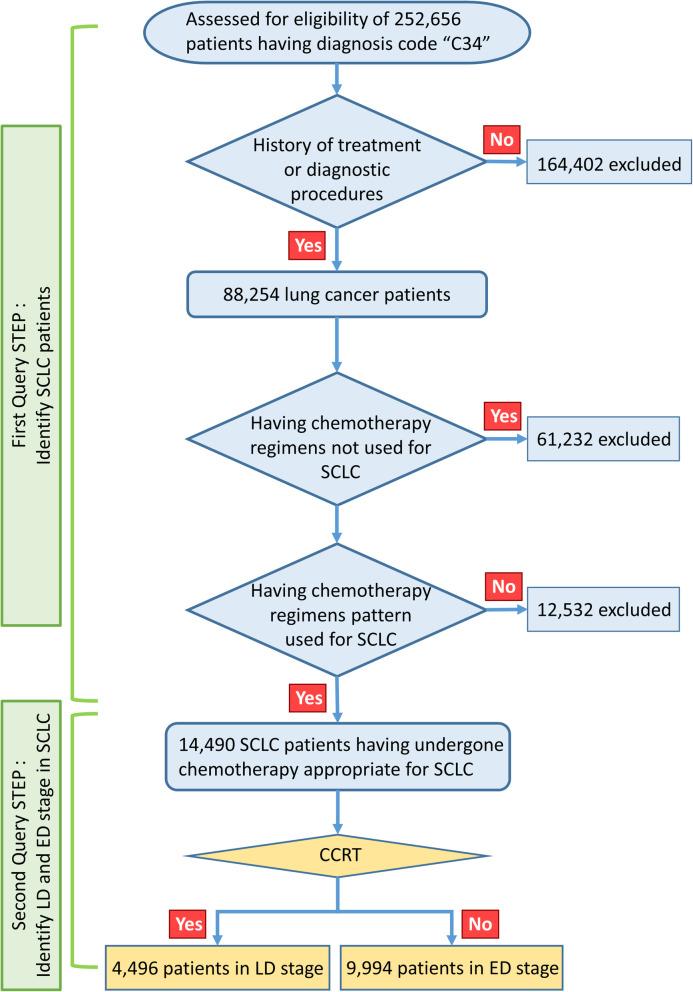
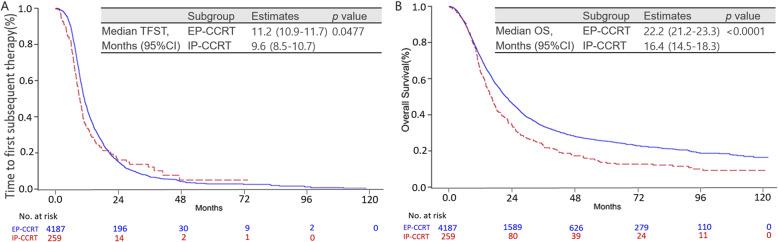
Patients who received EP-CCRT (n = 4187) showed better time to first subsequent therapy (TFST: 11.2 months) and overall survival (OS: 22.2 months) than those who received IP-CCRT (n = 259; TFST: 9.6 months, P = 0.0477; OS: 16.4 months, P < 0.0001). When CCRT failed, dual-agent chemotherapy (n = 925; OS: 9.1 months) provided a better survival benefit than single-agent chemotherapy (n = 815; OS: 7.5 months). IP-based chemotherapy resulted in better OS (9.6 months) than EP-based chemotherapy (7.1 months, P = 0.017) in platinum-resistant relapsed patients; the opposite was observed for platinum-sensitive relapsed patients (OS: EP, 17.2 months; IP, 6.6 months; P < 0.0001). Poisson regression analysis demonstrated that age, EP-CCRT, and hypercholesterolemia retained significant associations with OS after adjustment for all variables.
CONCLUSION
In the Korean population, the effects of EP-CCRT on OS and TFST are significantly more favorable than those of IP-CCRT.
背景
小细胞肺癌(SCLC)是一种高度增殖、快速生长的肿瘤,预后较差,即使是局限期(LD)病例也是如此。及时、准确的高强度治疗是必要的。对于同步放化疗(CCRT),推荐依托泊苷/铂类(EP)为基础的方案,尽管伊立替康/铂类(IP)为基础的方案与放疗联合也同样有效。本大规模、回顾性、全国性队列研究旨在分析 LD-SCLC 患者接受 CCRT 的疗效。
方法
从韩国健康保险审查与评估服务数据库中提取 2008 年 1 月至 2018 年 12 月期间登记的人群数据。分析了 4446 例接受 CCRT 的 LD-SCLC 患者的生存结局。
结果
接受 EP-CCRT(n=4187)的患者的首次后续治疗时间(TFST:11.2 个月)和总生存(OS:22.2 个月)均优于接受 IP-CCRT(n=259;TFST:9.6 个月,P=0.0477;OS:16.4 个月,P<0.0001)。当 CCRT 失败时,双药化疗(n=925;OS:9.1 个月)比单药化疗(n=815;OS:7.5 个月)提供了更好的生存获益。在铂类耐药复发患者中,IP 为基础的化疗(OS:9.6 个月)比 EP 为基础的化疗(7.1 个月,P=0.017)的 OS 更好;而在铂类敏感复发患者中则相反(OS:EP,17.2 个月;IP,6.6 个月;P<0.0001)。泊松回归分析表明,在调整所有变量后,年龄、EP-CCRT 和高胆固醇血症与 OS 仍有显著关联。
结论
在韩国人群中,EP-CCRT 对 OS 和 TFST 的影响明显优于 IP-CCRT。
 Zotero 插件