
当代多发性硬化症患者中疲劳的高患病率。
High prevalence of fatigue in contemporary patients with multiple sclerosis.
作者信息
Broch Line, Simonsen Cecilia Smith, Flemmen Heidi Øyen, Berg-Hansen Pål, Skardhamar Åshild, Ormstad Heidi, Celius Elisabeth Gulowsen
机构信息
Department of Neurology, Vestre Viken Hospital Trust, Drammen, Norway.
Department of Neurology, Oslo University Hospital, Oslo, Norway.
出版信息
Mult Scler J Exp Transl Clin. 2021 Mar 18;7(1):2055217321999826. doi: 10.1177/2055217321999826. eCollection 2021 Jan-Mar.
OBJECTIVE
The prevalence of multiple sclerosis (MS)-related fatigue may have changed due to new diagnostic criteria and new disease modifying drugs. We aimed to assess the prevalence of fatigue in a contemporary MS cohort, and to explore associations between fatigue and clinical and demographic factors.
METHODS
This is a cross-sectional study of the MS population in three Norwegian counties. Fatigue was assessed with the Fatigue Scale for Motor and Cognitive Functions (FSMC). We also assessed self-reported anxiety, depression and daytime sleepiness.
RESULTS
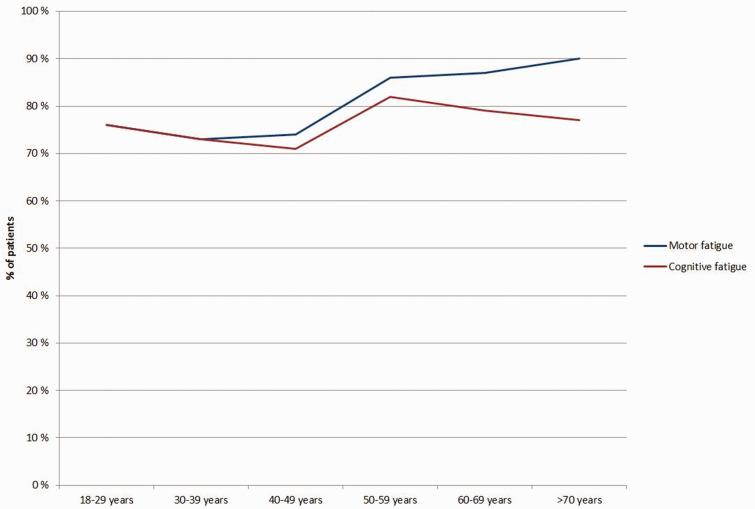
The response rate was 64% (1599/2512). The mean age of the participants was 52 ± 13 years, median EDSS was 2.5 (IQR 1.5-3.0) and median disease duration from onset was 16 years (IQR 8-25). We found a prevalence of fatigue of 81%. Women had a higher prevalence of fatigue than men (83% vs 78%, p = 0.02). The prevalence increased with age (p < 0.001) and with increasing disease severity (p < 0.001), but in multivariate analyses, only sex and disease severity remained independent determinants of fatigue. Anxiety, depression, and daytime sleepiness were more prevalent in patients with fatigue than in those without fatigue (all p-values < 0.001).
CONCLUSION
The prevalence of fatigue is high in contemporary patients with MS. Fatigue is associated with female sex and level of disability, as well as with anxiety, depression and excessive daytime sleepiness.
目的
由于新的诊断标准和新型疾病修正药物的出现,多发性硬化症(MS)相关疲劳的患病率可能已发生变化。我们旨在评估当代MS队列中疲劳的患病率,并探讨疲劳与临床及人口统计学因素之间的关联。
方法
这是一项对挪威三个郡的MS人群进行的横断面研究。使用运动和认知功能疲劳量表(FSMC)评估疲劳情况。我们还评估了自我报告的焦虑、抑郁和日间嗜睡情况。
结果
应答率为64%(1599/2512)。参与者的平均年龄为52±13岁,扩展残疾状态量表(EDSS)中位数为2.5(四分位间距1.5 - 3.0),发病后的疾病持续时间中位数为16年(四分位间距8 - 25)。我们发现疲劳的患病率为81%。女性疲劳的患病率高于男性(83%对78%,p = 0.02)。患病率随年龄增加(p < 0.001)以及疾病严重程度增加(p < 0.001)而升高,但在多变量分析中,只有性别和疾病严重程度仍然是疲劳的独立决定因素。与无疲劳的患者相比,焦虑、抑郁和日间嗜睡在有疲劳的患者中更为普遍(所有p值 < 0.001)。
结论
当代MS患者中疲劳的患病率很高。疲劳与女性性别、残疾程度以及焦虑、抑郁和日间过度嗜睡有关。




 Zotero 插件