
肾周脂肪组织——当前认知与未来机遇
Perirenal Adipose Tissue-Current Knowledge and Future Opportunities.
作者信息
Grigoraș Adriana, Balan Raluca Anca, Căruntu Irina-Draga, Giușcă Simona Eliza, Lozneanu Ludmila, Avadanei Roxana Elena, Rusu Andreea, Riscanu Laura Adriana, Amalinei Cornelia
机构信息
Department of Morphofunctional Sciences I, "Grigore T. Popa" University of Medicine and Pharmacy Iasi, 700115 Iasi, Romania.
出版信息
J Clin Med. 2021 Mar 21;10(6):1291. doi: 10.3390/jcm10061291.
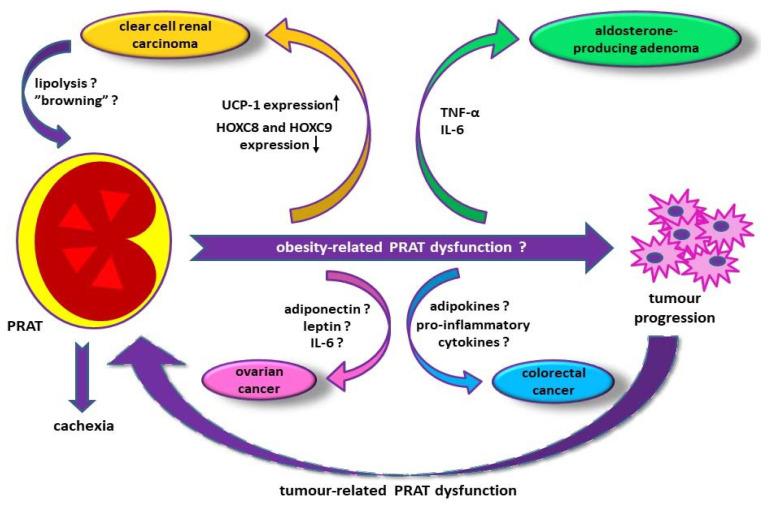
The perirenal adipose tissue (PRAT), a component of visceral adipose tissue, has been recently recognized as an important factor that contributes to the maintenance of the cardiovascular system and kidney homeostasis. PRAT is a complex microenvironment consisting of a mixture of white adipocytes and dormant and active brown adipocytes, associated with predipocytes, sympathetic nerve endings, vascular structures, and different types of inflammatory cells. In this review, we summarize the current knowledge about PRAT and discuss its role as a major contributing factor in the pathogenesis of hypertension, obesity, chronic renal diseases, and involvement in tumor progression. The new perspectives of PRAT as an endocrine organ and recent knowledge regarding the possible activation of dormant brown adipocytes are nowadays considered as new areas of research in obesity, in close correlation with renal and cardiovascular pathology. Supplementary PRAT complex intervention in tumor progression may reveal new pathways involved in carcinogenesis and, implicitly, may identify additional targets for tailored cancer therapy.
肾周脂肪组织(PRAT)是内脏脂肪组织的一个组成部分,最近已被公认为是有助于维持心血管系统和肾脏内环境稳定的一个重要因素。PRAT是一个复杂的微环境,由白色脂肪细胞以及休眠和活跃的棕色脂肪细胞混合而成,与前脂肪细胞、交感神经末梢、血管结构和不同类型的炎症细胞相关。在这篇综述中,我们总结了关于PRAT的当前知识,并讨论了其作为高血压、肥胖、慢性肾脏疾病发病机制中的一个主要促成因素的作用,以及其在肿瘤进展中的参与情况。PRAT作为一个内分泌器官的新观点以及关于休眠棕色脂肪细胞可能激活的最新知识,如今被视为肥胖研究的新领域,与肾脏和心血管病理学密切相关。对肿瘤进展进行补充性PRAT复合干预可能会揭示致癌过程中涉及的新途径,并且含蓄地说,可能会确定定制癌症治疗的其他靶点。

 Zotero 插件