
肠道菌群失调在 1 型糖尿病及其相关并发症发病机制中的作用:从发病机制到靶向肠道微生物调控治疗。
Dysbiosis in the Development of Type I Diabetes and Associated Complications: From Mechanisms to Targeted Gut Microbes Manipulation Therapies.
机构信息
Research Institute of University of Bucharest (ICUB), 300645 Bucharest, Romania.
Bacteriology Branch, Veterinary Sciences Division, Agri-Food and Biosciences Institute, Belfast BT9 5PX, UK.
出版信息
Int J Mol Sci. 2021 Mar 9;22(5):2763. doi: 10.3390/ijms22052763.
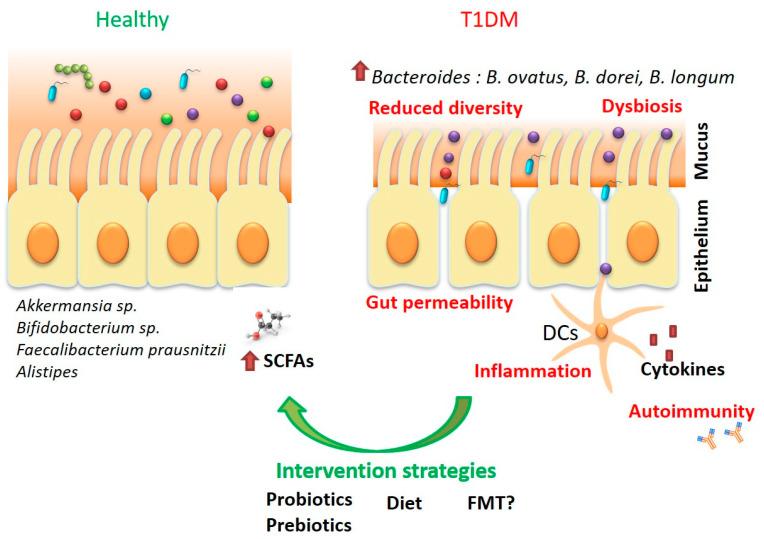
Globally, we are facing a worrying increase in type 1 diabetes mellitus (T1DM) incidence, with onset at younger age shedding light on the need to better understand the mechanisms of disease and step-up prevention. Given its implication in immune system development and regulation of metabolism, there is no surprise that the gut microbiota is a possible culprit behind T1DM pathogenesis. Additionally, microbiota manipulation by probiotics, prebiotics, dietary factors and microbiota transplantation can all modulate early host-microbiota interactions by enabling beneficial microbes with protective potential for individuals with T1DM or at high risk of developing T1DM. In this review, we discuss the challenges and perspectives of translating microbiome data into clinical practice. Nevertheless, this progress will only be possible if we focus our interest on developing numerous longitudinal, multicenter, interventional and double-blind randomized clinical trials to confirm their efficacy and safety of these therapeutic approaches.
全球范围内,1 型糖尿病(T1DM)的发病率呈令人担忧的上升趋势,发病年龄更小,这表明我们需要更好地了解疾病的发病机制,并加强预防。由于其在免疫系统发育和代谢调节中的作用,肠道微生物群是 T1DM 发病机制背后的一个可能的罪魁祸首,这并不奇怪。此外,益生菌、益生元、饮食因素和微生物群移植等微生物群操作可以通过使具有保护潜力的有益微生物与 T1DM 患者或有发展为 T1DM 高风险的个体进行早期的宿主-微生物群相互作用,从而调节其作用。在这篇综述中,我们讨论了将微生物组数据转化为临床实践所面临的挑战和前景。然而,如果我们专注于开发大量的纵向、多中心、干预性和双盲随机临床试验,以确认这些治疗方法的疗效和安全性,那么这一进展才有可能实现。

 Zotero 插件