
非透析 CKD 患者高钾血症的当前管理:接受稳定肾脏护理的患者的纵向研究。
Current Management of Hyperkalemia in Non-Dialysis CKD: Longitudinal Study of Patients Receiving Stable Nephrology Care.
机构信息
Nephrology Unit, University of Campania "Luigi Vanvitelli", 80138 Naples, Italy.
Medical Statistics Unit, University of Campania "Luigi Vanvitelli", 80138 Naples, Italy.
出版信息
Nutrients. 2021 Mar 15;13(3):942. doi: 10.3390/nu13030942.
BACKGROUND
No study has explored the limitations of current long-term management of hyperkalemia (HK) in outpatient CKD clinics.
METHODS
We evaluated the association between current therapeutic options and control of serum K (sK) during 12-month follow up in ND-CKD patients stratified in four groups by HK (sK ≥ 5.0 mEq/L) at baseline and month 12: Absent (no-no), Resolving (yes-no), New Onset (no-yes), Persistent (yes-yes).
RESULTS
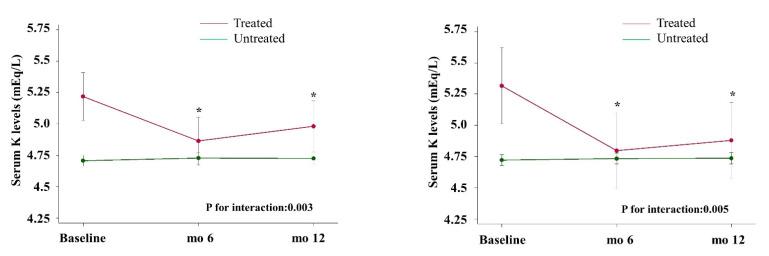
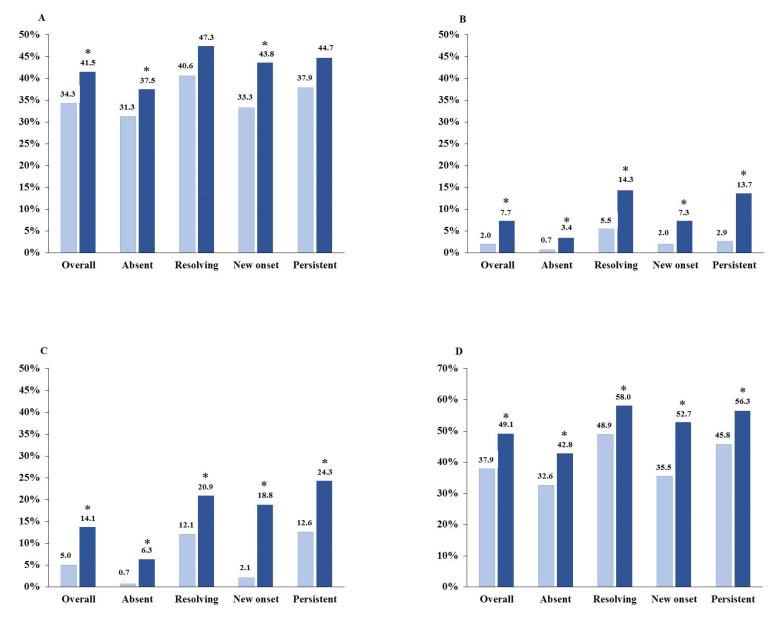
We studied 562 patients (age 66.2 ± 14.5 y; 61% males; eGFR 39.8 ± 21.8 mL/min/1.73 m, RAASI 76.2%). HK was "absent" in 50.7%, "resolving" in 15.6%, "new onset" in 16.6%, and "persistent" in 17.1%. Twenty-four hour urinary measurements testified adherence to nutritional recommendations in the four groups at either visit. We detected increased prescription from baseline to month 12 of bicarbonate supplements (from 5.0 to 14.1%, < 0.0001), K-binders (from 2.0 to 7.7%, < 0.0001), and non-K sparing diuretics (from 34.3 to 41.5%, < 0.001); these changes were consistent across groups. Similar results were obtained when using higher sK level (≥5.5 mEq/L) to stratify patients. Mixed-effects regression analysis showed that higher sK over time was associated with eGFR < 60, diabetes, lower serum bicarbonate, lower use of non-K sparing diuretics, bicarbonate supplementation, and K-binder use. Treatment-by-time interaction showed that sK decreased in HK patients given bicarbonate ( = 0.003) and K-binders ( = 0.005).
CONCLUSIONS
This observational study discloses that one-third of ND-CKD patients under nephrology care remain with or develop HK during a 12-month period despite low K intake and increased use of sK-lowering drugs.
背景
目前尚没有研究探讨门诊慢性肾脏病(CKD)诊所中高钾血症(HK)长期管理的局限性。
方法
我们根据基线和第 12 个月时的血清钾(sK)水平,将 HK(sK≥5.0 mEq/L)的 ND-CKD 患者分为 4 组:无(无-无)、缓解(有-无)、新发(无-有)和持续(有-有),评估了在 12 个月的随访过程中,当前治疗方案与 sK 控制之间的关系。
结果
共纳入 562 例患者(年龄 66.2±14.5 岁,61%为男性,估算肾小球滤过率 39.8±21.8 mL/min/1.73 m2,肾素-血管紧张素-醛固酮系统抑制剂使用率 76.2%)。HK 为“无”的患者占 50.7%,“缓解”的占 15.6%,“新发”的占 16.6%,“持续”的占 17.1%。在两次就诊时,24 小时尿测量均证实了各组对营养建议的依从性。从基线到第 12 个月,我们发现碳酸氢盐补充剂(从 5.0%增加到 14.1%,<0.0001)、钾结合剂(从 2.0%增加到 7.7%,<0.0001)和非保钾利尿剂(从 34.3%增加到 41.5%,<0.001)的处方比例增加,这些变化在各组中是一致的。当使用更高的 sK 水平(≥5.5 mEq/L)对患者进行分层时,也得到了类似的结果。混合效应回归分析显示,随着时间的推移,sK 升高与 eGFR<60、糖尿病、血清碳酸氢盐降低、非保钾利尿剂使用减少、碳酸氢盐补充和钾结合剂使用相关。治疗与时间的交互作用表明,给予碳酸氢盐(=0.003)和钾结合剂(=0.005)的 HK 患者 sK 下降。
结论
本观察性研究表明,尽管低钾摄入和使用更多的 sK 降低药物,但在 12 个月期间,仍有三分之一的接受肾病学治疗的 ND-CKD 患者存在或新发 HK。

 Zotero 插件