
中国武汉育龄女性中与新冠肺炎相关的卵巢损伤分析:一项观察性研究
Analysis of Ovarian Injury Associated With COVID-19 Disease in Reproductive-Aged Women in Wuhan, China: An Observational Study.
作者信息
Ding Ting, Wang Tian, Zhang Jinjin, Cui Pengfei, Chen Zhe, Zhou Su, Yuan Suzhen, Ma Wenqing, Zhang Minli, Rong Yueguang, Chang Jiang, Miao Xiaoping, Ma Xiangyi, Wang Shixuan
机构信息
Department of Obstetrics and Gynecology, National Clinical Research Center for Obstetrical and Gynecological Diseases, Tongji Medical College, Tongji Hospital, Huazhong University of Science and Technology, Wuhan, China.
Department of Pathogen Biology, School of Basic Medicine, Huazhong University of Science and Technology, Wuhan, China.
出版信息
Front Med (Lausanne). 2021 Mar 19;8:635255. doi: 10.3389/fmed.2021.635255. eCollection 2021.
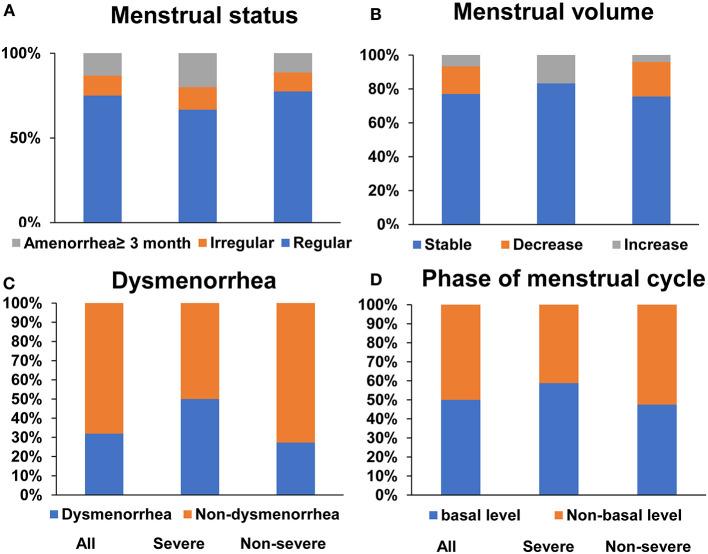
This study was intended to investigate the relationship between COVID-19 disease and ovarian function in reproductive-aged women. Female COVID-19 patients of reproductive age were recruited between January 28 and March 8, 2020 from Tongji Hospital in Wuhan. Their baseline and clinical characteristics, as well as menstrual conditions, were recorded. Differentials in ovarian reserve markers and sex hormones (including anti-Müllerian hormone [AMH], follicle-stimulating hormone [FSH], the ratio of FSH to luteinizing hormone [LH], estradiol [E2], progesterone [P], testosterone [T], and prolactin [PRL] were compared to those of healthy women who were randomly selected and individually matched for age, region, and menstrual status. Uni- and multi-variable hierarchical linear regression analyses were performed to identify risk factors associated with ovarian function in COVID-19 women. Seventy eight patients agreed to be tested for serum hormone, of whom 17 (21.79%) were diagnosed as the severe group and 39 (50%) were in the basal level group. Menstrual status ( = 0.55), menstrual volumes ( = 0.066), phase of menstrual cycle ( = 0.58), and dysmenorrhea history ( = 0.12) were similar without significant differences between non-severe and severe COVID-19 women. Significant lower serum AMH level/proportion (0.19/0.28 vs. 1.12 ng/ml, = 0.003/0.027; AMH ≤ 1.1 ng/ml: 75/70.4 vs. 49.7%, = 0.009/0.004), higher serum T (0.38/0.39 vs. 0.22 ng/ml, < 0.001/0.001) and PRL (25.43/24.10 vs. 12.12 ng/ml, < 0.001/0.001) levels were observed in basal level and the all-COVID-19 group compared with healthy age-matched control. When adjusted for age, menstrual status and parity variations in multivariate hierarchical linear regression analysis, COVID-19 disease was significantly associated with serum AMH (β = -0.191; 95% CI: -1.177-0.327; = 0.001), T (β = 0.411; 95% CI: 11.154-22.709; < 0.001), and PRL (β = 0.497; 95% CI: 10.787-20.266; < 0.001), suggesting an independent risk factor for ovarian function, which accounted for 3.2% of the decline in AMH, 14.3% of the increase in T, and 20.7% of the increase in PRL. Ovarian injury, including declined ovarian reserve and reproductive endocrine disorder, can be observed in women with COVID-19. More attention should be paid to their ovarian function under this pandemic, especially regarding reproductive-aged women. ChiCTR2000030015.
本研究旨在调查新冠病毒病与育龄期女性卵巢功能之间的关系。2020年1月28日至3月8日期间,从武汉同济医院招募了育龄期女性新冠病毒病患者。记录她们的基线和临床特征以及月经情况。将卵巢储备标志物和性激素(包括抗苗勒管激素[AMH]、促卵泡生成素[FSH]、FSH与促黄体生成素[LH]的比值、雌二醇[E2]、孕酮[P]、睾酮[T]和催乳素[PRL])的差异与随机选择的、在年龄、地区和月经状况方面进行个体匹配的健康女性进行比较。进行单变量和多变量分层线性回归分析,以确定与新冠病毒病女性卵巢功能相关的危险因素。78名患者同意进行血清激素检测,其中17名(21.79%)被诊断为重症组,39名(50%)为基础水平组。非重症和重症新冠病毒病女性的月经状况(P = 0.55)、月经量(P = 0.066)、月经周期阶段(P = 0.58)和痛经史(P = 0.12)相似,无显著差异。与年龄匹配的健康对照组相比,基础水平组和所有新冠病毒病组的血清AMH水平/比例显著降低(0.19/0.28 vs. 1.12 ng/ml,P = 0.003/0.027;AMH≤1.1 ng/ml:75/70.4 vs. 49.7%,P = 0.009/0.004),血清T(0.38/0.39 vs. 0.22 ng/ml,P < 0.001/0.001)和PRL(25.43/24.10 vs. 12.12 ng/ml,P < 0.001/0.001)水平升高。在多变量分层线性回归分析中,调整年龄、月经状况和产次差异后,新冠病毒病与血清AMH(β = -0.191;95%CI:-1.177 - 0.327;P = 0.001)、T(β = 0.411;95%CI:11.154 - 22.709;P < 0.001)和PRL(β = 0.497;95%CI:10.787 - 20.266;P < 0.001)显著相关,表明是卵巢功能的独立危险因素,其分别占AMH下降的3.2%、T升高的14.3%和PRL升高的20.7%。在新冠病毒病女性中可观察到卵巢损伤,包括卵巢储备下降和生殖内分泌紊乱。在这场大流行期间,应更加关注她们的卵巢功能,尤其是育龄期女性。ChiCTR2000030015。


 Zotero 插件