
[晚期非小细胞肺癌且PD-L1高表达患者对免疫检查点抑制剂单药治疗或联合化疗反应的评估]
[Evaluation of Response to Immune Checkpoint Inhibitor Monotherapy or Combination with Chemotherapy for Patients with Advanced Non-small Cell Lung Cancer and High PD-L1 Expression].
作者信息
Li Haoyang, Qin Na, Yu Mengjun, Ma Li, Wu Yuhua, Zhang Hui, Zhang Xinyong, Li Xi, Wang Jinghui
机构信息
Department of Medical Oncology, Beijing Tuberculosis and Thoracic Tumor Research Institute, Beijing Chest Hospital, Capital Medical University, Beijing 101149, China.
Cancer Research Center, Beijing Tuberculosis and Thoracic Tumor Research Institute, Beijing Chest Hospital, Capital Medical University, Beijing 101149, China.
出版信息
Zhongguo Fei Ai Za Zhi. 2021 Mar 20;24(3):161-166. doi: 10.3779/j.issn.1009-3419.2021.103.02.
BACKGROUND
Immunotherapy represented by immune checkpoint inhibitors (ICIs) has been widely used in the treatment of lung cancer. There are controversies in clinical practice for patients with advanced non-small cell lung cancer (NSCLC) and high programmed cell death-ligand 1 (PD-L1) expression receiving ICIs monotherapy or combination chemotherapy.
METHODS
This study retrospectively analyzed the clinical data of 49 patients with advanced NSCLC and high PD-L1 expression. Immunohistochemistry was performed with 22C3 antibody, and the expression level of PD-L1 was evaluated according to tumor proportion score (TPS). Objective response rate (ORR) and progression free survival (PFS) were compared by groups of different clinical characteristics.
RESULTS
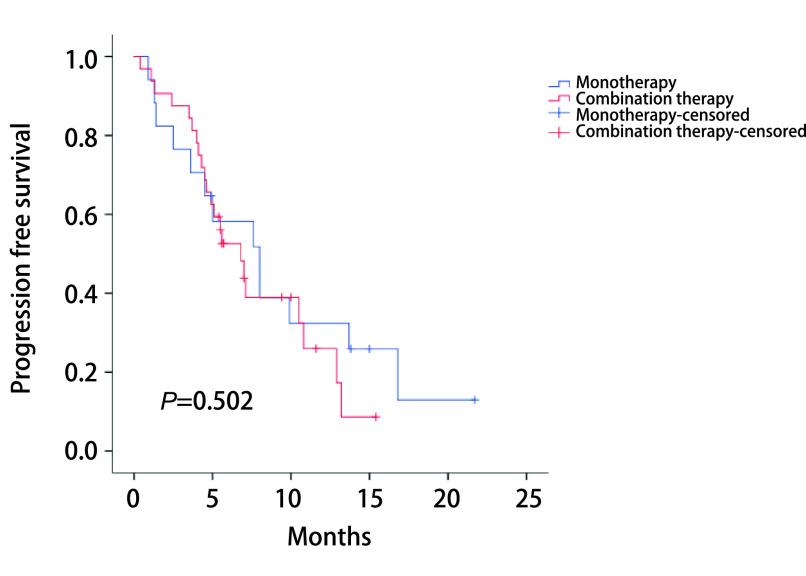
ORR of monotherapy and combination therapy group was 47.1% (8/17) and 43.8% (14/32), respectively, without statistical difference (P=0.825). The median PFS of monotherapy and combination therapy group was 8.0 months and 6.8 months, respectively, without statistical difference (P=0.502). Statistical analysis of predictors of immunotherapy for the patients showed first-line immunotherapy had better ORR than subsequent immunotherapy (12/19, 63.2% vs 10/30, 33.3%, P=0.041), however no difference in PFS. And there were no differences in ORR or PFS among groups of age, gender, smoking status, performance status (PS), pathological type, tumor size and tumor-node-metastasis (TNM) stage.
CONCLUSIONS
The therapeutic effect is similar between ICIs monotherapy and combination chemotherapy for patients with advanced NSCLC and high PD-L1 expression. ORR of first-line immunotherapy was better in patients with advanced NSCLC and high PD-L1 expression. The optimal treatment for this population remains further prospective clinical studies.
背景
以免疫检查点抑制剂(ICIs)为代表的免疫疗法已广泛应用于肺癌治疗。对于晚期非小细胞肺癌(NSCLC)且程序性细胞死亡配体1(PD-L1)高表达的患者,在临床实践中接受ICIs单药治疗或联合化疗存在争议。
方法
本研究回顾性分析了49例晚期NSCLC且PD-L1高表达患者的临床资料。采用22C3抗体进行免疫组化,根据肿瘤比例评分(TPS)评估PD-L1表达水平。比较不同临床特征组的客观缓解率(ORR)和无进展生存期(PFS)。
结果
单药治疗组和联合治疗组的ORR分别为47.1%(8/17)和43.8%(14/32),无统计学差异(P=0.825)。单药治疗组和联合治疗组的中位PFS分别为8.0个月和6.8个月,无统计学差异(P=0.502)。对患者免疫治疗预测因素的统计分析显示,一线免疫治疗的ORR优于后续免疫治疗(12/19,63.2%对10/30,33.3%,P=0.041),但PFS无差异。年龄、性别、吸烟状态、体能状态(PS)、病理类型、肿瘤大小和肿瘤-淋巴结-转移(TNM)分期组之间的ORR或PFS无差异。
结论
对于晚期NSCLC且PD-L1高表达的患者,ICIs单药治疗和联合化疗的疗效相似。晚期NSCLC且PD-L1高表达患者一线免疫治疗的ORR更好。该人群的最佳治疗方案仍需进一步的前瞻性临床研究。
 Zotero 插件