
电生理学作为糖尿病患者白内障手术中视力恢复的预后指标。
Electrophysiology as a prognostic indicator of visual recovery in diabetic patients undergoing cataract surgery.
机构信息
Southwest Hospital/Southwest Eye Hospital, Third Military Medical University (Army Military Medical University), Chongqing, China.
Key lab of Visual Damage and Regeneration & Restoration in Chongqing, Chongqing, China.
出版信息
Graefes Arch Clin Exp Ophthalmol. 2021 Jul;259(7):1879-1887. doi: 10.1007/s00417-021-05100-8. Epub 2021 Apr 6.
PURPOSE
Visual outcomes after cataract surgery in diabetic patients with retinal or visual pathway disease are difficult to predict as the fundus may be obscured, and assessment of visual potential is challenging. This study assessed the value of visual electrophysiology as a prognostic indicator of visual recovery in diabetic patients with cataract, prior to cataract surgery.
METHODS
Forty-one diabetic patients (aged 52-80; 74 eyes) and 13 age-matched non-diabetic control patients (21 eyes) were examined prior to cataract surgery. Pre-surgical examinations included best-corrected visual acuity (BCVA), slit-lamp bio-microscopy, ISCEV-standard full-field electroretinography (ffERG), and flash visual evoked potential (flash VEP) testing. Electrophysiological assessments included quantification of the DA and LA ERG, oscillatory potentials (OPs; OP1, OP2, OP3, OP4) and flash VEP P1, P2, and P3 components. Post-operative BCVA was measured in all cases and the diabetic patients grouped according to the severity of visual acuity loss: mild (logMAR ≤ 0.1), moderate (0.1 < logMAR < 0.5), or severe (logMAR ≥ 0.5). A fourth group included those without diabetes. The pre-surgical electrophysiological data was compared between the four groups by analysis of variance.
RESULTS
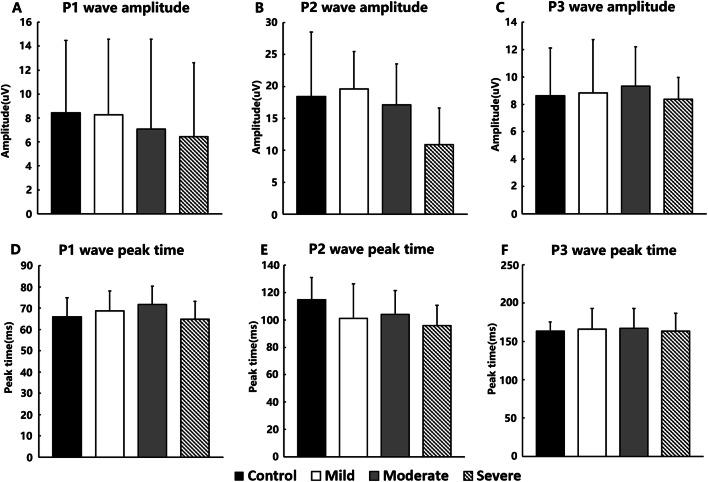
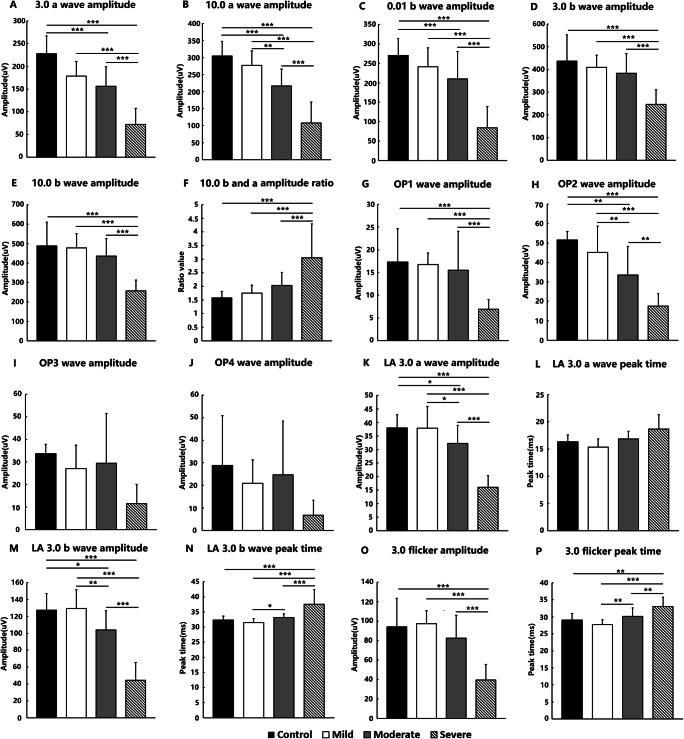
The severity of post-surgical visual acuity loss in the diabetic patients was classified as mild (N=22 eyes), moderate (N=31 eyes), or severe (N=21 eyes). In the group without diabetes, post-surgical visual impairment was classified as mild (N=21 eyes). The pre-operative DA 10.0 ERG a-wave amplitudes, DA 3.0 ERG OP2 amplitudes, and the LA 3.0 a- and b-wave amplitudes showed best significant differences among the four groups. The flash VEP did not show significant difference between groups.
CONCLUSION
Electrophysiological assessment of diabetic patients with cataract can provide a useful measure of retinal function. Full-field ERG components, including the DA 10.0 ERG a-wave, DA 3.0 ERG OP2 component, and the LA 3.0 a- and b-wave amplitudes, are of prognostic value in predicting post-surgical visual acuity, and may inform the surgical management of cataract patients with diabetes.
目的
患有视网膜或视觉通路疾病的糖尿病患者在白内障手术后的视觉结果难以预测,因为眼底可能被遮挡,并且视觉潜力的评估具有挑战性。本研究评估了视觉电生理学作为白内障术前糖尿病患者视觉恢复的预后指标的价值。
方法
41 名糖尿病患者(年龄 52-80 岁;74 只眼)和 13 名年龄匹配的非糖尿病对照患者(21 只眼)在白内障手术前接受了检查。术前检查包括最佳矫正视力(BCVA)、裂隙灯生物显微镜检查、ISCEV 标准全视野视网膜电图(ffERG)和闪光视觉诱发电位(闪光 VEP)测试。电生理评估包括量化 DA 和 LA ERG、振荡电位(OP;OP1、OP2、OP3、OP4)和闪光 VEP P1、P2 和 P3 成分。所有病例均测量术后 BCVA,并根据视力丧失程度将糖尿病患者分为轻度(logMAR≤0.1)、中度(0.1<logMAR<0.5)或重度(logMAR≥0.5)。第四组包括无糖尿病患者。通过方差分析比较了四组之间的术前电生理数据。
结果
糖尿病患者术后视力丧失的严重程度分为轻度(N=22 只眼)、中度(N=31 只眼)或重度(N=21 只眼)。在无糖尿病组中,术后视力障碍分为轻度(N=21 只眼)。在四组中,DA 10.0 ERG a 波振幅、DA 3.0 ERG OP2 振幅和 LA 3.0 a-和 b-波振幅的术前 DA 10.0 ERG 振幅具有最佳的显著差异。闪光 VEP 各组之间无显著差异。
结论
白内障糖尿病患者的电生理评估可为视网膜功能提供有用的测量方法。全视野 ERG 成分,包括 DA 10.0 ERG a 波、DA 3.0 ERG OP2 成分和 LA 3.0 a-和 b-波振幅,对预测术后视力具有预后价值,并可能为糖尿病白内障患者的手术治疗提供信息。

 Zotero 插件