
急性动脉血栓形成致急性肠系膜缺血患者血管内支架植入血管再通术:临床结果和预测因素。
Endovascular Revascularization with Stent Implantation in Patients with Acute Mesenteric Ischemia due to Acute Arterial Thrombosis: Clinical Outcome and Predictive Factors.
机构信息
Department of Diagnostic and Interventional Radiology, University Hospital RWTH Aachen, Pauwelsstraße 30, 52074, Aachen, Germany.
Department of Vascular Surgery, University Hospital RWTH Aachen, Pauwelsstraße 30, 52074, Aachen, Germany.
出版信息
Cardiovasc Intervent Radiol. 2021 Jul;44(7):1030-1038. doi: 10.1007/s00270-021-02824-2. Epub 2021 Apr 6.
PURPOSE
To determine 30-day-mortality rates and identify predictors for survival in patients undergoing endovascular revascularization for acute mesenteric ischemia (AMI) due to occlusion of the celiac (CA) or superior mesenteric artery (SMA) from arterial thrombosis in the setting of atherosclerosis at the vessel origin.
MATERIALS AND METHODS
A retrospective analysis on patients who underwent acute endovascular revascularization to treat AMI caused by thrombotic occlusion of the CA and/or SMA between January 2011 and December 2019 was conducted. 30-day-mortality rates were calculated. Univariate binomial logistic regression analyses (p < 0.05) were performed to assess whether the following factors were associated with 30-day mortality: sex, age, history of smoking, history of abdominal angina, signs of bowel necrosis on pre-interventional CT, one- vs. two-vessel disease, patency of the inferior mesenteric artery, outpatient or inpatient occurrence of ischemia, onset of AMI during ITU stay, elevated pre-interventional serum lactate levels, total leukocyte count, platelet/lymphocyte ratio and neutrophil/lymphocyte ratio.
RESULTS
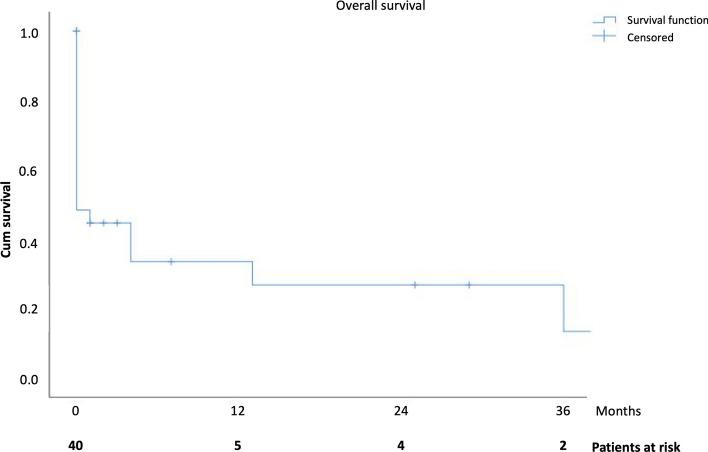
40 patients were included in this analysis. 30-day-mortality rate was 25/40 (62.5%). Median overall survival of patients who survived the first 30 days was 36 ± 18 months. None of the analyzed factors was statistically significantly associated with 30-day mortality.
CONCLUSION
Although mortality of patients with AMI due to acute arterial thrombosis remains high, almost 40% of patient who underwent emergent endovascular revascularization survived longer than one month. Since no predictors for the outcome in these patients were identified, all patients with AMI should be offered an immediate revascularization effort.
目的
确定因动脉粥样硬化导致血管起源处动脉血栓形成而导致腹腔干(CA)或肠系膜上动脉(SMA)闭塞的急性肠系膜缺血(AMI)患者行血管内血运重建的 30 天死亡率,并确定其生存的预测因素。
材料和方法
回顾性分析了 2011 年 1 月至 2019 年 12 月期间因 CA 和/或 SMA 血栓性闭塞而行急性血管内血运重建治疗的 AMI 患者。计算 30 天死亡率。采用单变量二项逻辑回归分析(p<0.05),评估以下因素是否与 30 天死亡率相关:性别、年龄、吸烟史、腹部心绞痛史、介入前 CT 上肠坏死征象、单血管病变与双血管病变、肠系膜下动脉通畅性、门诊或住院发生缺血、AMI 在 ICU 期间发病、介入前血清乳酸水平升高、白细胞总数、血小板/淋巴细胞比值和中性粒细胞/淋巴细胞比值。
结果
本研究共纳入 40 例患者。30 天死亡率为 25/40(62.5%)。存活超过 30 天的患者的中位总生存期为 36±18 个月。分析的因素均与 30 天死亡率无统计学显著相关性。
结论
尽管急性动脉血栓形成导致 AMI 患者的死亡率仍然较高,但近 40%接受紧急血管内血运重建的患者存活时间超过一个月。由于未确定这些患者结局的预测因素,所有 AMI 患者均应立即进行血运重建。

 Zotero 插件