
《COVID-19 大流行对印度慢性病患者的健康、心理社会和经济影响:一项混合方法研究》
Health, psychosocial, and economic impacts of the COVID-19 pandemic on people with chronic conditions in India: a mixed methods study.
机构信息
Public Health Foundation of India, Plot number 47, Sector 44, Gurugram, New Delhi, Haryana, 122002, India.
Centre for Chronic Disease Control, New Delhi, India.
出版信息
BMC Public Health. 2021 Apr 8;21(1):685. doi: 10.1186/s12889-021-10708-w.
BACKGROUND
People with chronic conditions are disproportionately prone to be affected by the COVID-19 pandemic but there are limited data documenting this. We aimed to assess the health, psychosocial and economic impacts of the COVID-19 pandemic on people with chronic conditions in India.
METHODS
Between July 29, to September 12, 2020, we telephonically surveyed adults (n = 2335) with chronic conditions across four sites in India. Data on participants' demographic, socio-economic status, comorbidities, access to health care, treatment satisfaction, self-care behaviors, employment, and income were collected using pre-tested questionnaires. We performed multivariable logistic regression analysis to examine the factors associated with difficulty in accessing medicines and worsening of diabetes or hypertension symptoms. Further, a diverse sample of 40 participants completed qualitative interviews that focused on eliciting patient's experiences during the COVID-19 lockdowns and data analyzed using thematic analysis.
RESULTS
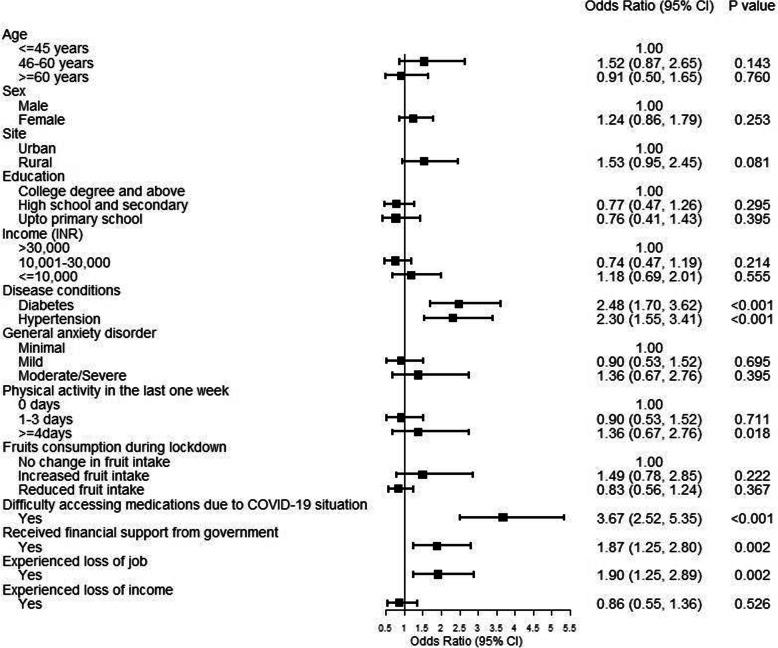
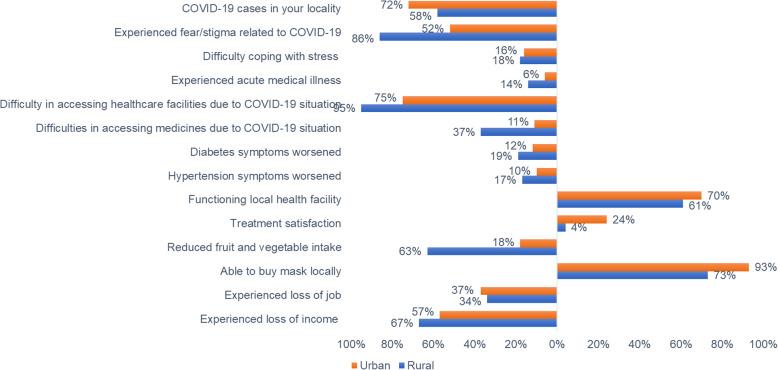
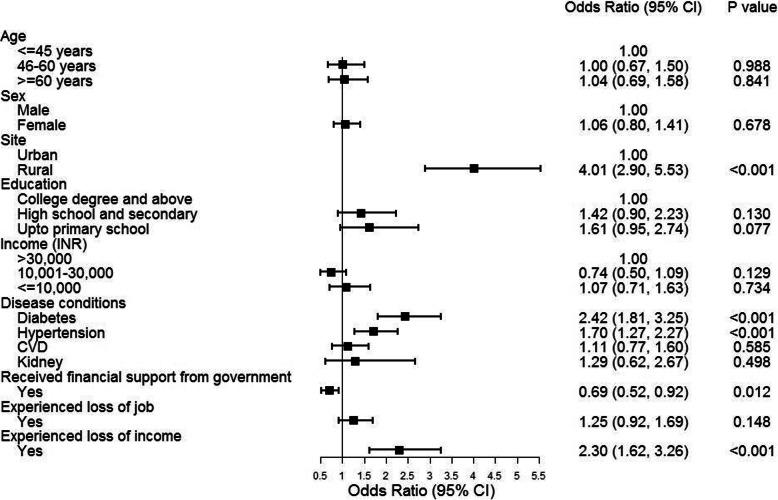
One thousand seven hundred thirty-four individuals completed the survey (response rate = 74%). The mean (SD) age of respondents was 57.8 years (11.3) and 50% were men. During the COVID-19 lockdowns in India, 83% of participants reported difficulty in accessing healthcare, 17% faced difficulties in accessing medicines, 59% reported loss of income, 38% lost jobs, and 28% reduced fruit and vegetable consumption. In the final-adjusted regression model, rural residence (OR, 95%CI: 4.01,2.90-5.53), having diabetes (2.42, 1.81-3.25) and hypertension (1.70,1.27-2.27), and loss of income (2.30,1.62-3.26) were significantly associated with difficulty in accessing medicines. Further, difficulties in accessing medicines (3.67,2.52-5.35), and job loss (1.90,1.25-2.89) were associated with worsening of diabetes or hypertension symptoms. Qualitative data suggest most participants experienced psychosocial distress due to loss of job or income and had difficulties in accessing in-patient services.
CONCLUSION
People with chronic conditions, particularly among poor, rural, and marginalized populations, have experienced difficulties in accessing healthcare and been severely affected both socially and financially by the COVID-19 pandemic.
背景
患有慢性病的人更容易受到 COVID-19 大流行的影响,但目前记录这一情况的数据有限。我们旨在评估 COVID-19 大流行对印度慢性病患者的健康、心理社会和经济影响。
方法
2020 年 7 月 29 日至 9 月 12 日,我们在印度的四个地点通过电话调查了患有慢性病的成年人(n=2335)。使用预先测试的问卷收集参与者的人口统计学、社会经济地位、合并症、获得医疗保健的机会、治疗满意度、自我保健行为、就业和收入方面的数据。我们进行了多变量逻辑回归分析,以研究与难以获得药物和糖尿病或高血压症状恶化相关的因素。此外,我们还对 40 名不同的参与者进行了定性访谈,重点了解患者在 COVID-19 封锁期间的经历,使用主题分析对数据进行分析。
结果
1734 人完成了调查(应答率为 74%)。受访者的平均(SD)年龄为 57.8 岁(11.3 岁),其中 50%为男性。在印度 COVID-19 封锁期间,83%的参与者报告难以获得医疗保健,17%的参与者难以获得药物,59%的参与者报告收入损失,38%的参与者失业,28%的参与者减少了水果和蔬菜的摄入。在最终调整的回归模型中,农村居民(OR,95%CI:4.01,2.90-5.53)、患有糖尿病(2.42,1.81-3.25)和高血压(1.70,1.27-2.27)以及收入损失(2.30,1.62-3.26)与难以获得药物显著相关。此外,难以获得药物(3.67,2.52-5.35)和失业(1.90,1.25-2.89)与糖尿病或高血压症状恶化相关。定性数据表明,大多数参与者因失业或收入损失而经历心理社会困扰,并且难以获得住院服务。
结论
患有慢性病的人,尤其是贫困、农村和边缘人群,在获得医疗保健方面遇到困难,并且受到 COVID-19 大流行的严重社会和经济影响。
 Zotero 插件