
COVID-19 合并心血管疾病史患者的死亡率和主要不良事件的高风险。
Mortality and high risk of major adverse events in patients with COVID-19 and history of cardiovascular disease.
机构信息
Department of Cardiology, University Hospitals of Geneva Department of Medical Specializations, Geneva, Switzerland.
Department of Health and Community Medicine, University of Geneva, Geneva, Switzerland.
出版信息
Open Heart. 2021 Apr;8(1). doi: 10.1136/openhrt-2020-001526.
OBJECTIVE
History of cardiovascular diseases (CVDs) may influence the prognosis of patients hospitalised for COVID-19. We investigated whether patients with previous CVD have increased risk of death and major adverse cardiovascular event (MACE) when hospitalised for COVID-19.
METHODS
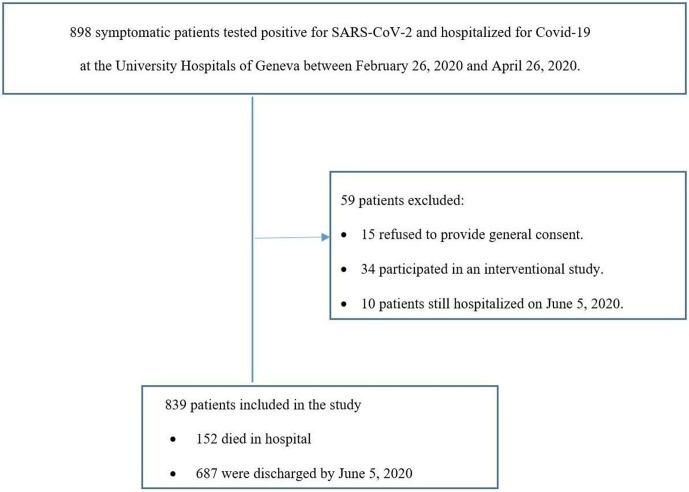
We included 839 patients with COVID-19 hospitalised at the University Hospitals of Geneva. Demographic characteristics, medical history, laboratory values, ECG at admission and medications at admission were collected based on electronic medical records. The primary outcome was a composite of in-hospital mortality or MACE.
RESULTS
Median age was 67 years, 453 (54%) were males and 277 (33%) had history of CVD. In total, 152 (18%) died and 687 (82%) were discharged, including 72 (9%) who survived a MACE. Patients with previous CVD were more at risk of composite outcomes 141/277 (51%) compared with those without CVD 83/562 (15%) (OR=6.0 (95% CI 4.3 to 8.4), p<0.001). Multivariate analyses showed that history of CVD remained an independent risk factor of in-hospital death or MACE (OR=2.4; (95% CI 1.6 to 3.5)), as did age (OR for a 10-year increase=2.2 (95% CI 1.9 to 2.6)), male gender (OR=1.6 (95% CI 1.1 to 2.3)), chronic obstructive pulmonary disease (OR=2.1 (95% CI 1.0 to 4.2)) and lung infiltration associated with COVID-19 at CT scan (OR=1.9 (95% CI 1.2 to 3.0)). History of CVD (OR=2.9 (95% CI 1.7 to 5)), age (OR=2.5 (95% CI 2.0 to 3.2)), male gender (OR=1.6 (95% CI 0.98 to 2.6)) and elevated C reactive protein (CRP) levels on admission (OR for a 10 mg/L increase=1.1 (95% CI 1.1 to 1.2)) were independent risk factors for mortality.
CONCLUSION
History of CVD is associated with higher in-hospital mortality and MACE in hospitalised patients with COVID-19. Other factors associated with higher in-hospital mortality are older age, male sex and elevated CRP on admission.
目的
心血管疾病(CVD)病史可能会影响因 COVID-19 住院的患者的预后。我们研究了因 COVID-19 住院的既往有 CVD 的患者的死亡风险和主要不良心血管事件(MACE)是否增加。
方法
我们纳入了在日内瓦大学附属医院住院的 839 名 COVID-19 患者。根据电子病历收集人口统计学特征、既往病史、实验室值、入院时心电图和入院时用药情况。主要结局为住院期间死亡或 MACE 的复合结局。
结果
中位年龄为 67 岁,453 名(54%)为男性,277 名(33%)有 CVD 病史。共有 152 名(18%)死亡,687 名(82%)出院,其中 72 名(9%)幸存 MACE。与无 CVD 的患者(83/562,15%)相比,既往有 CVD 的患者(141/277,51%)发生复合结局的风险更高(OR=6.0(95%CI 4.3 至 8.4),p<0.001)。多变量分析显示,CVD 病史仍然是住院期间死亡或 MACE 的独立危险因素(OR=2.4(95%CI 1.6 至 3.5)),年龄(每增加 10 岁的 OR=2.2(95%CI 1.9 至 2.6))、男性(OR=1.6(95%CI 1.1 至 2.3))、慢性阻塞性肺疾病(OR=2.1(95%CI 1.0 至 4.2))和 CT 扫描中 COVID-19 相关的肺部浸润(OR=1.9(95%CI 1.2 至 3.0))也是如此。CVD 病史(OR=2.9(95%CI 1.7 至 5))、年龄(OR=2.5(95%CI 2.0 至 3.2))、男性(OR=1.6(95%CI 0.98 至 2.6))和入院时 C 反应蛋白(CRP)水平升高(OR 每增加 10mg/L=1.1(95%CI 1.1 至 1.2))是死亡的独立危险因素。
结论
CVD 病史与 COVID-19 住院患者的院内死亡率和 MACE 发生率增加有关。其他与较高院内死亡率相关的因素是年龄较大、男性和入院时 CRP 升高。
 Zotero 插件