
当封锁政策加剧 COVID-19 感染中的社会不平等时:来自法国基于人群的横断面调查的证据。
When lockdown policies amplify social inequalities in COVID-19 infections: evidence from a cross-sectional population-based survey in France.
机构信息
Institut de Recherche Interdisciplinaire sur les enjeux Sociaux - Sciences sociales, politique, santé, IRIS (UMR 8156 CNRS - EHESS - U997 INSERM), 5 cours des humanités, 93322, Aubervilliers, France.
Paris Dauphine University, Paris, France.
出版信息
BMC Public Health. 2021 Apr 12;21(1):705. doi: 10.1186/s12889-021-10521-5.
BACKGROUND
Significant differences in COVID-19 incidence by gender, class and race/ethnicity are recorded in many countries in the world. Lockdown measures, shown to be effective in reducing the number of new cases, may not have been effective in the same way for all, failing to protect the most vulnerable populations. This survey aims to assess social inequalities in the trends in COVID-19 infections following lockdown.
METHODS
A cross-sectional survey conducted among the general population in France in April 2020, during COVID-19 lockdown. Ten thousand one hundred one participants aged 18-64, from a national cohort who lived in the three metropolitan French regions most affected by the first wave of COVID-19. The main outcome was occurrence of possible COVID-19 symptoms, defined as the occurrence of sudden onset of cough, fever, dyspnea, ageusia and/or anosmia, that lasted more than 3 days in the 15 days before the survey. We used multinomial regression models to identify social and health factors related to possible COVID-19 before and during the lockdown.
RESULTS
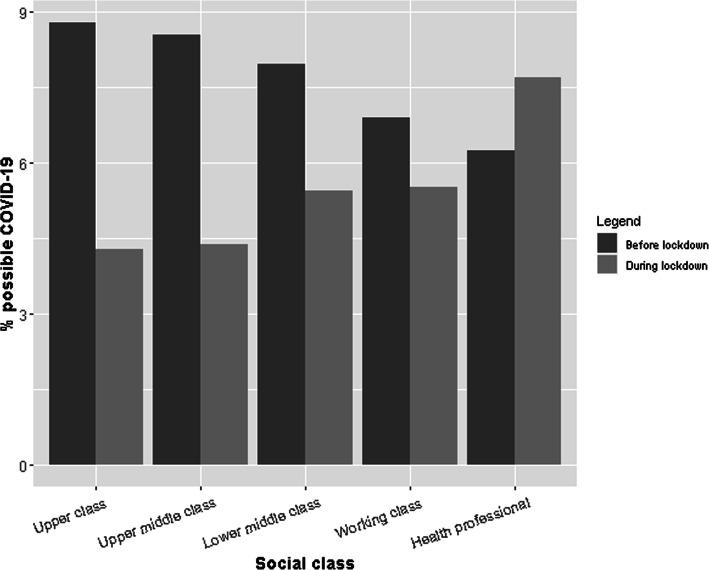
In all, 1304 (13.0%; 95% CI: 12.0-14.0%) reported cases of possible COVID-19. The effect of lockdown on the occurrence of possible COVID-19 was different across social hierarchies. The most privileged class individuals saw a significant decline in possible COVID-19 infections between the period prior to lockdown and during the lockdown (from 8.8 to 4.3%, P = 0.0001) while the decline was less pronounced among working class individuals (6.9% before lockdown and 5.5% during lockdown, P = 0.03). This differential effect of lockdown remained significant after adjusting for other factors including history of chronic disease. The odds of being infected during lockdown as opposed to the prior period increased by 57% among working class individuals (OR = 1.57; 95% CI: 1.00-2.48). The same was true for those engaged in in-person professional activities during lockdown (OR = 1.53; 95% CI: 1.03-2.29).
CONCLUSIONS
Lockdown was associated with social inequalities in the decline in COVID-19 infections, calling for the adoption of preventive policies to account for living and working conditions. Such adoptions are critical to reduce social inequalities related to COVID-19, as working-class individuals also have the highest COVID-19 related mortality, due to higher prevalence of comorbidities.
背景
在世界上许多国家,性别、阶层和种族/民族之间的 COVID-19 发病率存在显著差异。封锁措施已被证明可有效减少新病例数,但对所有人群的效果可能并不相同,未能保护最弱势群体。本研究旨在评估封锁后 COVID-19 感染趋势的社会不平等。
方法
2020 年 4 月,在 COVID-19 封锁期间,在法国进行了一项横断面调查。调查对象为来自受 COVID-19 第一波影响最大的三个法国大都市地区的全国队列中年龄在 18-64 岁之间的 10101 名普通人群。主要结局为出现可能的 COVID-19 症状,定义为在调查前 15 天内突然出现咳嗽、发热、呼吸困难、味觉丧失和/或嗅觉丧失,持续超过 3 天。我们使用多变量回归模型来确定封锁前和封锁期间与可能的 COVID-19 相关的社会和健康因素。
结果
共有 1304 人(13.0%;95%CI:12.0-14.0%)报告了可能的 COVID-19 病例。封锁对可能的 COVID-19 发生的影响因社会阶层而异。最具特权的阶层个体在封锁前后的可能 COVID-19 感染率显著下降(从 8.8%降至 4.3%,P=0.0001),而工人阶层个体的下降幅度较小(从封锁前的 6.9%降至封锁期间的 5.5%,P=0.03)。在调整了包括慢性病史在内的其他因素后,这种封锁的差异效应仍然显著。与封锁前相比,工人阶层个体在封锁期间感染的几率增加了 57%(OR=1.57;95%CI:1.00-2.48)。对于封锁期间从事面对面专业活动的个体,情况也是如此(OR=1.53;95%CI:1.03-2.29)。
结论
封锁与 COVID-19 感染下降的社会不平等有关,需要采取预防政策来考虑生活和工作条件。这种做法对于减少与 COVID-19 相关的社会不平等至关重要,因为工人阶级个体的 COVID-19 相关死亡率也最高,这是由于合并症的患病率较高所致。
 Zotero 插件