
细胞衰老的机制:细胞周期停滞与衰老相关分泌表型。
Mechanisms of Cellular Senescence: Cell Cycle Arrest and Senescence Associated Secretory Phenotype.
作者信息
Kumari Ruchi, Jat Parmjit
机构信息
MRC Prion Unit at UCL, UCL Institute of Prion Diseases, London, United Kingdom.
出版信息
Front Cell Dev Biol. 2021 Mar 29;9:645593. doi: 10.3389/fcell.2021.645593. eCollection 2021.
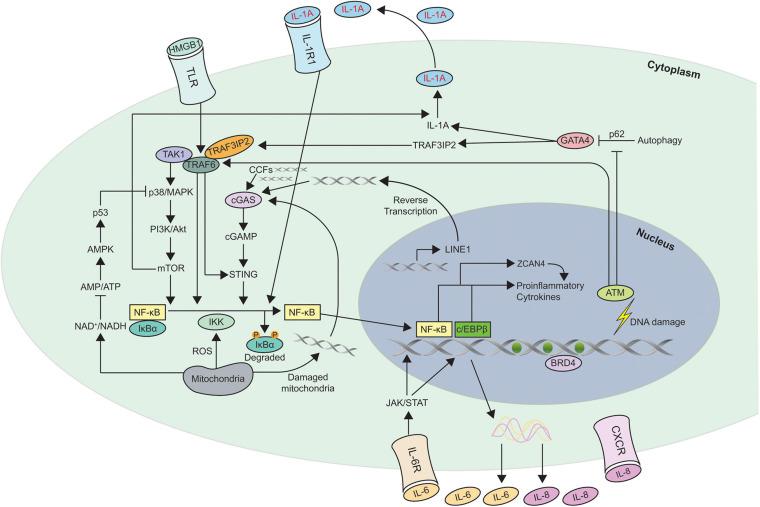
Cellular senescence is a stable cell cycle arrest that can be triggered in normal cells in response to various intrinsic and extrinsic stimuli, as well as developmental signals. Senescence is considered to be a highly dynamic, multi-step process, during which the properties of senescent cells continuously evolve and diversify in a context dependent manner. It is associated with multiple cellular and molecular changes and distinct phenotypic alterations, including a stable proliferation arrest unresponsive to mitogenic stimuli. Senescent cells remain viable, have alterations in metabolic activity and undergo dramatic changes in gene expression and develop a complex senescence-associated secretory phenotype. Cellular senescence can compromise tissue repair and regeneration, thereby contributing toward aging. Removal of senescent cells can attenuate age-related tissue dysfunction and extend health span. Senescence can also act as a potent anti-tumor mechanism, by preventing proliferation of potentially cancerous cells. It is a cellular program which acts as a double-edged sword, with both beneficial and detrimental effects on the health of the organism, and considered to be an example of evolutionary antagonistic pleiotropy. Activation of the p53/p21 and p16/pRB tumor suppressor pathways play a central role in regulating senescence. Several other pathways have recently been implicated in mediating senescence and the senescent phenotype. Herein we review the molecular mechanisms that underlie cellular senescence and the senescence associated growth arrest with a particular focus on why cells stop dividing, the stability of the growth arrest, the hypersecretory phenotype and how the different pathways are all integrated.
细胞衰老指的是一种稳定的细胞周期停滞状态,可由正常细胞响应各种内在和外在刺激以及发育信号而触发。衰老被认为是一个高度动态的多步骤过程,在此过程中,衰老细胞的特性会根据具体情况不断演变和多样化。它与多种细胞和分子变化以及明显的表型改变相关,包括对有丝分裂原刺激无反应的稳定增殖停滞。衰老细胞仍具活力,代谢活性会发生改变,基因表达也会经历显著变化,并形成复杂的衰老相关分泌表型。细胞衰老会损害组织修复和再生,从而促进衰老。清除衰老细胞可减轻与年龄相关的组织功能障碍并延长健康寿命。衰老还可作为一种强大的抗肿瘤机制,通过阻止潜在癌细胞的增殖来发挥作用。它是一个细胞程序,犹如一把双刃剑,对生物体健康既有有益影响也有有害影响,被认为是进化拮抗多效性的一个例子。p53/p21和p16/pRB肿瘤抑制通路的激活在调节衰老过程中起核心作用。最近有其他几条通路也被认为参与介导衰老和衰老表型。在此,我们综述细胞衰老及衰老相关生长停滞背后的分子机制,特别关注细胞为何停止分裂、生长停滞的稳定性、高分泌表型以及不同通路是如何整合的。

 Zotero 插件