
用于预测胎龄的 EPIC 模型及其在辅助生殖技术受孕新生儿中的应用。
An EPIC predictor of gestational age and its application to newborns conceived by assisted reproductive technologies.
机构信息
Department of Genetics and Bioinformatics, Norwegian Institute of Public Health, Oslo, Norway.
Centre for Fertility and Health, Norwegian Institute of Public Health, Oslo, Norway.
出版信息
Clin Epigenetics. 2021 Apr 19;13(1):82. doi: 10.1186/s13148-021-01055-z.
BACKGROUND
Gestational age is a useful proxy for assessing developmental maturity, but correct estimation of gestational age is difficult using clinical measures. DNA methylation at birth has proven to be an accurate predictor of gestational age. Previous predictors of epigenetic gestational age were based on DNA methylation data from the Illumina HumanMethylation 27 K or 450 K array, which have subsequently been replaced by the Illumina MethylationEPIC 850 K array (EPIC). Our aims here were to build an epigenetic gestational age clock specific for the EPIC array and to evaluate its precision and accuracy using the embryo transfer date of newborns from the largest EPIC-derived dataset to date on assisted reproductive technologies (ART).
METHODS
We built an epigenetic gestational age clock using Lasso regression trained on 755 randomly selected non-ART newborns from the Norwegian Study of Assisted Reproductive Technologies (START)-a substudy of the Norwegian Mother, Father, and Child Cohort Study (MoBa). For the ART-conceived newborns, the START dataset had detailed information on the embryo transfer date and the specific ART procedure used for conception. The predicted gestational age was compared to clinically estimated gestational age in 200 non-ART and 838 ART newborns using MM-type robust regression. The performance of the clock was compared to previously published gestational age clocks in an independent replication sample of 148 newborns from the Prediction and Prevention of Preeclampsia and Intrauterine Growth Restrictions (PREDO) study-a prospective pregnancy cohort of Finnish women.
RESULTS
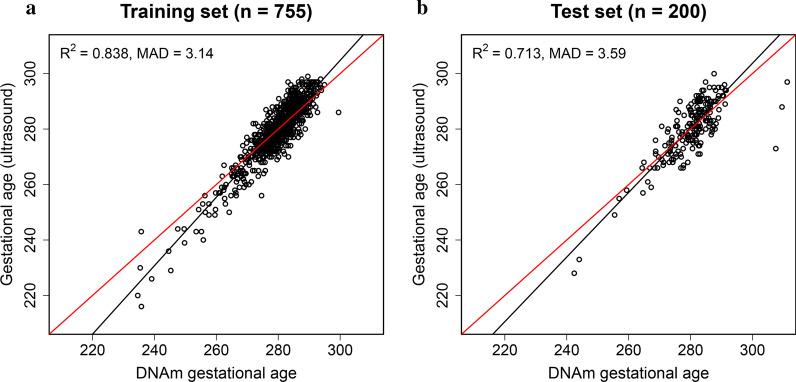
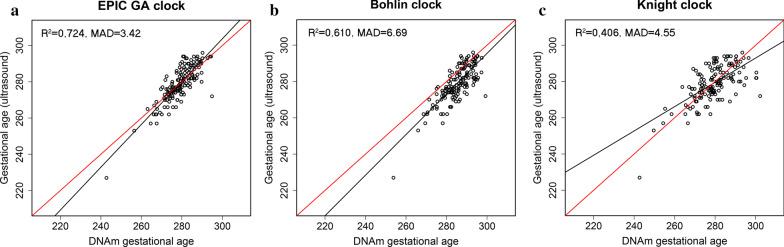
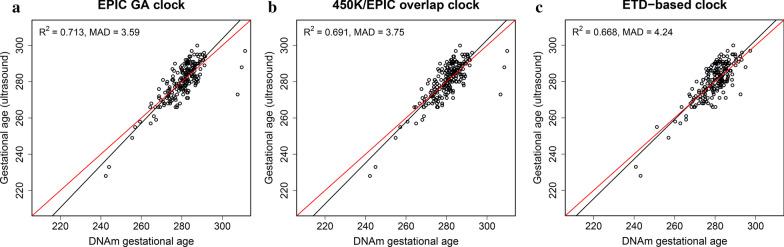
Our new epigenetic gestational age clock showed higher precision and accuracy in predicting gestational age than previous gestational age clocks (R = 0.724, median absolute deviation (MAD) = 3.14 days). Restricting the analysis to CpGs shared between 450 K and EPIC did not reduce the precision of the clock. Furthermore, validating the clock on ART newborns with known embryo transfer date confirmed that DNA methylation is an accurate predictor of gestational age (R = 0.767, MAD = 3.7 days).
CONCLUSIONS
We present the first EPIC-based predictor of gestational age and demonstrate its robustness and precision in ART and non-ART newborns. As more datasets are being generated on the EPIC platform, this clock will be valuable in studies using gestational age to assess neonatal development.
背景
胎龄是评估发育成熟度的有用指标,但临床测量很难准确估计胎龄。出生时的 DNA 甲基化已被证明是胎龄的准确预测指标。先前的表观遗传胎龄预测因子是基于 Illumina HumanMethylation 27K 或 450K 阵列的 DNA 甲基化数据,但后来已被 Illumina MethylationEPIC 850K 阵列(EPIC)取代。我们的目标是为 EPIC 阵列建立一个特定的表观遗传胎龄时钟,并使用迄今为止最大的基于 EPIC 的辅助生殖技术(ART)数据集的新生儿的胚胎移植日期来评估其精度和准确性。
方法
我们使用 Lasso 回归在 755 名随机选择的非 ART 新生儿的挪威辅助生殖技术研究(START)-挪威母亲、父亲和儿童队列研究(MoBa)的子研究中建立了一个表观遗传胎龄时钟。对于 ART 受孕的新生儿,START 数据集详细记录了胚胎移植日期和用于受孕的特定 ART 程序。使用 MM 型稳健回归在 200 名非 ART 和 838 名 ART 新生儿中比较预测的胎龄和临床估计的胎龄。在芬兰妇女的预测和预防子痫前期和宫内生长受限(PREDO)研究的一个前瞻性妊娠队列的 148 名新生儿的独立复制样本中,比较了时钟的性能与以前发表的胎龄时钟。
结果
我们的新表观遗传胎龄时钟在预测胎龄方面表现出更高的精度和准确性,优于先前的胎龄时钟(R=0.724,中位数绝对偏差(MAD)=3.14 天)。在 450K 和 EPIC 之间共享的 CpG 分析限制不会降低时钟的精度。此外,使用已知胚胎移植日期的 ART 新生儿验证时钟证实 DNA 甲基化是胎龄的准确预测指标(R=0.767,MAD=3.7 天)。
结论
我们提出了第一个基于 EPIC 的胎龄预测因子,并证明了其在 ART 和非 ART 新生儿中的稳健性和精度。随着更多基于 EPIC 平台的数据集的生成,该时钟将在使用胎龄评估新生儿发育的研究中具有重要价值。



 Zotero 插件