
土耳其蜂胶基本标准化中抗氧化活性和酚类化合物的测定
Determination of antioxidant activity and phenolic compounds for basic standardization of Turkish propolis.
作者信息
Özkök Aslı, Keskin Merve, Tanuğur Samancı Aslı Elif, Yorulmaz Önder Elif, Takma Çiğdem
机构信息
Bee and Bee Products Application and Research Center (HARUM), Hacettepe University, Ankara, Turkey.
Vocational School of Health Services, Bilecik Şeyh Edebali University, Bilecik, Turkey.
出版信息
Appl Biol Chem. 2021;64(1):37. doi: 10.1186/s13765-021-00608-3. Epub 2021 Apr 16.
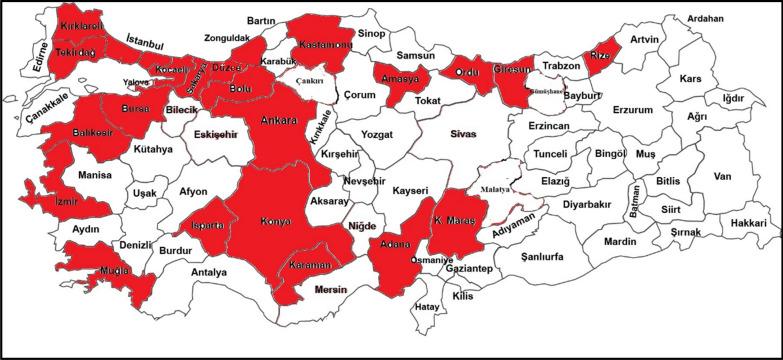
This study aimed to determine the standard amount of antioxidant content and compounds of the propolis for the standardization of propolis. For this purpose, the total flavonoids, total phenolic, CUPRAC antioxidant capacity content and the diversity of phenolic and flavonoid components of these propolis samples were found by HPLC determined at the 23 propolis samples which were collected different regions of Turkey. Beside that, the similarities and differences of these 23 provinces to each other according to their antioxidant capacities were investigated by multidimensional scaling analysis. The total flavonoid content in the propolis samples were determined between 21.28 and 152.56 mg CE/g. The total phenolic content in the propolis samples was found between 34.53 mg and 259.4 mg GAE/g. CUPRAC antioxidant capacity of the propolis samples and antioxidant range was found from 95.35 to 710.43 mg TE/g. Also, 4 flavonoid [Quercetin (min.1.12-max.4.14 mg/g), Galangin (min.0.72-max.40.79 mg/g), Apigenin (min.1.07-max.17.35 mg/g), Pinocembrin (min.1.32-max.39.92 mg/g] and 6 phenolic acid [Caffeic acid (min.1.20-max.7.6 mg/g), p-Coumaric acid (min.1.26-max.4.47 mg/g), trans-Ferulic acid (min.1.28-max.4.92 mg/g), Protocatechuic acid (1.78 mg/g), trans-Cinnamic acid (min.1.05-max.3.83 mg/g), Caffeic Acid Phenethyl Ester (CAPE) (min.1.41-max.30.15 mg/g)] components were detected as mg/g, in different ratios in propolis samples collected from different regions. The feature of this study, so far, is to have the maximum number of samples representing the Turkish propolis, and so is thought to help to national and international propolis standard workings.
本研究旨在确定蜂胶标准化所需的抗氧化剂含量及化合物的标准量。为此,通过高效液相色谱法(HPLC)测定了从土耳其不同地区采集的23个蜂胶样品中的总黄酮、总酚、CUPRAC抗氧化能力含量以及酚类和黄酮类成分的多样性。此外,通过多维尺度分析研究了这23个省份在抗氧化能力方面的异同。蜂胶样品中的总黄酮含量在21.28至152.56毫克儿茶素当量/克之间。蜂胶样品中的总酚含量在34.53毫克至259.4毫克没食子酸当量/克之间。蜂胶样品的CUPRAC抗氧化能力及抗氧化范围在95.35至710.43毫克 Trolox当量/克之间。此外,在从不同地区采集的蜂胶样品中,检测到4种黄酮类化合物[槲皮素(最低1.12 - 最高4.14毫克/克)、高良姜素(最低0.72 - 最高40.79毫克/克)、芹菜素(最低1.07 - 最高17.35毫克/克)、松属素(最低1.32 - 最高39.92毫克/克)]和6种酚酸[咖啡酸(最低1.20 - 最高7.6毫克/克)、对香豆酸(最低1.26 - 最高4.47毫克/克)、反式阿魏酸(最低1.28 - 最高4.92毫克/克)、原儿茶酸(1.78毫克/克)、反式肉桂酸(最低1.05 - 最高3.83毫克/克)、咖啡酸苯乙酯(CAPE)(最低1.41 - 最高30.15毫克/克)]成分,其比例各不相同。到目前为止,本研究的特点是拥有代表土耳其蜂胶的最大样本数量,因此被认为有助于国家和国际蜂胶标准制定工作。
 Zotero 插件