
2008-2017 年 ESME 队列中 20446 例转移性乳腺癌患者的总体生存和新疗法接受情况的亚型演变。
Evolution of overall survival and receipt of new therapies by subtype among 20 446 metastatic breast cancer patients in the 2008-2017 ESME cohort.
机构信息
Department of Cancer Medicine, Gustave Roussy, Villejuif, France.
Department of Biostatistics, Centre Léon Bérard, Lyon, France.
出版信息
ESMO Open. 2021 Jun;6(3):100114. doi: 10.1016/j.esmoop.2021.100114. Epub 2021 Apr 23.
BACKGROUND
Treatment strategies for metastatic breast cancer (MBC) have made great strides over the past 10 years. Real-world data allow us to evaluate the actual benefit of new treatments. ESME (Epidemio-Strategy-Medico-Economical)-MBC, a nationwide observational cohort (NCT03275311), gathers data of all consecutive MBC patients who initiated their treatment in 18 French Cancer Centres since 2008.
PATIENTS AND METHODS
We evaluated overall survival (OS) in the whole cohort (N = 20 446) and among subtypes: hormone receptor positive, human epidermal growth factor 2 negative (HR+/HER2-; N = 13 590), HER2+ (N = 3919), and triple-negative breast cancer (TNBC; N = 2937). We performed multivariable analyses including year of MBC diagnosis as one of the covariates, to assess the potential OS improvement over time, and we described exposure to newly released drugs at any time during MBC history by year of diagnosis (YOD).
RESULTS
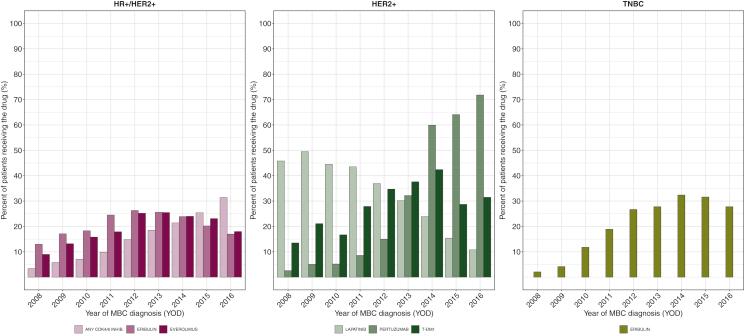
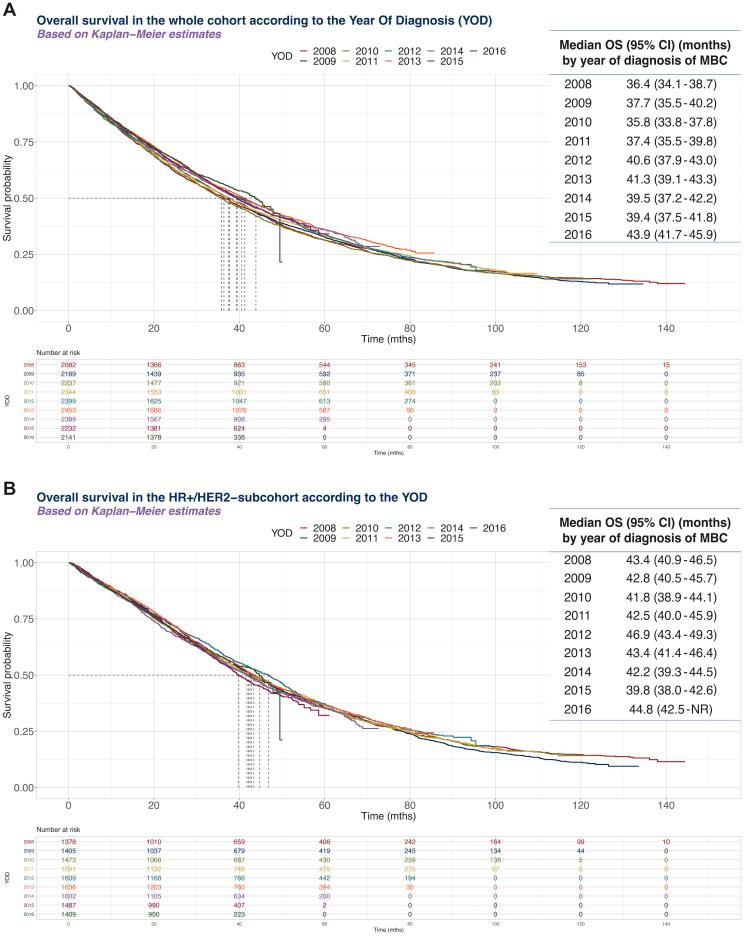
The median follow-up of the whole cohort was 65.5 months (95% CI 64.6-66.7). Year of metastatic diagnosis appears as a strong independent prognostic factor for OS [Year 2016 HR 0.89 (95% CI 0.82-0.97); P = 0.009, using 2008 as reference]. This effect is driven by the HER2+ subcohort, where it is dramatic [Year 2016 HR 0.52 (95% CI 0.42-0.66); P < 0.001, using 2008 as reference]. YOD had, however, no sustained impact on OS among patients with TNBC [Year 2016 HR 0.93 (95% CI 0.77-1.11); P = 0.41, using 2008 as reference] nor among those with HR+/HER2- MBC [Year 2016 HR 1.02 (95% CI 0.91-1.13); P = 0.41, using 2008 as reference]. While exposure to newly released anti-HER2 therapies appeared very high (e.g. >70% of patients received pertuzumab from 2016 onwards), use of everolimus or eribulin was recorded in less than one-third of HR+/HER2- and TNBC cohorts, respectively, whatever YOD.
CONCLUSION
OS has dramatically improved among HER2+ MBC patients, probably in association with the release of several major HER2-directed therapies, whose penetrance was high. This trend was not observed in the other subtypes, but the impact of CDK4/6 inhibitors cannot yet be assessed.
背景
在过去的 10 年中,转移性乳腺癌(MBC)的治疗策略取得了重大进展。真实世界的数据使我们能够评估新治疗方法的实际获益。ESME(Epidemio-Strategy-Medico-Economical)-MBC 是一项全国性观察队列研究(NCT03275311),收集了自 2008 年以来在法国 18 个癌症中心开始治疗的所有连续 MBC 患者的数据。
患者和方法
我们评估了整个队列(N=20446)和亚型的总生存期(OS):激素受体阳性、人表皮生长因子 2 阴性(HR+/HER2-;N=13590)、HER2+(N=3919)和三阴性乳腺癌(TNBC;N=2937)。我们进行了多变量分析,包括 MBC 诊断年份作为一个协变量,以评估随时间推移 OS 改善的潜力,并按诊断年份(YOD)描述 MBC 病史期间任何时间新发布药物的暴露情况。
结果
整个队列的中位随访时间为 65.5 个月(95%CI 64.6-66.7)。MBC 诊断年份似乎是 OS 的一个强独立预后因素[2016 年 HR 0.89(95%CI 0.82-0.97);P=0.009,以 2008 年为参照]。这种影响是由 HER2+亚组驱动的,在该亚组中,这一影响非常显著[2016 年 HR 0.52(95%CI 0.42-0.66);P<0.001,以 2008 年为参照]。然而,YOD 对 TNBC 患者的 OS 没有持续影响[2016 年 HR 0.93(95%CI 0.77-1.11);P=0.41,以 2008 年为参照],也没有对 HR+/HER2-MBC 患者的 OS 产生影响[2016 年 HR 1.02(95%CI 0.91-1.13);P=0.41,以 2008 年为参照]。尽管新发布的抗 HER2 治疗药物的使用非常高(例如,2016 年以后,超过 70%的患者接受了 pertuzumab),但在 HR+/HER2-和 TNBC 队列中,everolimus 或 eribulin 的使用记录分别不到三分之一,与 YOD 无关。
结论
HER2+MBC 患者的 OS 显著改善,可能与几种主要的 HER2 靶向治疗的发布有关,这些药物的渗透率很高。这一趋势在其他亚型中并未观察到,但 CDK4/6 抑制剂的影响尚无法评估。

 Zotero 插件