
基于健康生活方式的集成功能的移动健康应用程序(Kencom)对身体活动水平和心血管风险生物标志物的影响:对 12602 名用户的观察性研究。
Effects of an mHealth App (Kencom) With Integrated Functions for Healthy Lifestyles on Physical Activity Levels and Cardiovascular Risk Biomarkers: Observational Study of 12,602 Users.
机构信息
Division of Preventive Medicine, Department of Medicine, Brigham and Women's Hospital and Harvard Medical School, Boston, MA, United States.
Department of Epidemiology, Harvard University, Boston, MA, United States.
出版信息
J Med Internet Res. 2021 Apr 26;23(4):e21622. doi: 10.2196/21622.
BACKGROUND
Mobile health (mHealth) apps are considered to be potentially powerful tools for improving lifestyles and preventing cardiovascular disease (CVD), although only few have undergone large, well-designed epidemiological research. "kencom" is a novel mHealth app with integrated functions for healthy lifestyles such as monitoring daily health/step data, providing tailored health information, or facilitating physical activity through group-based game events. The app is linked to large-scale Japanese insurance claims databases and annual health check-up databases, thus comprising a large longitudinal cohort.
OBJECTIVE
We aimed to assess the effects of kencom on physical activity levels and CVD risk factors such as obesity, hypertension, dyslipidemia, and diabetes mellitus in a large population in Japan.
METHODS
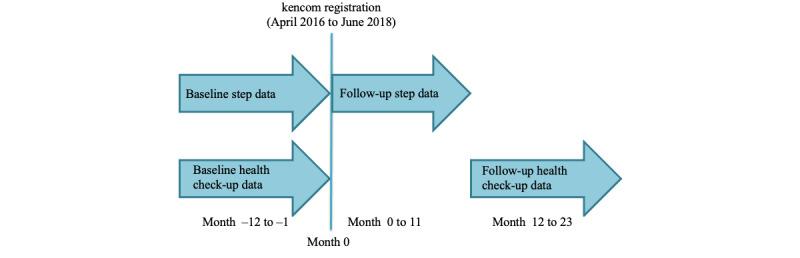
Daily step count, annual health check-up data, and insurance claim data of the kencom users were integrated within the kencom system. Step analysis was conducted by comparing the 1-year average daily step count before and after kencom registration. In the CVD risk analysis, changes in CVD biomarkers following kencom registration were evaluated among the users grouped into the quintile according to their change in step count.
RESULTS
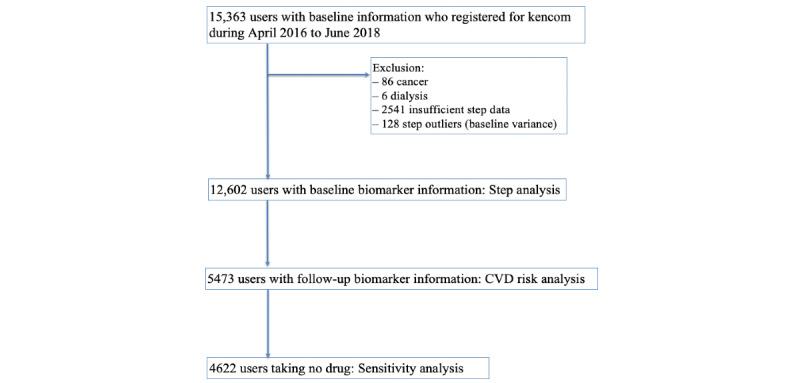
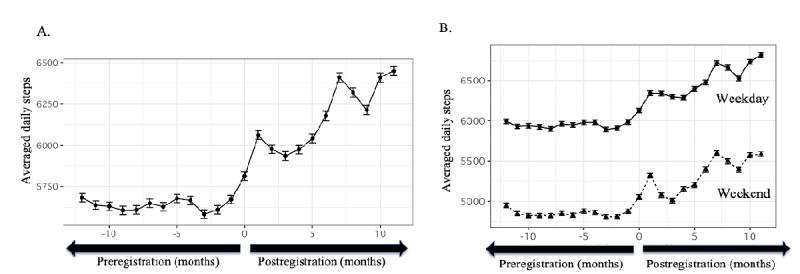
A total of 12,602 kencom users were included for the step analysis and 5473 for the CVD risk analysis. The participants were generally healthy and their mean age was 44.1 (SD 10.2) years. The daily step count significantly increased following kencom registration by a mean of 510 steps/day (P<.001). In particular, participation in "Arukatsu" events held twice a year within the app was associated with a remarkable increase in step counts. In the CVD risk analysis, the users of the highest quintile in daily step change had, compared with those of the lowest quartile, a significant reduction in weight (-0.92 kg, P<.001), low-density lipoprotein cholesterol (-2.78 mg/dL, P=.004), hemoglobin A (HbA; -0.04%, P=.004), and increase in high-density lipoprotein cholesterol (+1.91 mg/dL, P<.001) after adjustment of confounders.
CONCLUSIONS
The framework of kencom successfully integrated the Japanese health data from multiple data sources to generate a large, longitudinal data set. The use of the kencom app was significantly associated with enhanced physical activity, which might lead to weight loss and improvement in lipid profile.
背景
移动健康(mHealth)应用程序被认为是改善生活方式和预防心血管疾病(CVD)的潜在强大工具,尽管只有少数应用程序经过了大型、精心设计的流行病学研究。“kencom”是一款具有健康生活方式综合功能的新型 mHealth 应用程序,例如监测日常健康/步数数据、提供量身定制的健康信息或通过基于群组的游戏活动促进身体活动。该应用程序与大型日本保险索赔数据库和年度健康检查数据库相关联,因此构成了一个大型纵向队列。
目的
我们旨在评估 kencom 在日本大型人群中的身体活动水平和 CVD 风险因素(如肥胖、高血压、血脂异常和糖尿病)方面的效果。
方法
kencom 用户的日常步数、年度健康检查数据和保险索赔数据在 kencom 系统内进行了整合。通过比较 kencom 注册前后 1 年的平均每日步数来进行步数分析。在 CVD 风险分析中,根据步数变化将用户分为五组,评估注册后 CVD 生物标志物的变化。
结果
共纳入 12602 名 kencom 用户进行步数分析,5473 名用户进行 CVD 风险分析。参与者通常身体健康,平均年龄为 44.1(SD 10.2)岁。kencom 注册后,每日步数显著增加,平均增加 510 步/天(P<.001)。特别是,参加应用程序中每年举办两次的“Arukatsu”活动与步数的显著增加有关。在 CVD 风险分析中,与最低四分位组相比,每日步数变化最高五分位组的患者体重明显减轻(-0.92kg,P<.001),低密度脂蛋白胆固醇(-2.78mg/dL,P=.004),血红蛋白 A(HbA;-0.04%,P=.004),高密度脂蛋白胆固醇增加(+1.91mg/dL,P<.001),调整混杂因素后。
结论
kencom 的框架成功地整合了来自多个数据源的日本健康数据,生成了一个大型的纵向数据集。kencom 应用程序的使用与增强的身体活动显著相关,这可能导致体重减轻和改善血脂谱。


 Zotero 插件