
肥胖合并糖尿病患者行减重手术后主要糖尿病不良结局的相关性研究。
Association Between Bariatric Surgery and Major Adverse Diabetes Outcomes in Patients With Diabetes and Obesity.
机构信息
Division of General Surgery, McMaster University, Hamilton, Canada.
ICES, Toronto, Canada.
出版信息
JAMA Netw Open. 2021 Apr 1;4(4):e216820. doi: 10.1001/jamanetworkopen.2021.6820.
IMPORTANCE
There are high-quality randomized clinical trial data demonstrating the effect of bariatric surgery on type 2 diabetes remission, but these studies are not powered to study mortality in this patient group. Large observational studies are warranted to study the association of bariatric surgery with mortality in patients with type 2 diabetes.
OBJECTIVE
To determine the association between bariatric surgery and all-cause mortality among patients with type 2 diabetes and severe obesity.
DESIGN, SETTING, AND PARTICIPANTS: This retrospective, population-based matched cohort study included patients with type 2 diabetes and body mass index (BMI; calculated as weight in kilograms divided by height in meters squared) 35 or greater who underwent bariatric surgery from January 2010 to December 2016 in Ontario, Canada. Multiple linked administrative databases were used to define confounders, including age, baseline BMI, sex, comorbidities, duration of diabetes diagnosis, health care utilization, socioeconomic status, smoking status, substance abuse, cancer screening, and psychiatric history. Potential controls were identified from a primary care electronic medical record database. Data were analyzed in 2020.
EXPOSURE
Bariatric surgery (gastric bypass and sleeve gastrectomy) and nonsurgical management of obesity provided by the primary care physician.
MAIN OUTCOMES AND MEASURES
The primary outcome was all-cause mortality. Secondary outcomes were cause-specific mortality and nonfatal morbidities. Groups were compared through a multivariable Cox proportional Hazards model.
RESULTS
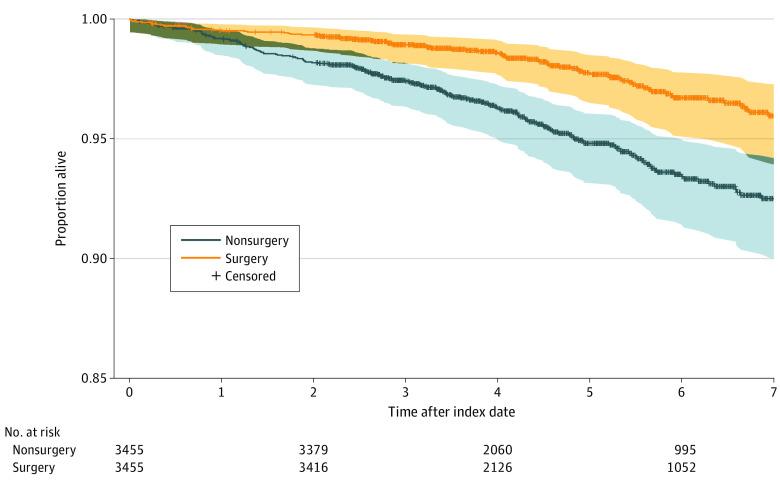
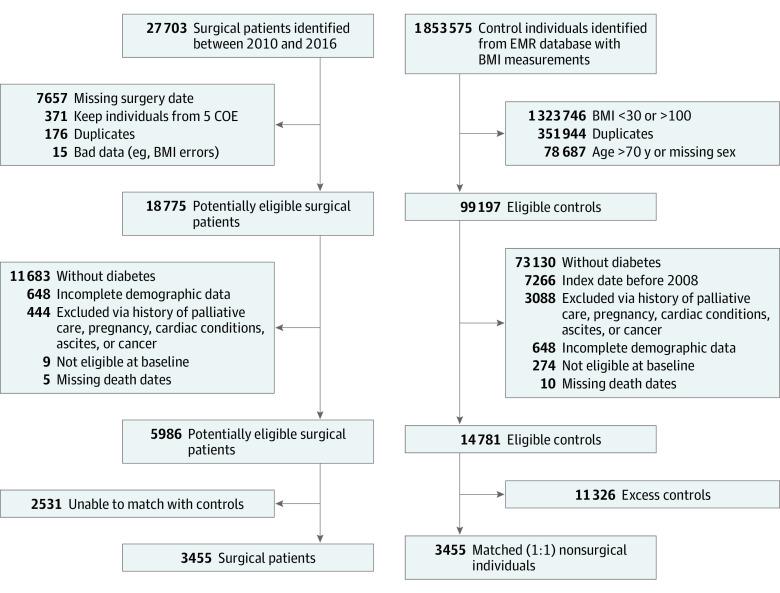
A total of 6910 patients (mean [SD] age at baseline, 52.04 [9.45] years; 4950 [71.6%] women) were included, with 3455 patients who underwent bariatric surgery and 3455 match controls and a median (interquartile range) follow-up time of 4.6 (3.22-6.35) years. In the surgery group, 83 patients (2.4%) died, compared with 178 individuals (5.2%) in the control group (hazard ratio [HR] 0.53 [95% CI, 0.41-0.69]; P < .001). Bariatric surgery was associated with a 68% lower cardiovascular mortality (HR, 0.32 [95% CI, 0.15-0.66]; P = .002) and a 34% lower rate of composite cardiac events (HR, 0.68 [95% CI, 0.55-0.85]; P < .001). Risk of nonfatal renal events was also 42% lower in the surgical group compared with the control group (HR, 0.58 [95% CI, 0.35-0.95], P = .03). Of the groups that had the highest absolute benefit associated with bariatric surgery, men had an absolute risk reduction (ARR) of 3.7% (95% CI, 1.7%-5.7%), individuals with more than 15 years of diabetes had an ARR of 4.3% (95% CI, 0.8%-7.8%), and individuals aged 55 years or older had an ARR of 4.7% (95% CI, 3.0%-6.4%).
CONCLUSIONS AND RELEVANCE
These findings suggest that bariatric surgery was associated with reduced all-cause mortality and diabetes-specific cardiac and renal outcomes in patients with type 2 diabetes and severe obesity.
重要性
有高质量的随机临床试验数据表明减重手术对 2 型糖尿病缓解的影响,但这些研究没有针对该患者群体的死亡率进行研究。有必要进行大型观察性研究,以研究 2 型糖尿病患者减重手术与死亡率之间的关联。
目的
确定减重手术与严重肥胖的 2 型糖尿病患者全因死亡率之间的关联。
设计、地点和参与者:这是一项回顾性、基于人群的匹配队列研究,纳入了 2010 年 1 月至 2016 年 12 月在加拿大安大略省接受过减重手术(胃旁路手术和袖状胃切除术)的 2 型糖尿病和 BMI(体重以千克为单位除以身高以米为单位的平方)35 或以上的患者。使用多个链接的行政数据库来确定混杂因素,包括年龄、基线 BMI、性别、合并症、糖尿病诊断持续时间、医疗保健利用、社会经济地位、吸烟状况、物质滥用、癌症筛查和精神病史。从初级保健电子病历数据库中确定潜在的对照。数据于 2020 年进行分析。
暴露
减重手术(胃旁路手术和袖状胃切除术)和初级保健医生提供的肥胖非手术管理。
主要结果和测量
主要结局是全因死亡率。次要结局是病因特异性死亡率和非致命性合并症。通过多变量 Cox 比例风险模型比较两组。
结果
共纳入 6910 名患者(基线时的平均[SD]年龄,52.04[9.45]岁;4950[71.6%]名女性),其中 3455 名患者接受了减重手术,3455 名匹配对照,中位(四分位间距)随访时间为 4.6(3.22-6.35)年。在手术组中,83 名患者(2.4%)死亡,而对照组中 178 名患者(5.2%)死亡(风险比[HR]0.53[95%CI,0.41-0.69];P<.001)。减重手术与心血管死亡率降低 68%相关(HR,0.32[95%CI,0.15-0.66];P=0.002),与复合心脏事件发生率降低 34%相关(HR,0.68[95%CI,0.55-0.85];P<.001)。与对照组相比,手术组的非致命性肾脏事件风险也降低了 42%(HR,0.58[95%CI,0.35-0.95],P=0.03)。在与减重手术关联度最高的群体中,男性的绝对风险降低(ARR)为 3.7%(95%CI,1.7%-5.7%),糖尿病病程超过 15 年的个体的 ARR 为 4.3%(95%CI,0.8%-7.8%),年龄在 55 岁或以上的个体的 ARR 为 4.7%(95%CI,3.0%-6.4%)。
结论和相关性
这些发现表明,在严重肥胖的 2 型糖尿病患者中,减重手术与全因死亡率以及糖尿病特定的心脏和肾脏结局降低相关。
 Zotero 插件