
局部注射透明质酸酶在引导骨再生手术中的疗效:一项随机对照试验。
Efficacy of local hyaluronidase administration in guided bone regeneration surgery: a randomized controlled trial.
作者信息
Kwoen Min-Jeong, Choi Yong-Hoon, Kim Keun-Suh, Chang Na-Hee, Kim Young-Kyun, Lee Hyo-Jung
机构信息
Department of Oral and Periodontology, Section of Dentistry, Seoul National University Bundang Hospital, Seoul, Korea.
Department of Conservative Dentistry, Section of Dentistry, Seoul National University Bundang Hospital, Seoul, Korea.
出版信息
J Korean Assoc Oral Maxillofac Surg. 2021 Apr 30;47(2):91-98. doi: 10.5125/jkaoms.2021.47.2.91.
OBJECTIVES
Hyaluronoglucosaminidase (hyaluronidase) increases the local intercellular permeability of the peripheral lymphatic channel and capillaries, which may help reduce edema. In the present study, the effects of hyaluronidase on postoperative edema and pain reduction were evaluated.
MATERIALS AND METHODS
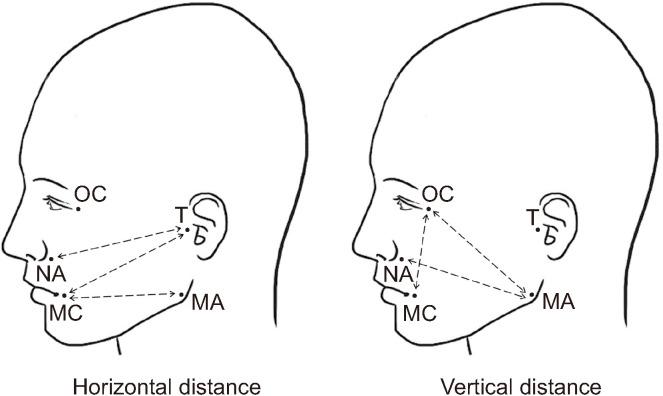
The study included 38 patients who underwent guided bone regeneration (GBR) surgery before implantation. Patients were randomly assigned to either the control group (n=20) or the test group (n=18). Hyaluronidase was injected into the GBR site of subjects in the test group. Postoperative edema was evaluated by measuring the distance between specific facial landmarks immediately after surgery (T1) and 2-4 days after surgery (T2). The degree of pain at T2 and at 10-14 days after surgery (T3) was assessed.
RESULTS
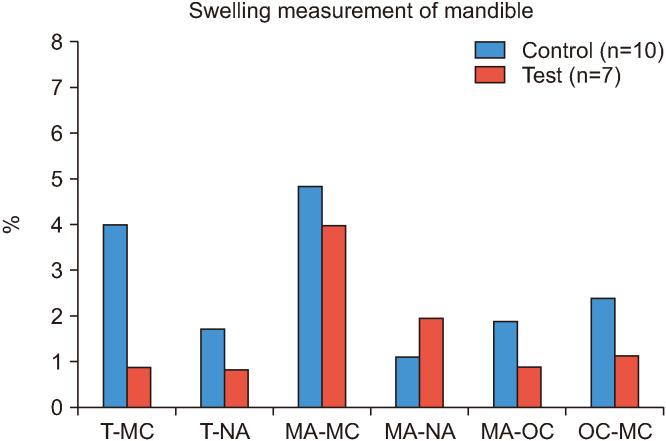
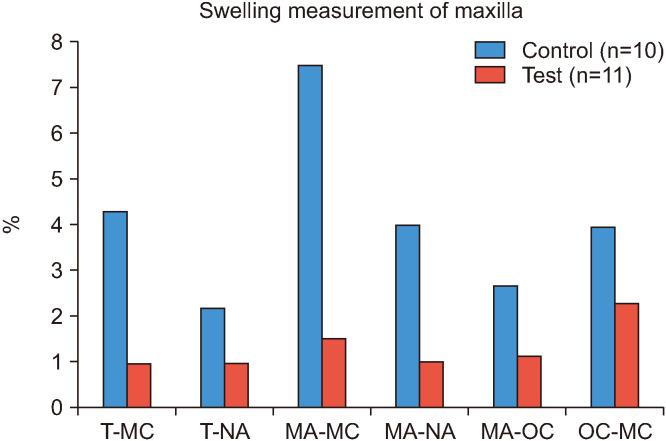
In the test group, the degree of swelling was lower than in the control group, however, only two measurements, from the tragus to the mouth corner and from the outer canthus to the mouth corner, showed statistically significant differences (=0.012 and =0.001, respectively). The anti-edema effect of hyaluronidase was more effective in the maxilla than in the mandible. In the maxilla, the percentage of facial swelling was significant for three measurements. However, in the mandible, the percentage of facial swelling was significant for only one measurement. Low levels of pain that were similar at T2 and T3 were reported in both groups.
CONCLUSION
The results indicate the degree of swelling was lower in the test group and hyaluronidase appeared to be more effective in the maxilla. The degree of pain reduction was similar between groups. Further in vivo and randomized controlled trials with larger sample sizes are warranted.
目的
透明质酸葡萄糖胺酶(透明质酸酶)可增加外周淋巴管和毛细血管的局部细胞间通透性,这可能有助于减轻水肿。在本研究中,评估了透明质酸酶对术后水肿和减轻疼痛的作用。
材料与方法
该研究纳入了38例在植入前接受引导骨再生(GBR)手术的患者。患者被随机分为对照组(n = 20)或试验组(n = 18)。将透明质酸酶注射到试验组受试者的GBR部位。通过测量手术后即刻(T1)和术后2 - 4天(T2)特定面部标志之间的距离来评估术后水肿。评估T2以及术后10 - 14天(T3)的疼痛程度。
结果
在试验组中,肿胀程度低于对照组,然而,只有从耳屏到口角以及从外眦到口角的两项测量显示出统计学显著差异(分别为 = 0.012和 = 0.001)。透明质酸酶的抗水肿作用在上颌比在下颌更有效。在上颌,三项测量的面部肿胀百分比具有显著性。然而,在下颌,只有一项测量的面部肿胀百分比具有显著性。两组在T2和T3时报告的疼痛程度较低且相似。
结论
结果表明试验组的肿胀程度较低,并且透明质酸酶在上颌似乎更有效。两组之间的疼痛减轻程度相似。有必要进行进一步的大样本量体内随机对照试验。

 Zotero 插件