
从墨西哥一家三级护理医院接受治疗的儿科患者血培养物中获得的分子特征分析。
Molecular Characterization of Obtained from Blood Cultures of Paediatric Patients Treated in a Tertiary Care Hospital in Mexico.
作者信息
Vazquez-Rosas Guillermo Jose, Merida-Vieyra Jocelin, Aparicio-Ozores Gerardo, Lara-Hernandez Antonino, De Colsa Agustin, Aquino-Andrade Alejandra
机构信息
Molecular Microbiology Laboratory, Instituto Nacional de Pediatria, Mexico City, Mexico.
Medical Bacteriology Laboratory, Instituto Politecnico Nacional, Mexico City, Mexico.
出版信息
Infect Drug Resist. 2021 Apr 21;14:1545-1556. doi: 10.2147/IDR.S302416. eCollection 2021.
PURPOSE
is one of the main causative agents of hospital-acquired (HA) infections. In Mexico, information about the characteristics of clinical isolates is limited. Our aim was to characterize strains obtained from blood cultures of paediatric patients treated in a tertiary care hospital.
MATERIALS AND METHODS
We analysed 249 isolates over the period from 2006 to 2019, and their resistance profiles were determined. The isolates were classified into methicillin-resistant (MRSA) or methicillin-sensitive (MSSA). Staphylococcal cassettes chromosome (SCC) were detected. Virulence genes ( and ) were amplified, and their clonal relationships were established by pulsed-field gel electrophoresis (PFGE), multilocus sequence typing (MLST) and clonal complex (CC) typing. We reviewed one hundred medical files to collect clinical information.
RESULTS
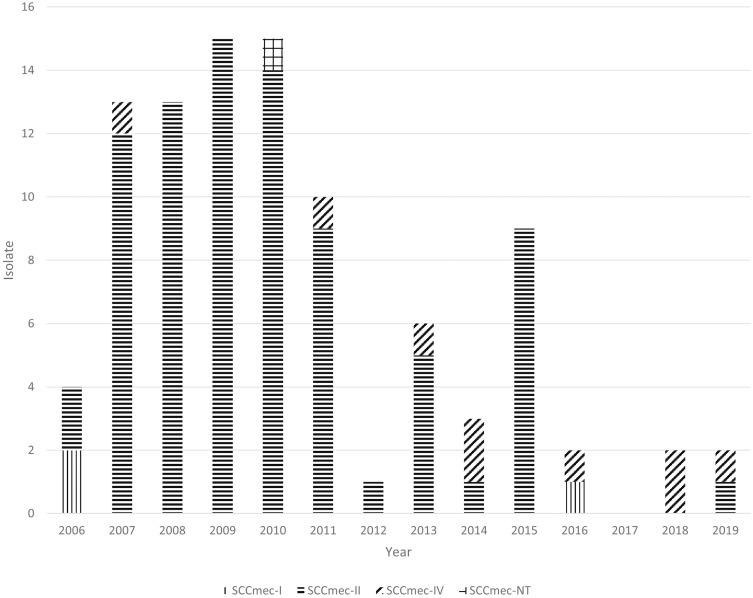
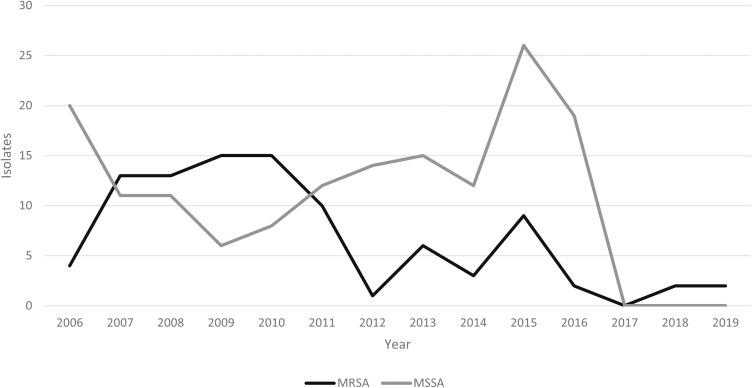
Thirty-eight percent of the isolates were MRSA and showed an expanded profile of resistance to other non-beta-lactam antibiotics, while MSSA strains presented a reduced resistance profile. SCCII was the most frequent element (86.3%). Eight virulence factors were detected in MSSA and six in MRSA. The gene was detected in four MRSA-SCCIV isolates (≤0.0001). MRSA isolates were distributed among 14 clones and were classified into 15 sequence types (ST); the most frequent was ST1011 (17%). The most common CC in MRSA was CC5 (69%, ≤0.0001), and in MSSA, it was CC30 (30%, ≤0.0001). Eighty-seven percent of MRSA isolates were HA-MRSA, and 13% were community-acquired MRSA (CA-MRSA). Of 21 HA-MRSA isolates, 17 had SCC-II, while two CA-MRSA isolates had SCC-IV. Of MSSA isolates, 77% were derived from HA infections and 23% from CA infections.
CONCLUSION
MSSA isolates had more virulence factors. MRSA isolates were resistant to more non-beta-lactam antibiotics, and those with SCC-IV expressed a greater variety of virulence factors. Most isolates belonged to CC5.
目的
是医院获得性(HA)感染的主要病原体之一。在墨西哥,关于临床分离株特征的信息有限。我们的目的是对在一家三级护理医院接受治疗的儿科患者血培养中获得的菌株进行特征分析。
材料与方法
我们分析了2006年至2019年期间的249株分离株,并确定了它们的耐药谱。分离株分为耐甲氧西林金黄色葡萄球菌(MRSA)或甲氧西林敏感金黄色葡萄球菌(MSSA)。检测葡萄球菌盒式染色体(SCC)。扩增毒力基因(和),并通过脉冲场凝胶电泳(PFGE)、多位点序列分型(MLST)和克隆复合体(CC)分型确定它们的克隆关系。我们查阅了100份病历以收集临床信息。
结果
38%的分离株为MRSA,对其他非β-内酰胺类抗生素呈现出扩大的耐药谱,而MSSA菌株的耐药谱则有所降低。SCCII是最常见的元件(86.3%)。在MSSA中检测到8种毒力因子,在MRSA中检测到6种。在4株MRSA-SCCIV分离株中检测到基因(≤0.0001)。MRSA分离株分布在14个克隆中,分为15种序列类型(ST);最常见的是ST1011(17%)。MRSA中最常见的CC是CC5(69%,≤0.0001),在MSSA中是CC30(30%,≤0.0001)。87%的MRSA分离株为HA-MRSA,13%为社区获得性MRSA(CA-MRSA)。在21株HA-MRSA分离株中,17株有SCC-II,而2株CA-MRSA分离株有SCC-IV。在MSSA分离株中,77%来自HA感染,23%来自CA感染。
结论
MSSA分离株具有更多毒力因子。MRSA分离株对更多非β-内酰胺类抗生素耐药,且携带SCC-IV的分离株表达的毒力因子种类更多。大多数分离株属于CC5。

 Zotero 插件