
基于红海中无脊椎动物的萜类化合物的计算机挖掘,寻找 SARS-CoV-2 主蛋白酶(M)抑制剂。
In Silico Mining of Terpenes from Red-Sea Invertebrates for SARS-CoV-2 Main Protease (M) Inhibitors.
机构信息
Computational Chemistry Laboratory, Chemistry Department, Faculty of Science, Minia University, Minia 61519, Egypt.
Chemistry of Medicinal Plants Department, National Research Centre, 33 El-Bohouth St., Dokki, Giza 12622, Egypt.
出版信息
Molecules. 2021 Apr 5;26(7):2082. doi: 10.3390/molecules26072082.
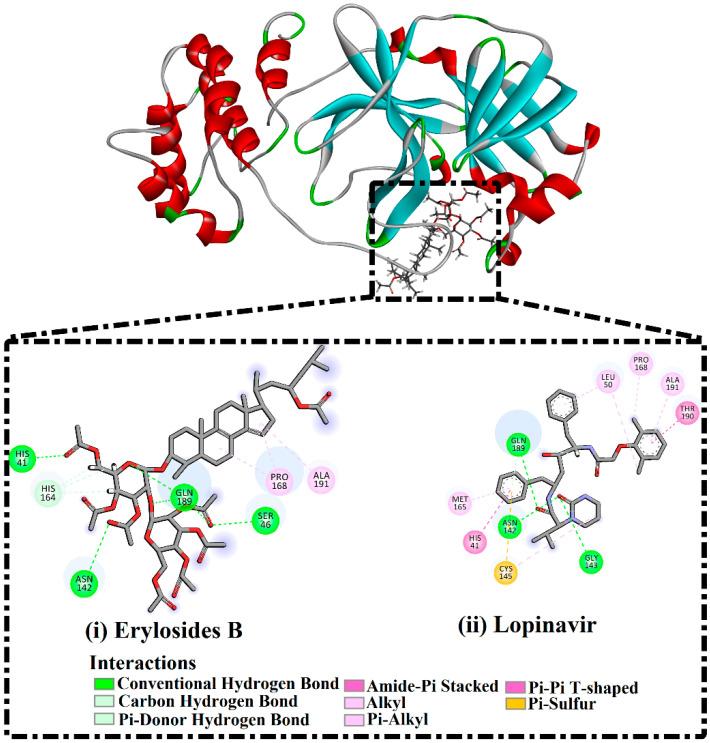
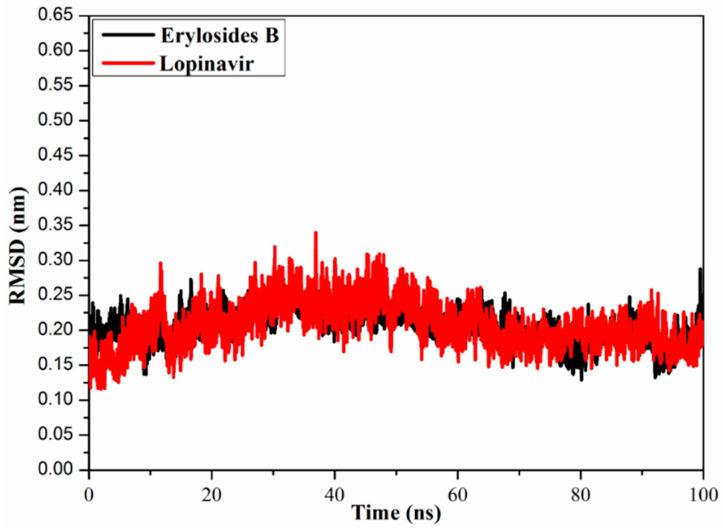
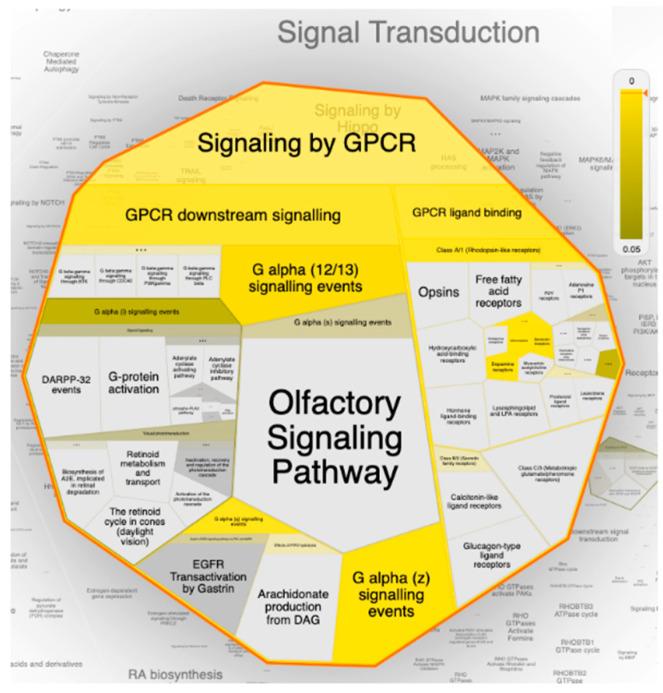
Severe acute respiratory syndrome coronavirus 2 (SARS-CoV-2) is the causative agent for the COVID-19 pandemic, which generated more than 1.82 million deaths in 2020 alone, in addition to 83.8 million infections. Currently, there is no antiviral medication to treat COVID-19. In the search for drug leads, marine-derived metabolites are reported here as prospective SARS-CoV-2 inhibitors. Two hundred and twenty-seven terpene natural products isolated from the biodiverse Red-Sea ecosystem were screened for inhibitor activity against the SARS-CoV-2 main protease (M) using molecular docking and molecular dynamics (MD) simulations combined with molecular mechanics/generalized Born surface area binding energy calculations. On the basis of analyses, six terpenes demonstrated high potency as M inhibitors with Δ ≤ -40.0 kcal/mol. The stability and binding affinity of the most potent metabolite, erylosides B, were compared to the human immunodeficiency virus protease inhibitor, lopinavir. Erylosides B showed greater binding affinity towards SARS-CoV-2 M than lopinavir over 100 ns with Δ values of -51.9 vs. -33.6 kcal/mol, respectively. Protein-protein interactions indicate that erylosides B biochemical signaling shares gene components that mediate severe acute respiratory syndrome diseases, including the cytokine- and immune-signaling components , , and . Pathway enrichment analysis and Boolean network modeling were performed towards a deep dissection and mining of the erylosides B target-function interactions. The current study identifies erylosides B as a promising anti-COVID-19 drug lead that warrants further and testing.
严重急性呼吸综合征冠状病毒 2 (SARS-CoV-2) 是 COVID-19 大流行的病原体,仅在 2020 年就导致超过 182 万人死亡,另有 8380 万人感染。目前,尚无治疗 COVID-19 的抗病毒药物。在寻找药物先导物的过程中,这里报道了海洋衍生代谢物作为有前途的 SARS-CoV-2 抑制剂。从生物多样性丰富的红海生态系统中分离出的 227 种萜类天然产物,通过分子对接和分子动力学(MD)模拟结合分子力学/广义 Born 表面面积结合能计算,对 SARS-CoV-2 主蛋白酶(M)的抑制剂活性进行了筛选。基于分析,有 6 种萜类化合物表现出作为 M 抑制剂的高活性,Δ ≤ -40.0 kcal/mol。与人类免疫缺陷病毒蛋白酶抑制剂洛匹那韦相比,最有效的代谢物 erylosides B 的稳定性和结合亲和力进行了比较。Erylosides B 对 SARS-CoV-2 M 的结合亲和力大于洛匹那韦,在 100 ns 内的Δ值分别为-51.9 和-33.6 kcal/mol。蛋白质-蛋白质相互作用表明,erylosides B 的生化信号与介导严重急性呼吸综合征疾病的基因成分共享,包括细胞因子和免疫信号成分 、 、 。通路富集分析和布尔网络建模用于深入剖析和挖掘 erylosides B 的靶标功能相互作用。本研究确定 erylosides B 是一种有前途的抗 COVID-19 药物先导物,值得进一步 和 测试。





 Zotero 插件