
产前邻苯二甲酸盐暴露与脐带甲状腺激素:台湾南部的一项出生队列研究。
Prenatal Phthalates Exposure and Cord Thyroid Hormones: A Birth Cohort Study in Southern Taiwan.
作者信息
Huang Po-Chin, Kuo Pao-Lin, Chang Wei-Hsiang, Shih Shu-Fang, Chang Wan-Ting, Lee Ching-Chang
机构信息
National Institute of Environmental Health Sciences, National Health Research Institutes, Miaoli 350, Taiwan.
Research Center for Environmental Medicine, Kaohsiung Medical University, Kaohsiung 807, Taiwan.
出版信息
Int J Environ Res Public Health. 2021 Apr 19;18(8):4323. doi: 10.3390/ijerph18084323.
BACKGROUND
The regulation of thyroid hormones in the early stages of gestation plays a crucial role in the outcome of a pregnancy. Furthermore, thyroid hormones are fundamental for the fetal development of all organs, including endocrine hormone changes in uterus. Endocrine disrupting chemicals have been shown to have an effect on thyroid hormone homeostasis in newborns, which affects their later development. Few studies have proposed how phthalates could alter thyroid function through several mechanisms and the possible effects on thyroid hormone homeostasis of phthalates on pregnant women. However, the effects of cord blood phthalates and prenatal phthalate exposure on thyroid hormones in newborns remain unclear.
OBJECTIVES
We aim to follow up on our previous established subjects and determine the correlation between phthalate exposure and thyroid hormones in pregnant women and newborns.
MATERIALS AND METHODS
We recruited 61 pregnant women from the Obstetrics and Gynecology Department of a medical hospital in southern Taiwan and followed up. High performance liquid chromatography electrospray ionization tandem mass spectrometry (HPLC-ESI-MS/MS) was used to analyze urine samples for five phthalate metabolites. Serum levels of thyroid hormones were analyzed using electrochemoluminescence immunoassay (ECLIA) method. We used Spearman and Pearson correlation coefficients to evaluate the correlation between each phthalate metabolites in serum and the thyroid hormone levels in fetus and parturient. Finally, multiple logistic regression was used to explore the relationship between hormones and their corresponding phthalate metabolites in cord blood.
RESULTS
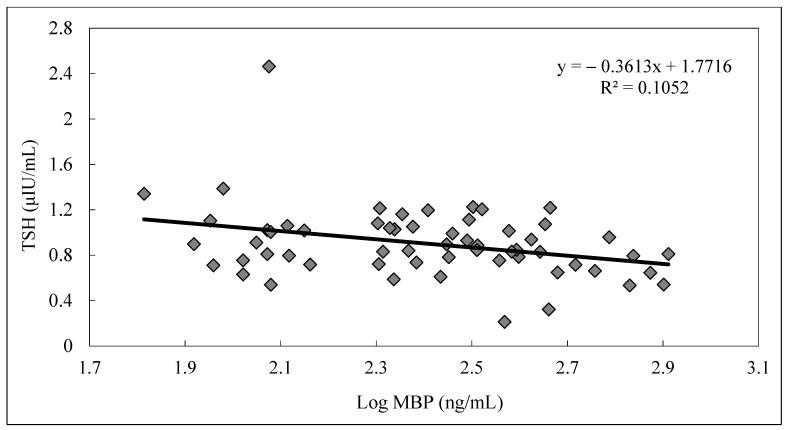
High MBP in cord blood was correlated with negative cord serum TSH in newborns (r = -0.25, < 0.06). By using multiple linear regression after adjusting for potential confounders (gestational and maternal age), cord serum MBP levels showed a negative association with cord serum TSH (β = 0.217, < 0.05), cord serum T (β = 1.71, < 0.05) and cord serum T × TSH (β = 42.8, < 0.05), respectively.
CONCLUSION
We found that levels of cord serum TSH and T in newborns was significantly negatively associated with cord serum MBP levels after adjusting for significant covariate. The fall in TSH in newborns may potentially be delaying their development.
背景
孕期早期甲状腺激素的调节对妊娠结局起着至关重要的作用。此外,甲状腺激素对包括子宫内分泌激素变化在内的所有器官的胎儿发育至关重要。已表明内分泌干扰化学物质会影响新生儿的甲状腺激素稳态,进而影响其后期发育。很少有研究提出邻苯二甲酸盐如何通过多种机制改变甲状腺功能以及邻苯二甲酸盐对孕妇甲状腺激素稳态的可能影响。然而,脐血邻苯二甲酸盐和产前邻苯二甲酸盐暴露对新生儿甲状腺激素的影响仍不清楚。
目的
我们旨在对之前建立的研究对象进行随访,并确定孕妇和新生儿中邻苯二甲酸盐暴露与甲状腺激素之间的相关性。
材料与方法
我们从台湾南部一家医院的妇产科招募了61名孕妇并进行随访。采用高效液相色谱电喷雾电离串联质谱法(HPLC - ESI - MS/MS)分析尿液样本中的五种邻苯二甲酸酯代谢物。使用电化学发光免疫分析法(ECLIA)分析血清甲状腺激素水平。我们使用Spearman和Pearson相关系数来评估血清中每种邻苯二甲酸酯代谢物与胎儿和产妇甲状腺激素水平之间的相关性。最后,使用多元逻辑回归来探讨脐血中激素与其相应邻苯二甲酸酯代谢物之间的关系。
结果
脐血中高浓度的单丁基邻苯二甲酸酯(MBP)与新生儿脐血血清促甲状腺激素(TSH)呈负相关(r = -0.25,P < 0.06)。在调整潜在混杂因素(孕周和产妇年龄)后进行多元线性回归分析,脐血血清MBP水平与脐血血清TSH(β = 0.217,P < 0.05)、脐血血清总甲状腺素(T)(β = 1.71,P < 0.05)以及脐血血清T×TSH(β = 42.8,P < 0.05)分别呈负相关。
结论
我们发现,在调整显著协变量后,新生儿脐血血清TSH和T水平与脐血血清MBP水平显著负相关。新生儿TSH的下降可能会潜在地延迟其发育。
 Zotero 插件