
社会经济剥夺与麻疹发病率呈负相关:德国 2001 至 2017 年的小面积纵向分析。
Socioeconomic deprivation is inversely associated with measles incidence: a longitudinal small-area analysis, Germany, 2001 to 2017.
机构信息
Section for Health Equity Studies and Migration, Department of General Practice and Health Services Research, University Hospital Heidelberg, Heidelberg, Germany.
Department of Population Medicine and Health Services Research, School of Public Health, Bielefeld University, Bielefeld, Germany.
出版信息
Euro Surveill. 2021 Apr;26(17). doi: 10.2807/1560-7917.ES.2021.26.17.1900755.
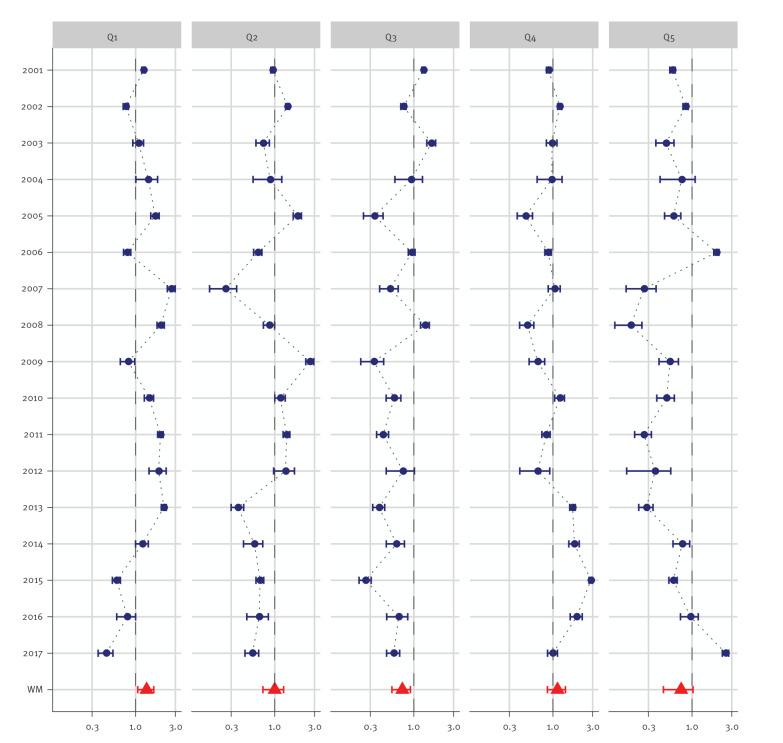
BackgroundAlthough measles is endemic throughout the World Health Organization European Region, few studies have analysed socioeconomic inequalities and spatiotemporal variations in the disease's incidence.AimTo study the association between socioeconomic deprivation and measles incidence in Germany, while considering relevant demographic, spatial and temporal factors.MethodsWe conducted a longitudinal small-area analysis using nationally representative linked data in 401 districts (2001-2017). We used spatiotemporal Bayesian regression models to assess the potential effect of area deprivation on measles incidence, adjusted for demographic and geographical factors, as well as spatial and temporal effects. We estimated risk ratios (RR) for deprivation quintiles (Q1-Q5), and district-specific adjusted relative risks (ARR) to assess the area-level risk profile of measles in Germany.ResultsThe risk of measles incidence in areas with lowest deprivation quintile (Q1) was 1.58 times higher (95% credible interval (CrI): 1.32-2.00) than in those with highest deprivation (Q5). Areas with medium-low (Q2), medium (Q3) and medium-high deprivation (Q4) had higher adjusted risks of measles relative to areas with highest deprivation (Q5) (RR: 1.23, 95%CrI: 0.99-1.51; 1.05, 95%CrI: 0.87-1.26 and 1.23, 95%CrI: 1.05-1.43, respectively). We identified 54 districts at medium-high risk for measles (ARR > 2) in Germany, of which 22 were at high risk (ARR > 3).ConclusionSocioeconomic deprivation in Germany, one of Europe's most populated countries, is inversely associated with measles incidence. This association persists after demographic and spatiotemporal factors are considered. The social, spatial and temporal patterns of elevated risk require targeted public health action and policy to address the complexity underlying measles epidemiology.
背景
尽管麻疹在世界卫生组织欧洲区域普遍存在,但很少有研究分析该疾病发病率的社会经济不平等和时空变化。
目的
研究德国社会经济贫困与麻疹发病率之间的关联,同时考虑相关的人口统计学、空间和时间因素。
方法
我们使用全国代表性的 401 个区(2001-2017 年)的关联数据进行了纵向小区域分析。我们使用时空贝叶斯回归模型来评估区域贫困对麻疹发病率的潜在影响,同时调整了人口统计学和地理因素以及空间和时间效应。我们估计了贫困五分位数(Q1-Q5)的风险比(RR),并评估了德国各地区麻疹的特定地区调整相对风险(ARR)。
结果
在最低贫困五分位数(Q1)地区,麻疹发病率的风险比(RR)是最高贫困五分位数(Q5)地区的 1.58 倍(95%可信区间(CrI):1.32-2.00)。中低贫困(Q2)、中等(Q3)和中高贫困(Q4)地区的麻疹调整后风险高于最高贫困(Q5)地区(RR:1.23,95%CrI:0.99-1.51;1.05,95%CrI:0.87-1.26 和 1.23,95%CrI:1.05-1.43)。我们确定了德国 54 个麻疹中度高风险地区(ARR>2),其中 22 个地区处于高风险(ARR>3)。
结论
在欧洲人口最多的国家之一的德国,社会经济贫困与麻疹发病率呈负相关。在考虑人口统计学和时空因素后,这种关联仍然存在。高风险的社会、空间和时间模式需要采取有针对性的公共卫生行动和政策,以解决麻疹流行病学背后的复杂性。




 Zotero 插件