Division of Research, Kaiser Permanente Northern California, Oakland.
Department of Health System Science, Kaiser Permanente Bernard J. Tyson School of Medicine, Pasadena, California.
JAMA Netw Open. 2021 Apr 1;4(4):e218559. doi: 10.1001/jamanetworkopen.2021.8559.
For lung cancer screening to confer mortality benefit, adherence to annual screening with low-dose computed tomography scans is essential. Although the National Lung Screening Trial had an adherence rate of 95%, current data are limited on screening adherence across diverse practice settings in the United States.
To evaluate patterns and factors associated with adherence to annual screening for lung cancer after negative results of a baseline examination, particularly in centralized vs decentralized screening programs.
DESIGN, SETTING, AND PARTICIPANTS: This observational cohort study was conducted at 5 academic and community-based sites in North Carolina and California among 2283 individuals screened for lung cancer between July 1, 2014, and March 31, 2018, who met US Preventive Services Task Force eligibility criteria, had negative results of a baseline screening examination (American College of Radiology Lung Imaging Reporting and Data System category 1 or 2), and were eligible to return for a screening examination in 12 months.
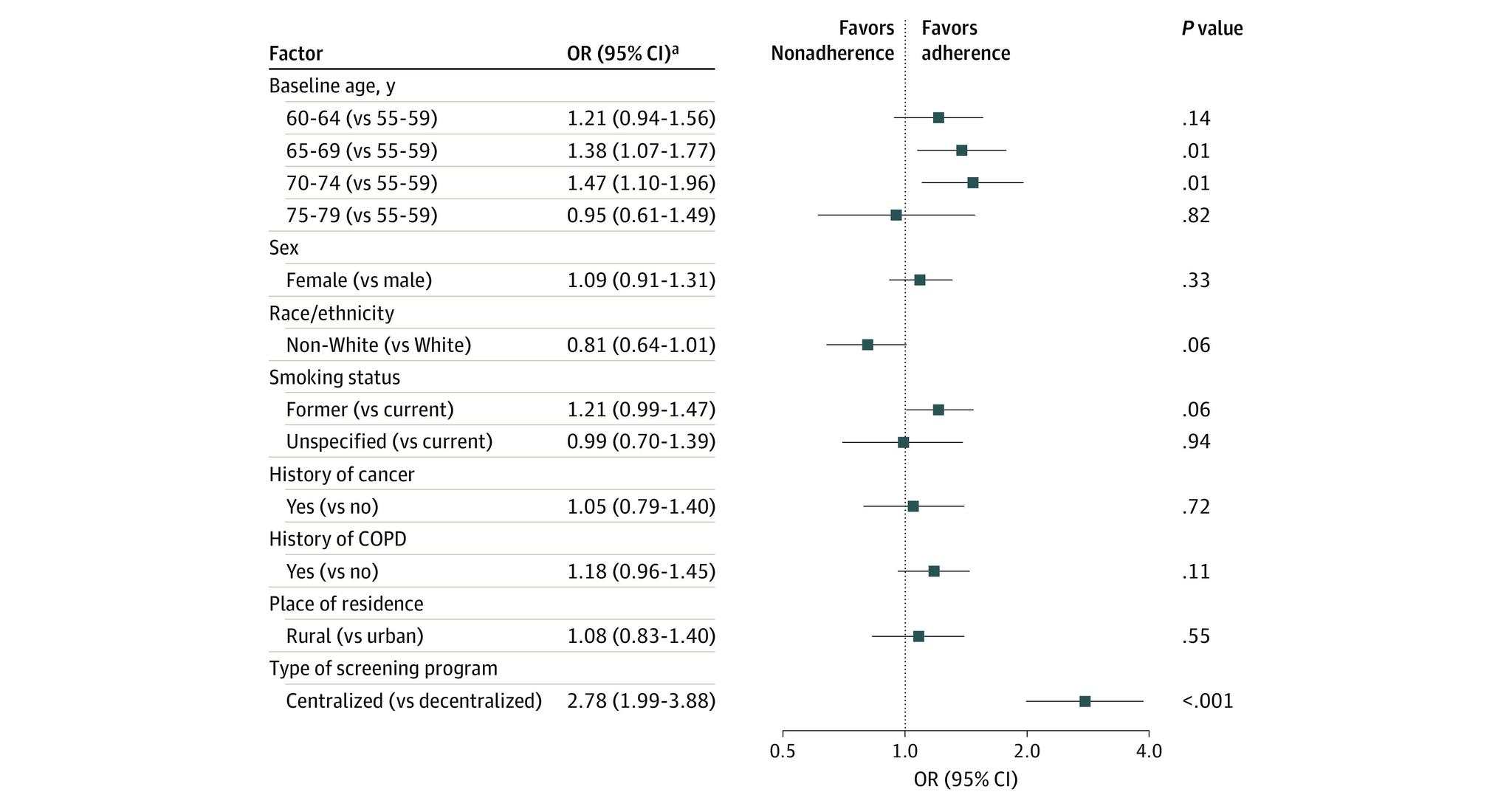
To identify factors associated with adherence, the association of adherence with selected baseline demographic and clinical characteristics, including type of screening program, was estimated using multivariable logistic regression. Screening program type was classified as centralized if individuals were referred through a lung cancer screening clinic or program and as decentralized if individuals had a direct clinician referral for the baseline low-dose computed tomography scan.
Adherence to annual lung cancer screening, defined as a second low-dose computed tomography scan within 11 to 15 months after baseline screening.
Among the 2283 eligible individuals (1294 men [56.7%]; mean [SD] age, 64.9 [5.8] years; 1160 [50.8%] aged ≥65 years) who had negative screening results at baseline, overall adherence was 40.2% (n = 917), with higher adherence among those who underwent screening through centralized (46.0% [478 of 1039]) vs decentralized (35.3% [439 of 1244]) programs. The independent factor most strongly associated with adherence was type of screening program, with a 2.8-fold increased likelihood of adherence associated with centralized screening (adjusted odds ratio [aOR], 2.78; 95% CI, 1.99-3.88). Another associated factor was age (65-69 vs 55-59 years: aOR, 1.38; 95% CI, 1.07-1.77; 70-74 vs 55-59 years: aOR, 1.47; 95% CI, 1.10-1.96).
After negative results of a baseline examination, adherence to annual lung cancer screening was suboptimal, although adherence was higher among individuals who were screened through a centralized program. These results support the value of centralized screening programs and the need to further implement strategies that improve adherence to annual screening for lung cancer.
为了使肺癌筛查带来死亡率获益,每年进行低剂量计算机断层扫描的筛查至关重要。尽管国家肺癌筛查试验的依从率达到了 95%,但目前在美国不同实践环境中,关于筛查依从性的相关数据有限。
评估在基线检查结果为阴性后,对肺癌进行年度筛查的模式和与依从性相关的因素,尤其是在集中式与分散式筛查计划中。
设计、地点和参与者:这是一项在北卡罗来纳州和加利福尼亚州的 5 个学术和社区基地进行的观察性队列研究,共纳入了 2283 名符合美国预防服务工作组资格标准的个体,这些个体在 2014 年 7 月 1 日至 2018 年 3 月 31 日期间接受了肺癌筛查,且基线筛查检查结果为阴性(美国放射学院肺部成像报告和数据系统类别 1 或 2),且有资格在 12 个月后进行筛查。
为了确定与依从性相关的因素,使用多变量逻辑回归估计了与选定的基线人口统计学和临床特征相关的依从性,包括筛查计划类型。如果个体通过肺癌筛查诊所或计划被转介,则将筛查计划类型归类为集中式,如果个体有直接临床医生转介进行基线低剂量计算机断层扫描,则将其归类为分散式。
年度肺癌筛查的依从性定义为在基线筛查后 11 至 15 个月内进行第二次低剂量计算机断层扫描。
在 2283 名符合条件的个体(1294 名男性[56.7%];平均[标准差]年龄为 64.9[5.8]岁;1160 名[50.8%]年龄≥65 岁)中,基线筛查结果为阴性的个体中,总体依从率为 40.2%(n=917),集中式筛查(46.0%[478/1039])的依从率高于分散式筛查(35.3%[439/1244])。与依从性最密切相关的独立因素是筛查计划类型,与分散式筛查相比,集中式筛查的依从性增加了 2.8 倍(调整后的优势比[OR],2.78;95%CI,1.99-3.88)。另一个相关因素是年龄(65-69 岁比 55-59 岁:OR,1.38;95%CI,1.07-1.77;70-74 岁比 55-59 岁:OR,1.47;95%CI,1.10-1.96)。
在基线检查结果为阴性后,年度肺癌筛查的依从性并不理想,尽管通过集中式计划进行筛查的个体依从性更高。这些结果支持集中式筛查计划的价值,并需要进一步实施策略,以提高对肺癌年度筛查的依从性。


 Zotero 插件