
在接受结直肠癌肝转移根治性切除术后患者中循环肿瘤 DNA 动力学与复发风险:一项前瞻性队列研究。
Circulating tumor DNA dynamics and recurrence risk in patients undergoing curative intent resection of colorectal cancer liver metastases: A prospective cohort study.
机构信息
The Walter and Eliza Hall Institute of Medical Research, Melbourne, Australia.
Western Health, Melbourne, Australia.
出版信息
PLoS Med. 2021 May 3;18(5):e1003620. doi: 10.1371/journal.pmed.1003620. eCollection 2021 May.
BACKGROUND
In patients with resectable colorectal liver metastases (CRLM), the role of pre- and postoperative systemic therapy continues to be debated. Previous studies have shown that circulating tumor DNA (ctDNA) analysis, as a marker of minimal residual disease, is a powerful prognostic factor in patients with nonmetastatic colorectal cancer (CRC). Serial analysis of ctDNA in patients with resectable CRLM could inform the optimal use of perioperative chemotherapy. Here, we performed a validation study to confirm the prognostic impact of postoperative ctDNA in resectable CRLM observed in a previous discovery study.
METHODS AND FINDINGS
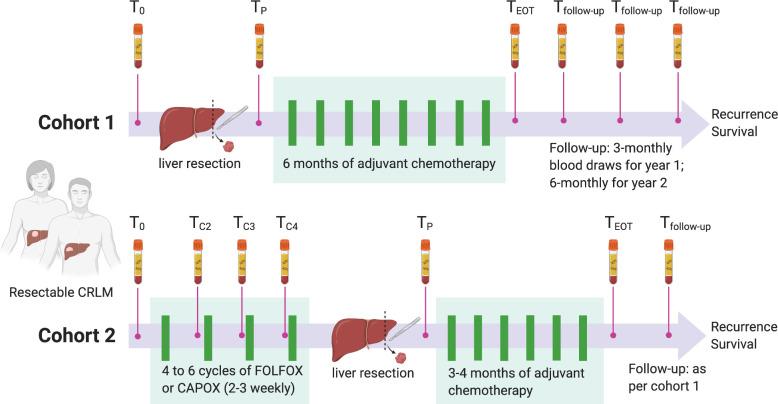
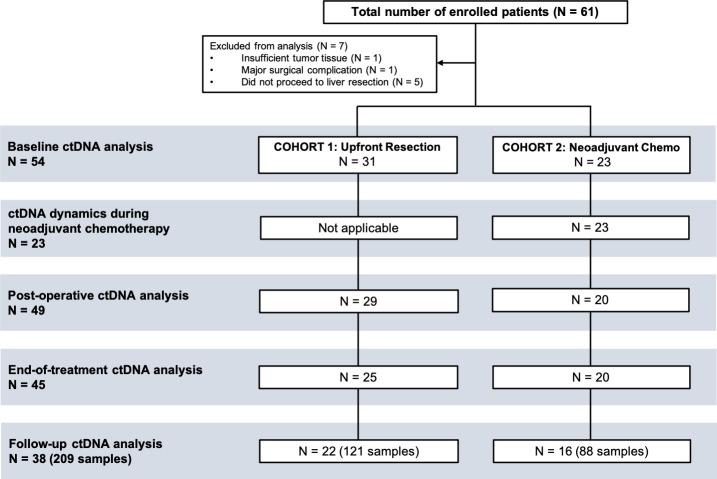
We prospectively collected plasma samples from patients with resectable CRLM, including presurgical and postsurgical samples, serial samples during any pre- or postoperative chemotherapy, and serial samples in follow-up. Via targeted sequencing of 15 genes commonly mutated in CRC, we identified at least 1 somatic mutation in each patient's tumor. We then designed a personalized assay to assess 1 mutation in plasma samples using the Safe-SeqS assay. A total of 380 plasma samples from 54 patients recruited from July 2011 to Dec 2014 were included in our analysis. Twenty-three (43%) patients received neoadjuvant chemotherapy, and 42 patients (78%) received adjuvant chemotherapy after surgery. Median follow-up was 51 months (interquartile range, 31 to 60 months). At least 1 somatic mutation was identified in all patients' tumor tissue. ctDNA was detectable in 46/54 (85%) patients prior to any treatment and 12/49 (24%) patients after surgery. There was a median 40.93-fold (19.10 to 87.73, P < 0.001) decrease in ctDNA mutant allele fraction with neoadjuvant chemotherapy, but ctDNA clearance during neoadjuvant chemotherapy was not associated with a better recurrence-free survival (RFS). Patients with detectable postoperative ctDNA experienced a significantly lower RFS (HR 6.3; 95% CI 2.58 to 15.2; P < 0.001) and overall survival (HR 4.2; 95% CI 1.5 to 11.8; P < 0.001) compared to patients with undetectable ctDNA. For the 11 patients with detectable postoperative ctDNA who had serial ctDNA sampling during adjuvant chemotherapy, ctDNA clearance was observed in 3 patients, 2 of whom remained disease-free. All 8 patients with persistently detectable ctDNA after adjuvant chemotherapy have recurred. End-of-treatment (surgery +/- adjuvant chemotherapy) ctDNA detection was associated with a 5-year RFS of 0% compared to 75.6% for patients with an undetectable end-of-treatment ctDNA (HR 14.9; 95% CI 4.94 to 44.7; P < 0.001). Key limitations of the study include the small sample size and the potential for false-positive findings with multiple hypothesis testing.
CONCLUSIONS
We confirmed the prognostic impact of postsurgery and posttreatment ctDNA in patients with resected CRLM. The potential utility of serial ctDNA analysis during adjuvant chemotherapy as an early marker of treatment efficacy was also demonstrated. Further studies are required to define how to optimally integrate ctDNA analyses into decision-making regarding the use and timing of adjuvant therapy for resectable CRLM.
TRIAL REGISTRATION
ACTRN12612000345886.
背景
在可切除结直肠肝转移(CRLM)患者中,术前和术后全身治疗的作用仍存在争议。先前的研究表明,循环肿瘤 DNA(ctDNA)分析作为微小残留疾病的标志物,是非转移性结直肠癌(CRC)患者强有力的预后因素。对可切除 CRLM 患者的 ctDNA 进行连续分析可以为围手术期化疗的最佳应用提供信息。在这里,我们进行了一项验证研究,以确认之前发现研究中观察到的可切除 CRLM 患者术后 ctDNA 的预后影响。
方法和发现
我们前瞻性地收集了包括术前和术后样本在内的可切除 CRLM 患者的血浆样本,在术前或术后任何化疗期间进行了连续样本采集,以及在随访期间进行了连续样本采集。通过对 15 个常见 CRC 突变基因的靶向测序,我们在每个患者的肿瘤中都鉴定出至少 1 个体细胞突变。然后,我们使用 Safe-SeqS 测定法设计了一种个性化的检测方法,以评估血浆样本中的 1 个突变。共纳入了 2011 年 7 月至 2014 年 12 月期间招募的 54 名患者的 380 份血浆样本进行分析。23 名(43%)患者接受了新辅助化疗,42 名(78%)患者在手术后接受了辅助化疗。中位随访时间为 51 个月(四分位距,31 至 60 个月)。所有患者的肿瘤组织中均鉴定出至少 1 个体细胞突变。在任何治疗之前,46/54(85%)名患者的 ctDNA 可检测到,而手术后 12/49(24%)名患者的 ctDNA 可检测到。新辅助化疗后,ctDNA 突变等位基因分数中位数降低了 40.93 倍(19.10 至 87.73,P<0.001),但新辅助化疗期间 ctDNA 清除与无复发生存期(RFS)无相关性。术后可检测到 ctDNA 的患者 RFS(HR 6.3;95%CI 2.58 至 15.2;P<0.001)和总生存期(HR 4.2;95%CI 1.5 至 11.8;P<0.001)明显降低,与无法检测到 ctDNA 的患者相比。在 11 名术后可检测到 ctDNA 的患者中,有 3 名患者在辅助化疗期间进行了连续 ctDNA 采样,其中 2 名患者仍无疾病。所有 8 名在辅助化疗后持续检测到 ctDNA 的患者均复发。手术(加/不加辅助化疗)结束时的 ctDNA 检测与无法检测到手术结束时 ctDNA 的患者的 5 年 RFS 为 0%相比(HR 14.9;95%CI 4.94 至 44.7;P<0.001)。研究的主要局限性包括样本量小和多次假设检验可能导致假阳性发现。
结论
我们证实了术后和治疗后 ctDNA 在可切除 CRLM 患者中的预后影响。还证明了在辅助化疗期间进行连续 ctDNA 分析作为治疗效果早期标志物的潜在效用。需要进一步的研究来确定如何将 ctDNA 分析最佳整合到可切除 CRLM 患者辅助治疗的使用和时间决策中。
试验注册
ACTRN12612000345886。



 Zotero 插件