
复合 CD79A/CD40 共刺激内源性结构域增强了 CD19CAR-T 细胞的增殖和存活。
Composite CD79A/CD40 co-stimulatory endodomain enhances CD19CAR-T cell proliferation and survival.
机构信息
Department of Hematology and Oncology, Nagoya University Graduate School of Medicine, Nagoya, Aichi 466-8560, Japan; Hematology Unit, Division of Internal Medicine, Faculty of Medicine, Prince of Songkla University, Songkhla, Thailand.
Department of Hematology and Oncology, Nagoya University Graduate School of Medicine, Nagoya, Aichi 466-8560, Japan.
出版信息
Mol Ther. 2021 Sep 1;29(9):2677-2690. doi: 10.1016/j.ymthe.2021.04.038. Epub 2021 May 1.
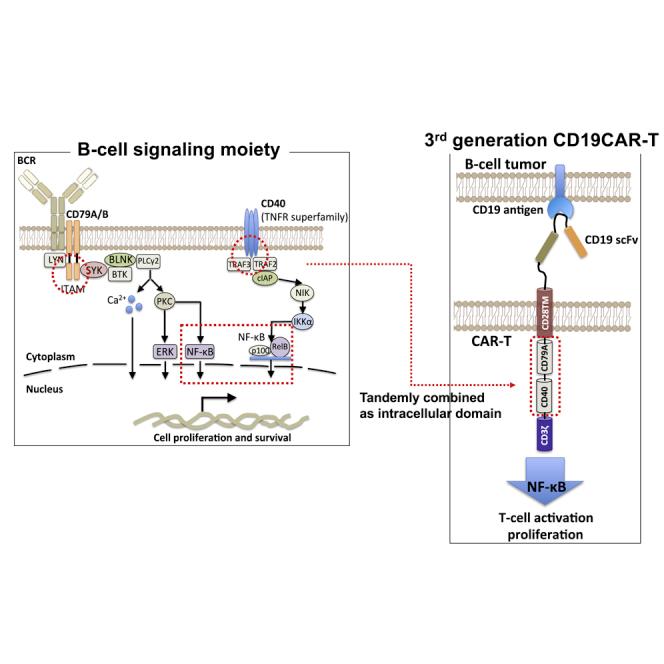
Adoptively transferred CD19 chimeric antigen receptor (CAR) T cells have led to impressive clinical outcomes in B cell malignancies. Beyond induction of remission, the persistence of CAR-T cells is required to prevent relapse and provide long-term disease control. To improve CAR-T cell function and persistence, we developed a composite co-stimulatory domain of a B cell signaling moiety, CD79A/CD40, to induce a nuclear translocating signal, NF-κB, to synergize with other T cell signals and improve CAR-T cell function. CD79A/CD40 incorporating CD19CAR-T cells (CD19.79a.40z) exhibited higher NF-κB and p38 activity upon CD19 antigen exposure compared with the CD28 or 4-1BB incorporating CD19CAR-T cells (CD19.28z and CD19.BBz). Notably, we found that CD19.79a.40z CAR-T cells continued to suppress CD19 target cells throughout the co-culture assay, whereas a tendency for tumor growth was observed with CD19.28z CAR-T cells. Moreover, CD19.79a.40z CAR-T cells exhibited robust T cell proliferation after culturing with CD19 target cells, regardless of exogenous interleukin-2. In terms of in vivo efficiency, CD19.79a.40z demonstrated superior anti-tumor activity and in vivo CAR-T cell proliferation compared with CD19.28z and CD19.BBz CD19CAR-T cells in Raji-inoculated mice. Our data demonstrate that the CD79A/CD40 co-stimulatory domain endows CAR-T cells with enhanced proliferative capacity and improved anti-tumor efficacy in a murine model.
嵌合抗原受体(CAR)T 细胞过继转移在 B 细胞恶性肿瘤中取得了令人瞩目的临床疗效。除了诱导缓解外,还需要 CAR-T 细胞的持续存在来预防复发并提供长期疾病控制。为了提高 CAR-T 细胞的功能和持久性,我们开发了一种 B 细胞信号部分的 CD79A/CD40 复合共刺激结构域,以诱导核易位信号 NF-κB,与其他 T 细胞信号协同作用,改善 CAR-T 细胞功能。与包含 CD28 或 4-1BB 的 CD19CAR-T 细胞(CD19.28z 和 CD19.BBz)相比,含有 CD79A/CD40 的 CD19CAR-T 细胞(CD19.79a.40z)在暴露于 CD19 抗原时表现出更高的 NF-κB 和 p38 活性。值得注意的是,我们发现 CD19.79a.40z CAR-T 细胞在整个共培养试验中继续抑制 CD19 靶细胞,而 CD19.28z CAR-T 细胞则观察到肿瘤生长的趋势。此外,CD19.79a.40z CAR-T 细胞在与 CD19 靶细胞培养后表现出强大的 T 细胞增殖,无论是否存在外源性白细胞介素-2。在体内效率方面,与 CD19.28z 和 CD19.BBz CD19CAR-T 细胞相比,CD19.79a.40z 在 Raji 接种小鼠中表现出更好的抗肿瘤活性和体内 CAR-T 细胞增殖。我们的数据表明,CD79A/CD40 共刺激结构域赋予 CAR-T 细胞增强的增殖能力,并在小鼠模型中提高了抗肿瘤疗效。
 Zotero 插件