
骨和软组织肉瘤免疫评分模型的基因表达谱。
Gene expression profiles for an immunoscore model in bone and soft tissue sarcoma.
机构信息
Department of Orthopedics, The First Affiliated Hospital of Guangxi Medical University, Nanning, Guangxi, China.
School of Graduate, Guangxi Medical University, Nanning, Guangxi, China.
出版信息
Aging (Albany NY). 2021 May 4;13(10):13708-13725. doi: 10.18632/aging.202956.
BACKGROUND
Immune infiltration is a prognostic marker to clinical outcomes in various solid tumors. However, reports that focus on bone and soft tissue sarcoma are rare. The study aimed to analyze and identify how immune components influence prognosis and develop a novel prognostic system for sarcomas.
METHODS
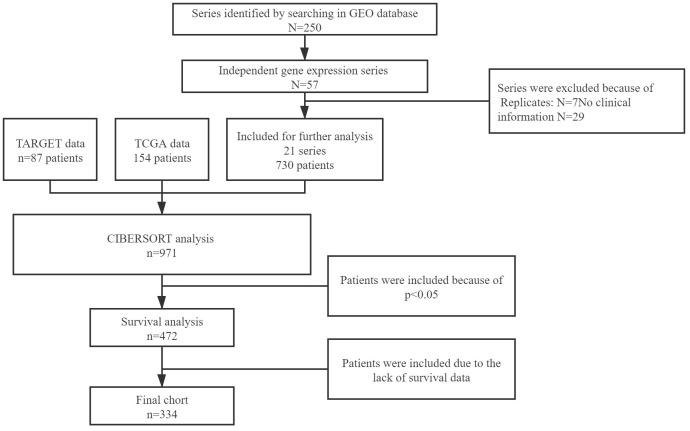
We retrieved the gene expression data from 3 online databases (GEO, TCGA, and TARGET). The immune fraction was estimated using the CIBERSORT algorithm. After that, we re-clustered samples by K-means and constructed immunoscore by the least absolute shrinkage and selection operator (LASSO) Cox regression model. Next, to confirm the prognostic value, nomograms were constructed.
RESULTS
334 samples diagnosed with 8 tumor types (including osteosarcoma) were involved in our analysis. Patients were next re-clustered into three subgroups (OS, SAR1, and SAR2) through immune composition. Survival analysis showed a significant difference between the two soft tissue groups: patients with a higher proportion of CD8+ T cells, macrophages M1, and mast cells had favorable outcomes (p=0.0018). Immunoscore models were successfully established in OS and SAR2 groups consisting of 12 and 9 cell fractions, respectively. We found immunosocre was an independent factor for overall survival time. Patients with higher immunoscore had poor prognosis (p<0.0001). Patients with metastatic lesions scored higher than those counterparts with localized tumors (p<0.05).
CONCLUSIONS
Immune fractions could be a useful tool for the classification and prognosis of bone and soft tissue sarcoma patients. This proposed immunoscore showed a promising impact on survival prediction.
背景
免疫浸润是各种实体瘤临床结局的预后标志物。然而,针对骨和软组织肉瘤的报道很少。本研究旨在分析和确定免疫成分如何影响预后,并为肉瘤开发一种新的预后系统。
方法
我们从 3 个在线数据库(GEO、TCGA 和 TARGET)中检索基因表达数据。使用 CIBERSORT 算法估计免疫分数。之后,我们通过 K-means 重新聚类样本,并通过最小绝对收缩和选择算子(LASSO)Cox 回归模型构建免疫评分。接下来,构建列线图以确认预后价值。
结果
我们的分析共涉及 334 例诊断为 8 种肿瘤类型(包括骨肉瘤)的患者。通过免疫组成,患者随后被重新聚类为三个亚组(OS、SAR1 和 SAR2)。生存分析显示两个软组织组之间存在显著差异:CD8+T 细胞、巨噬细胞 M1 和肥大细胞比例较高的患者预后较好(p=0.0018)。在包括 12 个和 9 个细胞亚群的 OS 和 SAR2 组中成功建立了免疫评分模型。我们发现免疫评分是总生存时间的独立因素。免疫评分较高的患者预后较差(p<0.0001)。有转移病灶的患者评分高于无转移病灶的患者(p<0.05)。
结论
免疫分数可以作为骨和软组织肉瘤患者分类和预后的有用工具。所提出的免疫评分在生存预测方面显示出良好的效果。
 Zotero 插件