
儿童超重和肥胖与上肢骨折特征的关联。
Associations of childhood overweight and obesity with upper-extremity fracture characteristics.
作者信息
Nhan Derek T, Leet Arabella I, Lee R Jay
机构信息
Shriners Hospital for Children Honolulu, Honolulu, HI.
The Johns Hopkins University, Baltimore, MD.
出版信息
Medicine (Baltimore). 2021 May 7;100(18):e25302. doi: 10.1097/MD.0000000000025302.
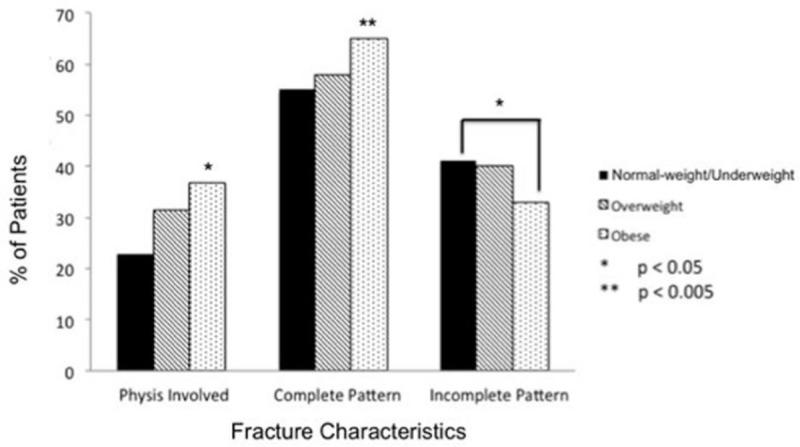
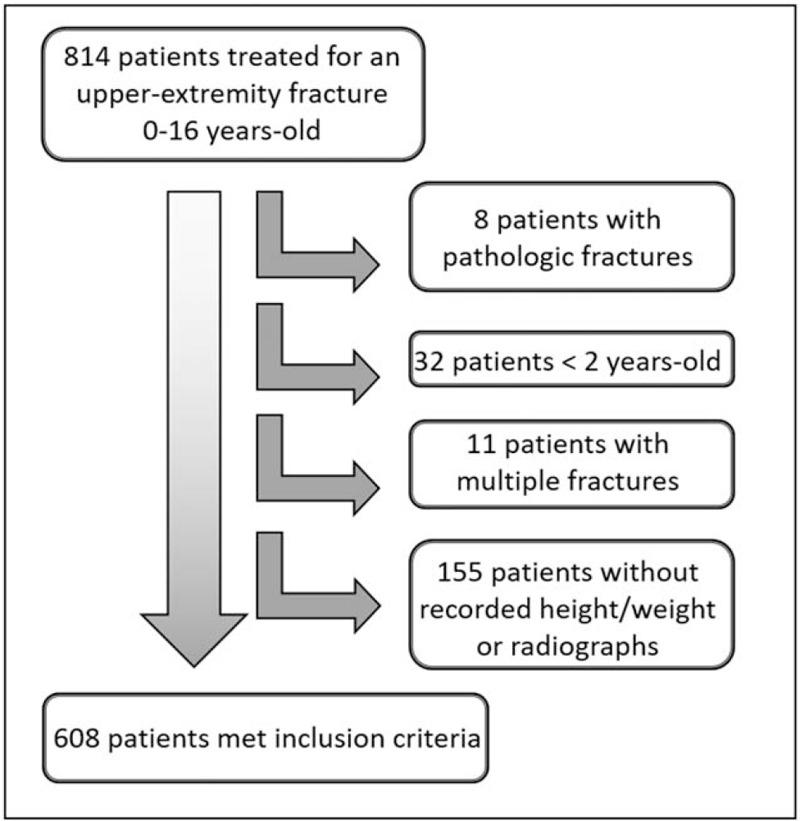
Childhood obesity is a growing epidemic in the United States, and is associated with an increased risk of lower-extremity physeal fractures, and fractures requiring operative intervention. However, no study has assessed the risk upper extremity physeal fractures among overweight children. Our purpose was to compare the following upper-extremity fracture characteristics in overweight and obese children with those of normal-weight/underweight children (herein, "normal weight"): mechanism of injury, anatomical location, fracture pattern, physeal involvement, and treatment types. We hypothesized that overweight and obese children would be higher risk for physeal and complete fractures with low-energy mechanisms and would therefore more frequently require operative intervention compared with normal-weight children.We performed a cross-sectional review of our database of 608 patients aged 2 to 16 years, and included patients who sustained isolated upper-extremity fractures at our level-1 pediatric tertiary care center from January 2014 to August 2017. Excluded were patients who sustained pathologic fractures and those without basic demographic or radiologic information. Using body mass index percentile for age and sex, we categorized patients as obese (≥95th percentile), overweight (85th to <95th percentile), normal weight (5th to <85th percentile), or underweight (<5th percentile). The obese and overweight groups were analyzed both separately and as a combined overweight/obese group. Demographic data included age, sex, height, and weight. Fractures were classified based on fracture location, fracture pattern (transverse, comminuted, buckle, greenstick, avulsion, or oblique), physeal involvement, and treatment type. Of the 608 patients, 58% were normal weight, 23% were overweight, and 19% were obese. There were no differences in the mean ages or sex distributions among the 3 groups.Among patients with low-energy mechanisms of injury, overweight/obese patients had significantly greater proportions of complete fractures compared with normal-weight children (complete: 65% vs 55%, P = .001; transverse: 43% vs 27%, P = .006). In addition, the overweight/obese group sustained significantly more upper-extremity physeal fractures (37%) than did the normal-weight group (23%) (P = .007).Compared with those in normal-weight children, upper-extremity fracture patterns differ in overweight and obese children, who have higher risk of physeal injuries and complete fractures caused by low-energy mechanisms.Level of Evidence: Level III, retrospective comparative study.
儿童肥胖在美国是一种日益严重的流行病,与下肢骨骺骨折以及需要手术干预的骨折风险增加有关。然而,尚无研究评估超重儿童上肢骨骺骨折的风险。我们的目的是比较超重和肥胖儿童与正常体重/体重不足儿童(以下简称“正常体重”)在上肢骨折的以下特征:损伤机制、解剖位置、骨折类型、骨骺受累情况和治疗方式。我们假设超重和肥胖儿童发生低能量机制导致的骨骺骨折和完全骨折的风险更高,因此与正常体重儿童相比,更常需要手术干预。
我们对608例2至16岁患者的数据库进行了横断面回顾,纳入了2014年1月至2017年8月在我们一级儿科三级护理中心发生孤立上肢骨折的患者。排除患有病理性骨折的患者以及没有基本人口统计学或放射学信息的患者。根据年龄和性别的体重指数百分位数,我们将患者分为肥胖(≥第95百分位数)、超重(第85至<第95百分位数)、正常体重(第5至<第85百分位数)或体重不足(<第5百分位数)。肥胖组和超重组分别进行分析,并作为超重/肥胖合并组进行分析。人口统计学数据包括年龄、性别、身高和体重。骨折根据骨折位置、骨折类型(横行、粉碎性、青枝、裂缝、撕脱或斜行)、骨骺受累情况和治疗方式进行分类。在608例患者中,58%为正常体重,23%为超重,19%为肥胖。三组患者的平均年龄和性别分布无差异。
在低能量损伤机制的患者中,超重/肥胖患者的完全骨折比例显著高于正常体重儿童(完全骨折:65%对55%,P = 0.001;横行骨折:43%对27%,P = 0.006)。此外,超重/肥胖组的上肢骨骺骨折发生率(37%)显著高于正常体重组(23%)(P = 0.007)。
与正常体重儿童相比,超重和肥胖儿童的上肢骨折类型不同,他们发生低能量机制导致的骨骺损伤和完全骨折的风险更高。
证据级别
III级,回顾性比较研究。
 Zotero 插件