
艰难梭菌定植清除与抗生素特异性细菌变化相关。
Clearance of Clostridioides difficile Colonization Is Associated with Antibiotic-Specific Bacterial Changes.
机构信息
Department of Microbiology and Immunology, University of Michigan, Ann Arbor, Michigan, USA.
Department of Microbiology and Immunology, University of Michigan, Ann Arbor, Michigan, USA
出版信息
mSphere. 2021 May 5;6(3):e01238-20. doi: 10.1128/mSphere.01238-20.
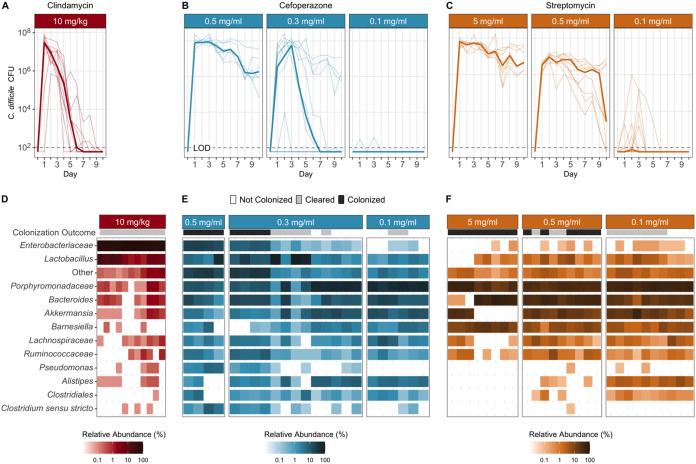
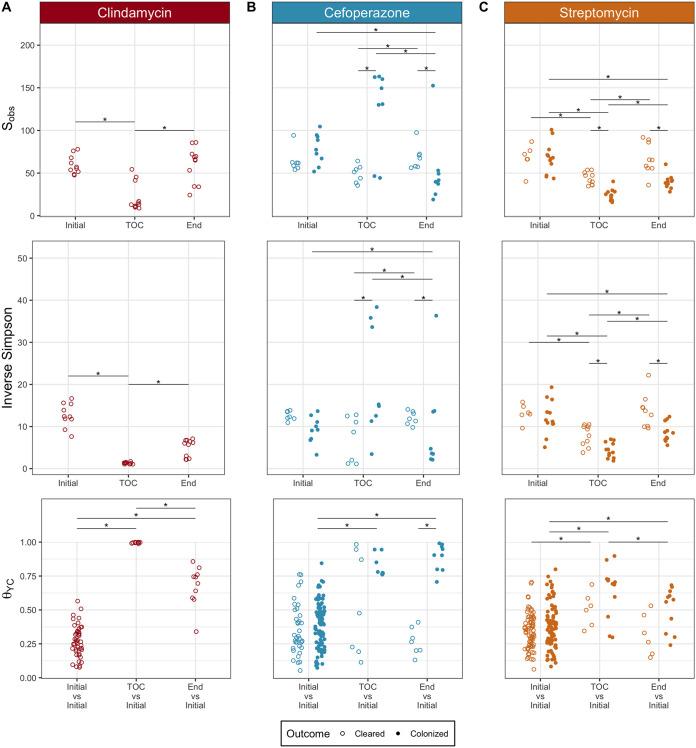
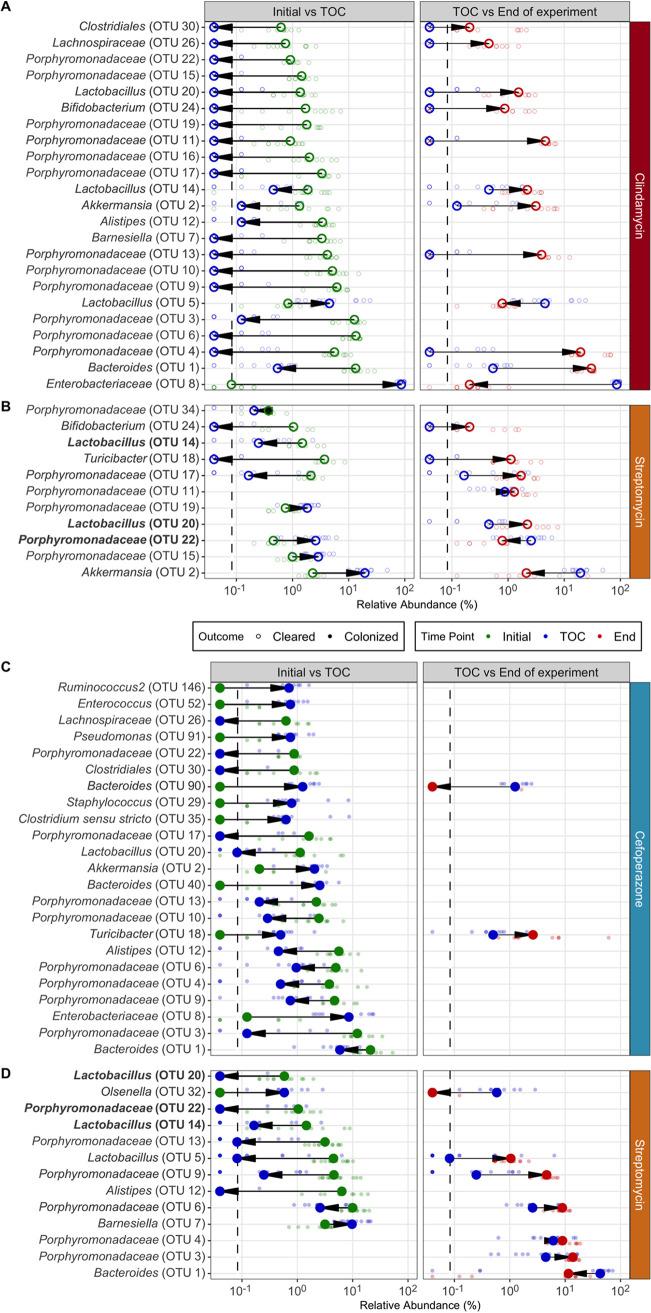
The gut bacterial community prevents many pathogens from colonizing the intestine. Previous studies have associated specific bacteria with clearing colonization across different community perturbations. However, those bacteria alone have been unable to clear colonization. To elucidate the changes necessary to clear colonization, we compared differences in bacterial abundance between communities able and unable to clear colonization. We treated mice with titrated doses of antibiotics prior to challenge, resulting in no colonization, colonization and clearance, or persistent colonization. Previously, we observed that clindamycin-treated mice were susceptible to colonization but spontaneously cleared Therefore, we investigated whether other antibiotics would show the same result. We found that reduced doses of cefoperazone and streptomycin permitted colonization and clearance of Mice that cleared colonization had antibiotic-specific community changes and predicted interactions with Clindamycin treatment led to a bloom in populations related to Clearance of was concurrent with the reduction of those blooming populations and the restoration of community members related to the and Cefoperazone created a susceptible community characterized by drastic reductions in the community diversity and interactions and a sustained increase in the abundance of many facultative anaerobes. Lastly, clearance in streptomycin-treated mice was associated with the recovery of multiple members of the , with little overlap in the specific observed in the clindamycin treatment. Further elucidation of how colonization is cleared from different gut bacterial communities will improve infection treatments. The community of microorganisms, or microbiota, in our intestines prevents pathogens like from colonizing and causing infection. However, antibiotics can disturb the gut microbiota, which allows to colonize. infections (CDI) are primarily treated with antibiotics, which frequently leads to recurrent infections because the microbiota has not yet returned to a resistant state. The recurrent infection cycle often ends when the fecal microbiota from a presumed resistant person is transplanted into the susceptible person. Although this treatment is highly effective, we do not understand the mechanism. We hope to improve the treatment of CDI through elucidating how the bacterial community eliminates CDI. We found that colonized susceptible mice but was spontaneously eliminated in an antibiotic treatment-specific manner. These data indicate that each community had different requirements for clearing colonization. Understanding how different communities clear colonization will reveal targets to improve CDI treatments.
肠道细菌群落可防止许多病原体在肠道定植。先前的研究已经将特定细菌与清除定植联系起来,但仅靠这些细菌还无法清除定植。为了阐明清除定植所需的变化,我们比较了能够和不能清除定植的群落之间细菌丰度的差异。我们在进行 挑战之前,用滴定剂量的抗生素处理小鼠,导致没有定植、定植和清除,或持续定植。以前,我们观察到克林霉素处理的小鼠易受定植,但会自发清除 因此,我们研究了其他抗生素是否会产生相同的结果。我们发现,减少剂量的头孢哌酮和链霉素允许 定植和清除。清除定植的小鼠具有抗生素特异性群落变化,并预测与 相互作用。克林霉素治疗导致与 相关的种群大量繁殖。清除 与这些繁殖种群的减少以及与 相关的群落成员的恢复同时发生。头孢哌酮导致一个易受影响的群落,其特征是群落多样性和相互作用急剧减少,许多兼性厌氧菌的丰度持续增加。最后,在链霉素处理的小鼠中,与 多种成员的恢复相关,与克林霉素处理中观察到的具体 很少重叠。进一步阐明如何从不同的肠道细菌群落中清除 定植将改善 感染的治疗方法。我们肠道中的微生物群落,或微生物组,可防止 等病原体定植并引起感染。然而,抗生素会干扰肠道微生物群,从而使 定植。艰难梭菌感染(CDI)主要用抗生素治疗,但由于微生物群尚未恢复到耐药状态,这经常导致复发感染。当从一个假定的耐药者身上移植来的粪便微生物群转移到易受感染的人身上时,这个复发性感染周期通常就会结束。尽管这种治疗方法非常有效,但我们并不了解其机制。我们希望通过阐明细菌群落如何消除 CDI 来改善 CDI 的治疗方法。我们发现 定植于易感小鼠,但以抗生素治疗特异性的方式被自发清除。这些数据表明,每个群落清除定植的要求都不同。了解不同群落如何清除定植将揭示改善 CDI 治疗的靶点。



 Zotero 插件