
基于移动健康的温度计用于监测慢性足部溃疡患者血管内治疗后的伤口愈合:前瞻性队列研究。
Mobile Health-Based Thermometer for Monitoring Wound Healing After Endovascular Therapy in Patients With Chronic Foot Ulcer: Prospective Cohort Study.
机构信息
Division of Cardiology, Department of Internal Medicine, National Taiwan University Hospital, Taipei, Taiwan.
Cardiovascular Center, National Taiwan University Hospital, Taipei, Taiwan.
出版信息
JMIR Mhealth Uhealth. 2021 May 7;9(5):e26468. doi: 10.2196/26468.
BACKGROUND
Foot temperature may increase after endovascular therapy, but the relationship between foot temperature and wound healing is unclear.
OBJECTIVE
This study was performed to evaluate the feasibility of a mobile health (mHealth)-based thermometer for foot temperature monitoring in patients with chronic foot ulcer before and after endovascular therapy and to determine the association between temperature change and wound healing time.
METHODS
This was a prospective cohort study. Patients who had a chronic foot ulcer (>3 months) and underwent endovascular therapy between July 2019 and December 2019 were included. The participants received standard medical care and endovascular therapy for revascularization. The mHealth-based thermometer, composed of 4 temperature-sensing chips, was put on the foot before and after endovascular therapy. Data from the chips were transferred to an associated mobile phone app via Bluetooth. Wound healing time was estimated using the Kaplan-Meier method, and the associations between baseline characteristics and clinical outcomes were evaluated using a Cox proportional hazard model.
RESULTS
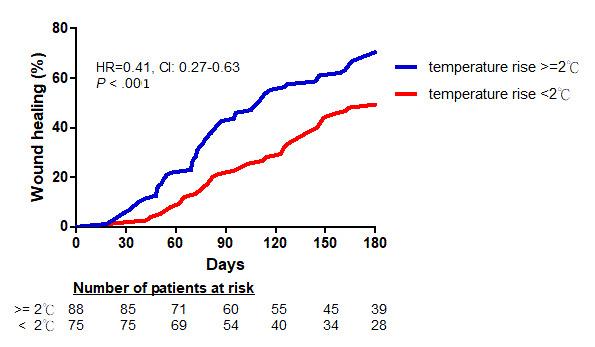
A total of 163 patients with chronic foot ulcer who underwent endovascular therapy were enrolled and followed up until wound healing was complete or for 180 days. The mean foot temperature before endovascular therapy was 30.6 (SD 2.8 °C). Foot temperature increased significantly (mean 32.1 °C, SD 2.8 °C; P=.01) after the procedure. Wound healing time was significantly different in the Kaplan-Meier curves of the patient group with temperature changes ≥2 °C and the group with temperature changes ≤2 °C (log-rank P<.001). A foot temperature increase ≥2 °C after endovascular therapy was associated with increased wound healing in univariate analysis (hazard ratio [HR] 1.78, 95% CI 1.24-2.76, P=.02), and the association remained significant in multivariate analysis (HR 1.69, 95% CI 1.21-2.67, P=.03).
CONCLUSIONS
The mHealth-based thermometer was feasible and useful for foot temperature monitoring, which may provide health care professionals with a new endpoint for endovascular therapy. Foot temperature increases ≥2 °C after endovascular therapy were associated with faster wound healing in patients with chronic foot ulcer. Further studies are needed, however, to confirm these findings.
背景
血管内治疗后足部温度可能会升高,但足部温度与伤口愈合之间的关系尚不清楚。
目的
本研究旨在评估基于移动健康(mHealth)的温度计在血管内治疗前后监测慢性足部溃疡患者足部温度的可行性,并确定温度变化与伤口愈合时间之间的关系。
方法
这是一项前瞻性队列研究。纳入 2019 年 7 月至 2019 年 12 月期间接受血管内治疗以实现血运重建的慢性足部溃疡(>3 个月)患者。参与者接受标准的医疗护理和血管内治疗。基于 mHealth 的温度计由 4 个温度感应芯片组成,在血管内治疗前后放在足部。通过蓝牙将芯片数据传输到关联的移动电话应用程序。使用 Kaplan-Meier 方法估计伤口愈合时间,并使用 Cox 比例风险模型评估基线特征与临床结局之间的关系。
结果
共纳入 163 例接受血管内治疗的慢性足部溃疡患者,随访至伤口完全愈合或 180 天。血管内治疗前足部平均温度为 30.6(SD 2.8°C)。治疗后足部温度显著升高(平均 32.1°C,SD 2.8°C;P=.01)。Kaplan-Meier 曲线显示,温度变化≥2°C 的患者组和温度变化≤2°C 的患者组之间的伤口愈合时间有显著差异(对数秩 P<.001)。血管内治疗后足部温度升高≥2°C 与单因素分析中的伤口愈合加快相关(危险比[HR]1.78,95%CI 1.24-2.76,P=.02),多因素分析结果仍然显著(HR 1.69,95%CI 1.21-2.67,P=.03)。
结论
基于 mHealth 的温度计在监测足部温度方面是可行且有用的,它可能为血管内治疗提供一个新的终点。慢性足部溃疡患者血管内治疗后足部温度升高≥2°C 与更快的伤口愈合相关。然而,需要进一步的研究来证实这些发现。


 Zotero 插件