
奥希替尼作为二线治疗对脑转移(BM)的控制可能比非 BM 的晚期 NSCLC 患者伴获得性 EGFR T790M 突变更有限。
Osimertinib alone as second-line treatment for brain metastases (BM) control may be more limited than for non-BM in advanced NSCLC patients with an acquired EGFR T790M mutation.
机构信息
Department of Pulmonary, Shanghai Chest Hospital, Shanghai Jiao Tong University, No.241 Huaihai West Road, Xuhui District, Shanghai, 200030, China.
Department of Radiation Oncology, Shanghai Chest Hospital, Shanghai Jiao Tong University, No.241 Huaihai West Road, Xuhui District, Shanghai, 200030, China.
出版信息
Respir Res. 2021 May 11;22(1):145. doi: 10.1186/s12931-021-01741-9.
BACKGROUND
This study was designed to investigate the difference between brain metastases (BM) and non-brain metastases (non-BM) treated by osimertinib in advanced patients with an acquired EGFR T790M mutation after obtaining first-generation EGFR-TKI resistance.
METHODS
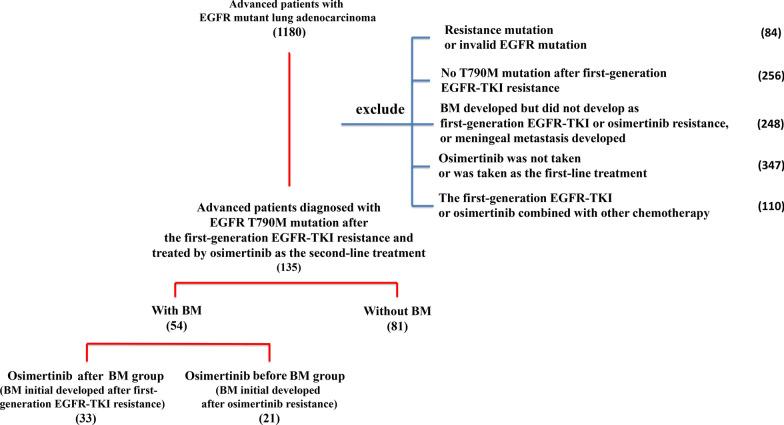
A total number of 135 first-generation EGFR-TKI-resistant patients with an acquired EGFR T790M mutation were retrospectively analyzed. The patients were divided into BM and non-BM groups. According to the type of treatment (whether brain radiotherapy), the BM patients were divided into an osimertinib combined with brain radiotherapy group and an osimertinib without brain radiotherapy group. In addition, according to the type of BM (the sequence between BM and osimertinib), the BM patients were subdivided into an osimertinib after BM group (initial BM developed after obtaining first-generation EGFR-TKI resistance) and an osimertinib before BM group (first-generation EGFR-TKI resistance then osimertinib administration performed; initial BM was not developed until osimertinib resistance). The progression-free survival (PFS) and overall survival (OS) were evaluated. The primary endpoint was OS between BM and no-BM patients. The secondary endpoints were PFS of osimertinib, and OS between brain radiotherapy and non-brain radiotherapy patients.
RESULTS
A total of 135 patients were eligible and the median follow-up time of all patients was 50 months. The patients with BM (n = 54) had inferior OS than those without BM (n = 81) (45 months vs. 55 months, P = 0.004). And in BM group, the OS was longer in patients that received osimertinib combined with brain radiotherapy than in those without brain radiotherapy (53 months vs. 40 months, P = 0.014). In addition, the PFS was analysed according to whether developed BM after osimertinib resistance. The PFS of the patients that developed BM after acquiring osimertinib resistance was shorter than that without BM development, whether patients developed initial BM after first-generation EGFR-TKI resistance (7 months vs. 13 months, P = 0.003), or developed non-BM after first-generation EGFR-TKI resistance (13 months vs. 17 months, P < 0.001).
CONCLUSIONS
In advanced patients with an acquired EGFR T790M mutation after obtaining first-generation EGFR-TKI resistance, osimertinib may be more limited in its control in BM than in non-BM. Also, osimertinib combined with brain radiotherapy may improve the survival time of BM patients.
背景
本研究旨在探讨第一代 EGFR-TKI 耐药后获得性 EGFR T790M 突变的晚期患者中,接受奥希替尼治疗的脑转移(BM)和非脑转移(non-BM)患者之间的差异。
方法
回顾性分析了 135 例第一代 EGFR-TKI 耐药且获得性 EGFR T790M 突变的患者。将患者分为 BM 和 non-BM 组。根据治疗类型(是否行脑部放疗),将 BM 患者分为奥希替尼联合脑部放疗组和奥希替尼无脑部放疗组。此外,根据 BM 类型(BM 与奥希替尼之间的顺序),将 BM 患者进一步分为奥希替尼后 BM 组(第一代 EGFR-TKI 耐药后发生初始 BM)和奥希替尼前 BM 组(第一代 EGFR-TKI 耐药后接受奥希替尼治疗;直至奥希替尼耐药才出现初始 BM)。评估无进展生存期(PFS)和总生存期(OS)。主要终点是 BM 和 non-BM 患者的 OS。次要终点是奥希替尼的 PFS 和脑部放疗与非脑部放疗患者的 OS。
结果
共纳入 135 例患者,所有患者的中位随访时间为 50 个月。BM 患者(n=54)的 OS 明显低于 non-BM 患者(n=81)(45 个月比 55 个月,P=0.004)。在 BM 组中,接受奥希替尼联合脑部放疗的患者 OS 明显长于未行脑部放疗的患者(53 个月比 40 个月,P=0.014)。此外,根据是否在奥希替尼耐药后发生 BM 对 PFS 进行了分析。奥希替尼耐药后发生 BM 的患者的 PFS 明显短于未发生 BM 患者,无论患者是在第一代 EGFR-TKI 耐药后发生初始 BM(7 个月比 13 个月,P=0.003),还是在第一代 EGFR-TKI 耐药后发生非 BM(13 个月比 17 个月,P<0.001)。
结论
在第一代 EGFR-TKI 耐药后获得性 EGFR T790M 突变的晚期患者中,奥希替尼在 BM 中的控制效果可能逊于 non-BM。此外,奥希替尼联合脑部放疗可能会延长 BM 患者的生存时间。



 Zotero 插件