
蜜蜂肠道微生物群中细菌间拮抗作用的演变反映了宿主和共生体的多样化。
Evolution of Interbacterial Antagonism in Bee Gut Microbiota Reflects Host and Symbiont Diversification.
作者信息
Steele Margaret I, Moran Nancy A
机构信息
The University of Texas at Austin, Department of Integrative Biology, Austin, Texas, USA.
The University of Texas at Austin, Department of Integrative Biology, Austin, Texas, USA
出版信息
mSystems. 2021 May 11;6(3):e00063-21. doi: 10.1128/mSystems.00063-21.
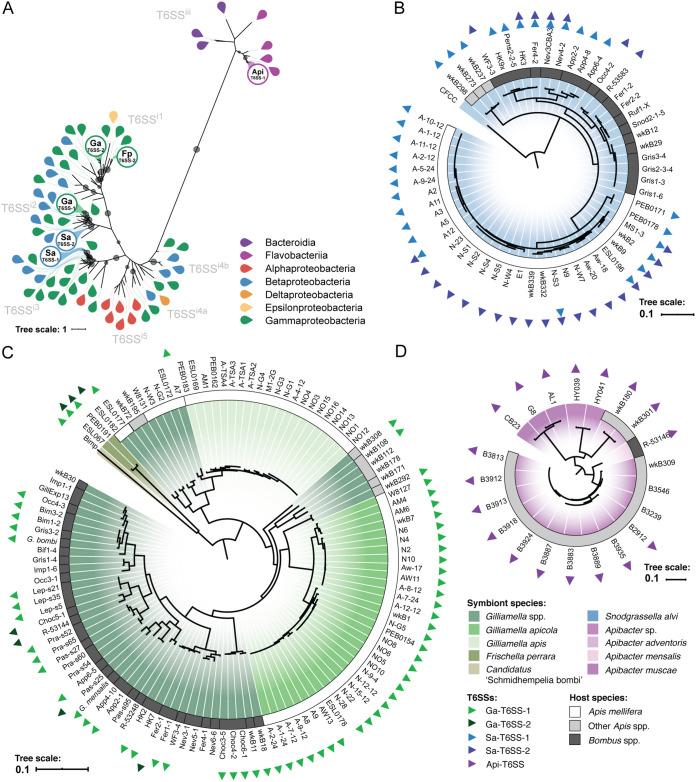
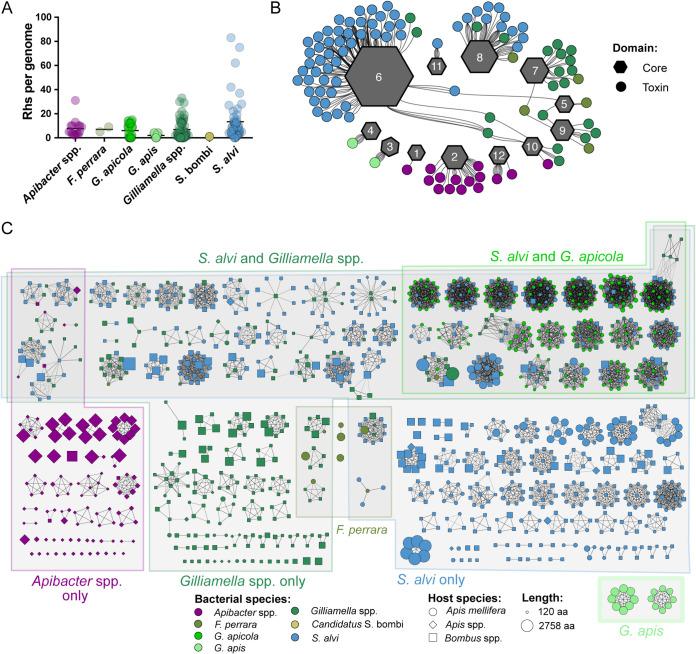
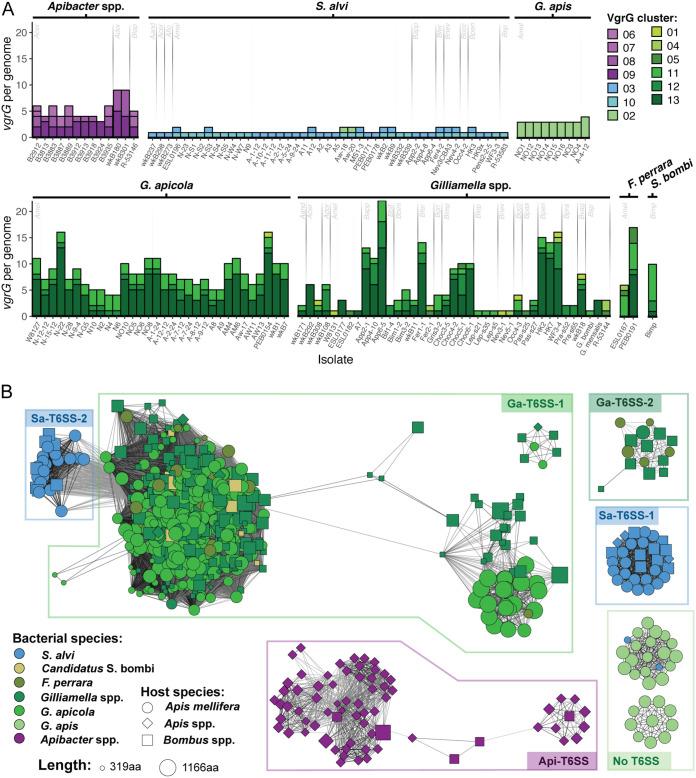
Gram-negative bacteria frequently possess type VI secretion systems (T6SSs), protein complexes that are able to inject toxic proteins into nearby cells. Many aspects of T6SS structure and function have been characterized for model species, but less is known about the evolutionary processes that shape T6SS and effector (toxin) diversity in host-associated microbial communities. The bee gut microbiota is a simple community that has codiversified with bees for >80 million years. This study investigated how complements of T6SSs and effectors within the bee microbiota changed as bacteria and their hosts diversified into isolated species. We used protein homology to survey 198 isolate genomes of 9 Gram-negative species for genes encoding T6SS structural components; Rhs toxins, which are common T6SS effectors; and VgrG proteins, which are structural components associated with specific toxins. T6SS loci were present in 5 species clusters found only in bees, namely spp., spp., , " Schmidhempelia bombi," and The distribution of T6SS loci suggests that at least 3 were present in the microbiota of the common ancestor of social bees and that loss of these genes in some bacterial lineages was linked to both host and bacterial speciation. Isolates differed enormously in repertoires of Rhs and VgrG proteins. We found that bacterial species employ different mechanisms for toxin acquisition and diversification and that species and strains sometimes lose the T6SS entirely, likely causing shifts in competitive dynamics within these communities. Antagonistic interactions between bacteria affect diversity and dynamics of host-associated communities, including gut communities that are linked to host health. In many bacterial communities, including human and honey bee gut microbiotas, antagonism is mediated by type VI secretion systems (T6SSs) that deliver lethal toxins to competing strains. In this study, we explored how T6SSs and associated toxins have evolved in the simple, host-specific gut microbiota of honey bees and bumble bees. Using comparative genomics, we explored the conservation, recombination, horizontal transfer, and loss of T6SSs and effectors during 80 million years of evolution of this bee-associated community. We find that that patterns of T6SS loss and retention are linked to differences in biology across host species, while trends in effector diversification are mostly specific to bacterial lineages.
革兰氏阴性菌通常拥有VI型分泌系统(T6SSs),这是一种能够将毒性蛋白注入附近细胞的蛋白复合体。对于模式物种,T6SS的结构和功能的许多方面已得到表征,但对于塑造宿主相关微生物群落中T6SS和效应物(毒素)多样性的进化过程了解较少。蜜蜂肠道微生物群是一个简单的群落,与蜜蜂共同进化了超过8000万年。本研究调查了随着细菌及其宿主分化为不同的孤立物种,蜜蜂微生物群中T6SS和效应物的组成是如何变化的。我们利用蛋白质同源性,对9种革兰氏阴性菌的198个分离株基因组进行了调查,以寻找编码T6SS结构成分的基因;Rhs毒素,这是常见的T6SS效应物;以及VgrG蛋白,这是与特定毒素相关的结构成分。T6SS基因座存在于仅在蜜蜂中发现的5个物种簇中,即 spp.、 spp.、 、“Schmidhempelia bombi”和 。T6SS基因座的分布表明,社会蜜蜂的共同祖先的微生物群中至少存在3个T6SS基因座,并且在一些细菌谱系中这些基因的丢失与宿主和细菌的物种形成都有关联。分离株在Rhs和VgrG蛋白的组成上差异巨大。我们发现,细菌物种采用不同的毒素获取和多样化机制,并且一些物种和菌株有时会完全失去T6SS,这可能会导致这些群落内竞争动态的变化。细菌之间的拮抗相互作用会影响宿主相关群落的多样性和动态,包括与宿主健康相关的肠道群落。在许多细菌群落中,包括人类和蜜蜂的肠道微生物群,拮抗作用是由VI型分泌系统(T6SSs)介导的,该系统会将致命毒素传递给竞争菌株。在本研究中,我们探索了T6SSs及其相关毒素在蜜蜂和熊蜂简单的、宿主特异性的肠道微生物群中是如何进化的。利用比较基因组学,我们研究了在这个与蜜蜂相关的群落8000万年的进化过程中,T6SSs和效应物的保守性、重组、水平转移和丢失情况。我们发现,T6SS丢失和保留的模式与宿主物种间生物学差异有关,而效应物多样化的趋势大多特定于细菌谱系。




 Zotero 插件