
antiSMASH 6.0:提高簇检测和比较能力。
antiSMASH 6.0: improving cluster detection and comparison capabilities.
机构信息
The Novo Nordisk Foundation Center for Biosustainability, Technical University of Denmark, Kgs. Lyngby, Denmark.
Institute of Biology, Leiden University, Leiden, The Netherlands.
出版信息
Nucleic Acids Res. 2021 Jul 2;49(W1):W29-W35. doi: 10.1093/nar/gkab335.
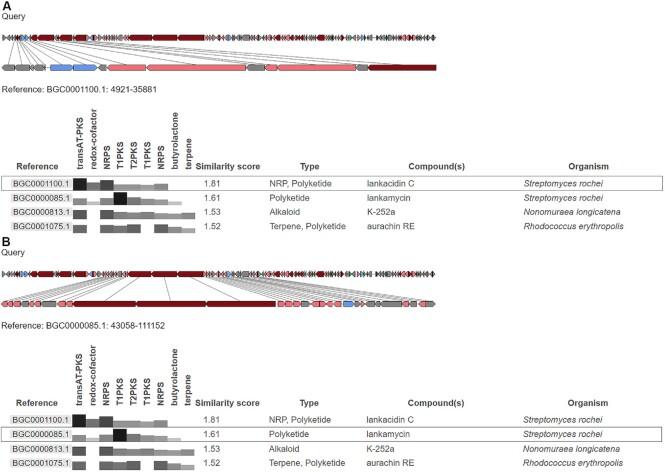
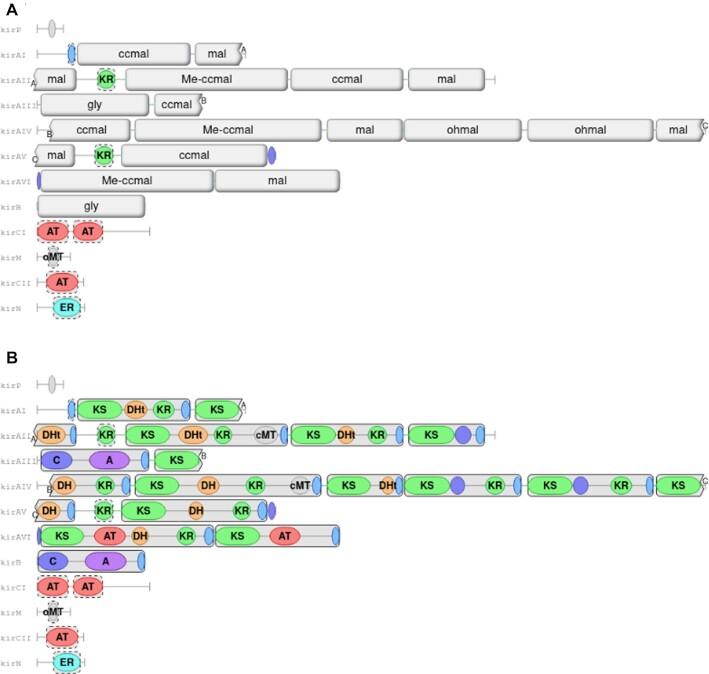
Many microorganisms produce natural products that form the basis of antimicrobials, antivirals, and other drugs. Genome mining is routinely used to complement screening-based workflows to discover novel natural products. Since 2011, the "antibiotics and secondary metabolite analysis shell-antiSMASH" (https://antismash.secondarymetabolites.org/) has supported researchers in their microbial genome mining tasks, both as a free-to-use web server and as a standalone tool under an OSI-approved open-source license. It is currently the most widely used tool for detecting and characterising biosynthetic gene clusters (BGCs) in bacteria and fungi. Here, we present the updated version 6 of antiSMASH. antiSMASH 6 increases the number of supported cluster types from 58 to 71, displays the modular structure of multi-modular BGCs, adds a new BGC comparison algorithm, allows for the integration of results from other prediction tools, and more effectively detects tailoring enzymes in RiPP clusters.
许多微生物产生的天然产物是抗生素、抗病毒药物和其他药物的基础。基因组挖掘通常用于补充基于筛选的工作流程,以发现新的天然产物。自 2011 年以来,“抗生素和次级代谢产物分析外壳 - antiSMASH”(https://antismash.secondarymetabolites.org/)一直支持研究人员进行微生物基因组挖掘任务,既是一个免费使用的网络服务器,也是一个符合 OSI 标准的开源许可证的独立工具。它是目前用于检测和描述细菌和真菌中生物合成基因簇(BGC)的最广泛使用的工具。在这里,我们介绍了更新的版本 6 的 antiSMASH。antiSMASH 6 将支持的簇类型数量从 58 个增加到 71 个,显示了多模块 BGC 的模块化结构,添加了一个新的 BGC 比较算法,允许整合来自其他预测工具的结果,并更有效地检测 RiPP 簇中的修饰酶。


 Zotero 插件