
利弗利塞(一种肿瘤浸润淋巴细胞疗法)治疗转移性黑色素瘤。
Lifileucel, a Tumor-Infiltrating Lymphocyte Therapy, in Metastatic Melanoma.
机构信息
H. Lee Moffitt Cancer Center, Tampa, FL.
The Angeles Clinic and Research Institute, A Cedars Sinai Affiliate, Los Angeles, CA.
出版信息
J Clin Oncol. 2021 Aug 20;39(24):2656-2666. doi: 10.1200/JCO.21.00612. Epub 2021 May 12.
PURPOSE
Effective treatment options are limited for patients with advanced (metastatic or unresectable) melanoma who progress after immune checkpoint inhibitors and targeted therapies. Adoptive cell therapy using tumor-infiltrating lymphocytes has demonstrated efficacy in advanced melanoma. Lifileucel is an autologous, centrally manufactured tumor-infiltrating lymphocyte product.
METHODS
We conducted a phase II open-label, single-arm, multicenter study in patients with advanced melanoma who had been previously treated with checkpoint inhibitor(s) and BRAF ± MEK targeted agents. Lifileucel was produced from harvested tumor specimens in central Good Manufacturing Practice facilities using a streamlined 22-day process. Patients received a nonmyeloablative lymphodepletion regimen, a single infusion of lifileucel, and up to six doses of high-dose interleukin-2. The primary end point was investigator-assessed objective response rate (ORR) per RECIST, version 1.1.
RESULTS
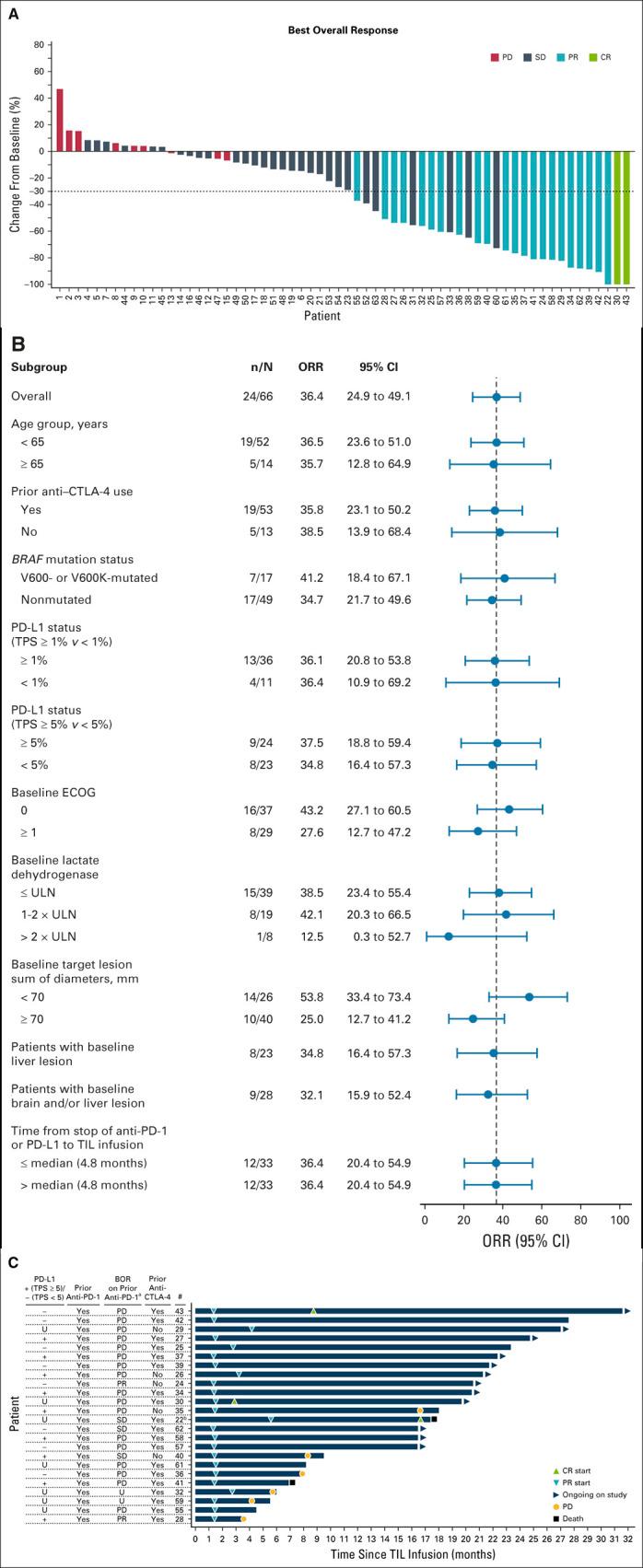
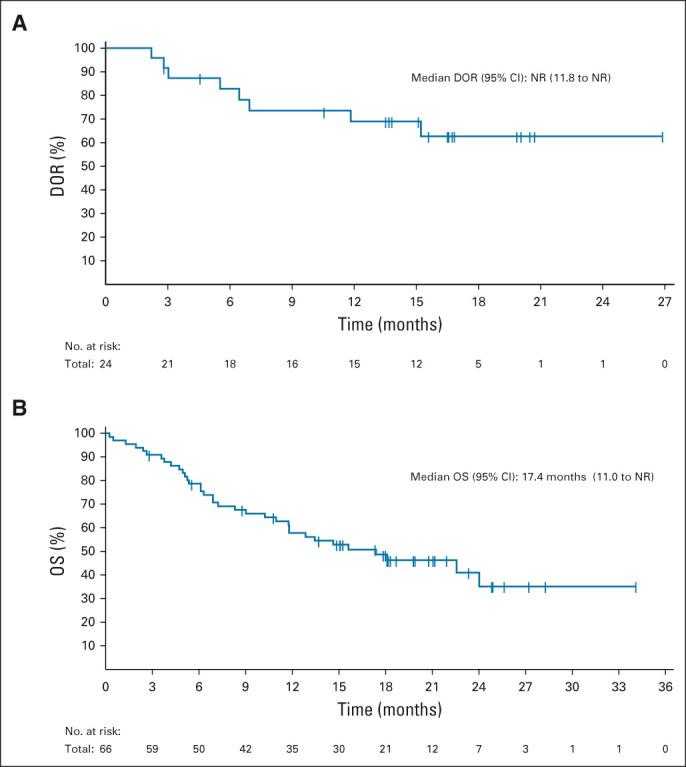
Sixty-six patients received a mean of 3.3 prior therapies (anti-programmed death 1 [PD-1] or programmed death ligand 1 [PD-L1]: 100%; anticytotoxic T-lymphocyte-associated protein-4: 80%; BRAF ± MEK inhibitor: 23%). The ORR was 36% (95% CI, 25 to 49), with two complete responses and 22 partial responses. Disease control rate was 80% (95% CI, 69 to 89). Median duration of response was not reached after 18.7-month median study follow-up (range, 0.2-34.1 months). In the primary refractory to anti-PD-1 or PD-L1 therapy subset, the ORR and disease control rate were 41% (95% CI, 26 to 57) and 81% (95% CI, 66 to 91), respectively. Safety profile was consistent with known adverse events associated with nonmyeloablative lymphodepletion and interleukin-2.
CONCLUSION
Lifileucel demonstrated durable responses and addresses a major unmet need in patients with metastatic melanoma with limited treatment options after approved therapy, including the primary refractory to anti-PD-1 or PD-L1 therapy subset.
目的
对于接受免疫检查点抑制剂和靶向治疗后进展的晚期(转移性或不可切除)黑色素瘤患者,有效的治疗选择有限。使用肿瘤浸润淋巴细胞的过继细胞疗法已在晚期黑色素瘤中显示出疗效。Lifileucel 是一种自体、中央制造的肿瘤浸润淋巴细胞产品。
方法
我们在先前接受过检查点抑制剂(s)和 BRAF ± MEK 靶向药物治疗的晚期黑色素瘤患者中进行了一项 II 期、开放性、单臂、多中心研究。Lifileucel 是从中央良好生产规范设施中收获的肿瘤标本中使用简化的 22 天流程生产的。患者接受非清髓性淋巴细胞耗竭方案、单次输注 lifileucel 和最多六剂高剂量白细胞介素-2。主要终点是根据 RECIST,版本 1.1 评估的研究者评估的客观缓解率(ORR)。
结果
66 名患者接受了平均 3.3 种先前的治疗(抗程序性死亡 1 [PD-1] 或程序性死亡配体 1 [PD-L1]:100%;抗细胞毒性 T 淋巴细胞相关蛋白 4:80%;BRAF ± MEK 抑制剂:23%)。ORR 为 36%(95%CI,25 至 49),包括两名完全缓解和 22 名部分缓解。疾病控制率为 80%(95%CI,69 至 89)。在中位研究随访 18.7 个月后(范围,0.2-34.1 个月),未达到中位缓解持续时间。在原发性抗 PD-1 或 PD-L1 治疗耐药亚组中,ORR 和疾病控制率分别为 41%(95%CI,26 至 57)和 81%(95%CI,66 至 91)。安全性与已知的非清髓性淋巴细胞耗竭和白细胞介素-2相关的不良事件一致。
结论
Lifileucel 表现出持久的缓解,并为接受批准治疗后治疗选择有限的转移性黑色素瘤患者,包括原发性抗 PD-1 或 PD-L1 治疗耐药亚组,解决了一个主要的未满足需求。

 Zotero 插件